Free to buy beer in Listuguj

recent ruling on cross-border trade allows New Brunswickers to buy beer in Listuguj or Cross-Point without fear of being charged. 

The ruling lifts the restrictions imposed by the N.B government that charged Gérard Comeau for importing more than five cases of beer into the province. The government of N.B. has until the end of the month to appeal the decision.

During the days following the ruling, there were reports that the sales of alcohol in Listuguj and Cross-Point stores increased, as the prices of beer and other alcoholic beverages are cheaper in Quebec than N.B. Christine Bujold, cashier at the Restigouche Drive-Thru – a Listuguj store located on the Interprovincial Boulevard – noted that there wasn’t an increase in the number of clients. 

“It’s almost the same,” she said. “But now instead of buying two or three cases of beer, they fill their car trunk.”

Canada is  a country that signs international Free Trade agreements with countries around the world. Economic Development Minister, Navdeep Bains, called the decision a “positive development.”

This legal battle for the recognitions of the Constitutional right to cross-border trade is a reminder of First Nations legal battles to implement the Jay Treaty signed in November 1744 which reaffirmed “that First Nations could cross the border without harassment and not pay tax or duty on goods.”  The implementation of the Treaty was challenged many times.

Gone Fishing

Boats have already been heading out on the water for the 2016 fishing season. They go for days at a time, to where you can’t see land in any direction.  The snow crab season opened mid-March, and the shrimp season started in April.

This marks the 15th season Listuguj has been participating in the commercial fisheries. With two boats entirely run by First Nations crew and 12 boats in total, the operation has been growing steadily. “It was a learning curve for everybody,” said Chris Metallic, the Commercial Fisheries Coordinator with the Natural Resource Directorate. “Although we had been participating in fishing salmon and other things, we still had to adjust to the commercial aspect of the fishery.”

In 1999, the Marshall Decision reaffirmed the Mi’gmaq right to fish in the Supreme Court of Canada. After that, Listuguj began taking the steps to enter the commercial fishery. Among the first community members to be involved was Blayze Isaac who started as a deckhand.

As a kid he would often head down to the beach with a fishing pole, but he never imagined it would be a job.  “I was a land lover, kind of thing,” he said.  He had been working in the woods when the opportunity to take a deckhand course  came up in 2001. He took it, and went out on the water for the first time.

First Nation fishing operations are run a little differently than the privately owned operations founded at Sainte-Thérèse-de-Gaspé, or elsewhere in the Gaspesie. The boats and licenses are communally owned —  which non-native fishermen sometimes don’t quite understand.

“It doesn’t go to one person, it doesn’t go to one family. Unlike non-native fishermen — their whole family benefits, whoever they hire,” said Metallic. “That’s not the case here for Listuguj. What we do is we hire people from different families, and all different families benefit from it … It’s a communal license, meaning it belongs to everybody.” But good jobs have been created.
Among the highest around. And 62 people are  employed during the season. Listuguj, combined with other First Nations fishing in the region also create jobs for local people in Matane, Fox-River, Ste Therese, etc.  Ways to expand the quotas are also always being explored, but as of now, the Listuguj Fishery holds the largest quota for snow crab and shrimp on the east coast says Metallic. Other species, like halibut and turbot are also fished. This is the second year in an attempt to grow scallops as well.

This is a significant change from when Isaac first headed out on a crab fishing boat, 15 years ago.  He’s now Captain of the Maqatgwig.   Isaac admits that the first year as a captain was stressful — taking care of everyone, and hoping to find the right spots to set traps. Now, into his third season, it’s second nature, he said.

As the captain, he often stays on the boat when it’s docked, and lets his crew go home. And even though the job is hard on the body, he still loves it. “You’re getting paid for something that you like,” he said over the phone before one of the few occasions during the season when he gets to go to Listuguj.

He plans to take a break for a few days, and then “head back home,” he said.  “Well, not home, but to my boat. Back on my boat — it’s pretty much home to me.”


Protect the fishery for future generations

By Dr. Fred Metallic,
Director of Listuguj Naturals Resources

The Mi’gmaq have been fishing within Gespe’gewa’gi territorial waters for countless generations and more recently, the courts and government have begun to recognize Mi’gmaq have a right to access fishery resources and to make a moderate livelihood. What does this mean? Even though we harvest approximately 1.7 million lbs. of crab and 4.5 million lbs. of shrimp (estimated gross revenue of 8-9 million dollars with over 60 direct jobs in Listuguj) the development of the fishery goes beyond making a moderate livelihood.

The development of the fishery aside from its economic value is also important from a cultural and political perspective. We see ourselves as fishermen and fisherwomen, as Treaty quota holders with a cultural responsibility to protect the fishery for future generations.  And even though the fishery generates revenues for much needed community programs (from health to education) the fishery is a source of pride, identity and self-determination.

Self-determination in the sense that we are re-establishing our place within the fishing Industry as a major player and our involvement goes beyond harvesting. We are looking to be more involved in the overall management and governance of fisheries resources found within our territorial waters. The development of the fishery means we are contributing to Listuguj’s goal of self-determination.

Is the Indian Act against Indians?

Nujignua’tegeg met with Dr. Palmater. Here is an extract of the interview. The full interview will be available on our YouTube channel.

Nujignua’tegeg:  Have we – and if we did – when did we lose control of Membership Codes?

Pamela Palmater: Under the Indian act, all First Nations have had their Indian status registration of individuals and their band membership controlled by the Federal Government since the Indian act in 1876. But for tens of thousands of years long, pre-Indian Act, we were always in control of our own citizenship and what it was to be a Mi’gmaq, and who got to live in which of the Mi’gmagi districts. That was never controlled by the Federal Government so we have a long history of controlling our own citizenship, but that got interfered with by the Indian Act.

Nuji:  What is the Canada’s ideology in deciding who is or is not an Indian.

P.P: The whole purpose of the Indian Act in setting up a registration system was for the express purpose of eliminating Indians over time. They designed a formula, literally to breed Indians out of existence. Their two policy objectives are to take all of our lands and resources, but also to reduce any financial obligations that come out of Treaty commitments.  Canada associates Treaty beneficiaries with registered Indians and they figured the best way to get rid of Treaties: get rid of Indians, then they have no beneficiaries.

Nuji: What smallpox and contaminated blankets failed to do, eliminate us, do you think mathematics could do it?

P.P: That’s the thing. They only had two ways of trying to get rid of us. Physically eliminate us, scalping, sterilizations and smallpox blankets or assimilate us over time — residential schools, take away your language and culture, make you hate yourselves so that you don’t want to be a part of your community, and Indian status is the final nail in the coffin, essentially. It’s for all of those who managed to survive. The idea is to legislate them out of existence, and because of the Indian Act there is an extinction date for each First Nations where there will be no more status Indians. We will all still be here, we are the fastest baby-makers in Canada, our populations are growing, but for legal and political recognition and whether or not were allowed to identify with our communities, occupy territories have Aboriginal Treaty and Rights recognized…that will be significantly impacted by the Indian Act, if we let it continue.

Nuji: What actions are we taking now to prevent this.

P.P: There’s all of the provisions under the Indian Act that deal with status and registration there all under litigation so there each sections being challenged by a different group of individuals because of discrimination. A large number of First Nations are moving towards developing their own Membership Codes either inside the Indian Act or outside the of the Indian Act just based on their own inherent laws or through self government or similar mechanisms to take away government control and then the next step is to renegotiate the relationship based on who we say our members are.

Nuji: Why do you think it`s important to have theses conversations of membership and identity.

P.P: Because in the past the federal government interfered with our communal processes our traditional governments. Our governments were based on the will of the people. It was the people who put the leaders in place and told the leaders what to do and what not to do. We always worked towards consensus on things. Coming up with our own code is bringing it back to the people and letting the people decide, letting the people undo the harms that have been done, through colonization and the Indian Act and letting the people decide how can we go forward and heal our communities and our nation. It's critically important that we at least start having the conversations and based on whatever information, research and experiences other First Nations have had so we can learn from it.

UNB held its second annual Pow Wow. (Photo: Lucy Peter-Paul)

University opens doors to Mi’gmaq Culture

As part of the many ongoing attempts to incorporate Mi’gmaq and First Nation’s culture, the University of New Brunswick held it’s second annual Pow Wow on April 6. Natasha Martin-Mitchell, from Listuguj, was one of the committee members. “Everything worked out the way we had hoped,” she said. “We had great attendance, it looked like everyone had a great time.”

The live stream also turned out to be a hit. People from all over logged in to see the ceremonies. Others from Listuguj, like Craig Isaac, danced.

Craig Isaac is known for his spirited dances. He was one of the Listuguj Mi'gmaq to support the UNB cultural event, one of the few winter Pow Wows in the province. (Photo: Lucy Peter-Paul)

Craig Isaac is known for his spirited dances. He was one of the Listuguj Mi’gmaq to support the UNB cultural event, one of the few winter Pow Wows in the province. (Photo: Lucy Peter-Paul)

The Pow Wow, and all the other First Nation’s driven initiatives are coming out of the Mi’kmaq-Wolastoqey Centre. As the director, and former Chief of Tobique First Nation, David Perley and his wife Imelda Perley – the Elder in Residence -have been working to make the University more inclusive.

“Everything that we’re doing here is based on a vision that’s been formulated in consultation with the elders of First Nations communities, and First Nation education directors, and so on,” said David Perley.

Perley said there are three main components to what they’re trying to achieve at the university. (Read about them online in the full story on news.listuguj.ca) For the Project Coordinator of the Pow Wow, Starlit Simon of Elsipogtog First Nation, the recent changes have been “refreshing.”

“Now it’s kind of like everyone is so interested,” she said. “Everybody wants to know, they want to know more about our history, more about our culture.”

For Martin-Mitchell, these trends and the diversity of people who attended the Pow Wow is directly meeting the goal.  “That’s what we wanted,” she said. “Sharing our culture with other nations, right.”

Martin-Mitchell and her husband Brandon Mitchell — also from Listuguj — are both graduating on May 19th from the Bachelor of Integrated Studies Program, but will remain a volunteer at the MWC.

DAVID PERLEY

For David Perley, it’s good to be surrounded by people who support what he’s trying to do. As the Director of the Mi’kmaq-Wolastoqey Centre, he has been helping develop initiatives around the University. He says there are three main components.

1st Component

“Mi’gmaq and Wolastoqey worldviews, histories, philosophies, knowledge bases, traditions, and contributions will flourish within UNB grounds. Either within the curriculum, or of course, UNB in general”

2nd Component

“I’m a strong believer that when our Mi’gmaq and Wolastoqey graduates leave here, they should also have a strong cultural foundation.

So having an education doesn’t mean you have to abandon your identity. What we want to do here is reinforce that identity, so that students know they have something to be proud of — that could be Mi’gmaq identity, or that could be the Wolastoqey identity. But when they leave here, they will have that strong cultural foundation. So when I see  our graduates walking across the that stage to get their diplomas and degrees, then I know that student has a strong cultural foundation. ”

3rd Component

“We have to ensure that our faculty members – doesn’t matter which faculty it is – they should know something about Mi’gmaq Wolastoqey histories, traditions, worldviews, contributions, and knowledge bases, and so on.

They should have some knowledge about that. So what we want to do is educate them on those aspects of Mi’gmaq/Wolastoqey societies and ensure that they, hopefully, have a better understanding of Mi’gmaq/Wolastoqey societies.

As a matter of fact, one of the initiatives that we’re now planning is cultural immersion for faculty members. So I’m hoping that sometime this late spring, or summer, we’ll have at least one week with them, and then they’ll be immersed in the culture of our ancestors.

I would like for the faculty members to know at least the greetings in Mi’gmaq and Wolastoqey languages. So we’ll have Mi’gmaq or Wolastoqey elders who will come and teach them about the greetings in their languages.

Another one would be to ensure that they also take part in ceremonies. As I mentioned to my colleagues, I keep on saying that it’s nice to read about those ceremonies, but what’s more important is for you to take part in those ceremonies, so this way you have a deeper understanding, because when you read something, it gives you a superficial understanding of the ceremony, but if you take part then it has a whole new meaning.”

 

Is racism a barrier to employment for Mi’gmaq?

Shopping in Campbellton is business as usual until you go to the bakery section at Sobeys and get attended to by Bernadine Barnaby, a Mi’gmaq from Listuguj. Even if Listuguj injects millions of dollars into Campbellton’s economy, it’s rare to see a Mi’gmaq working in the retail services there. “It’s a piece of cake,” said Bernadine talking about her one-year experience at the Sobeys bakery.

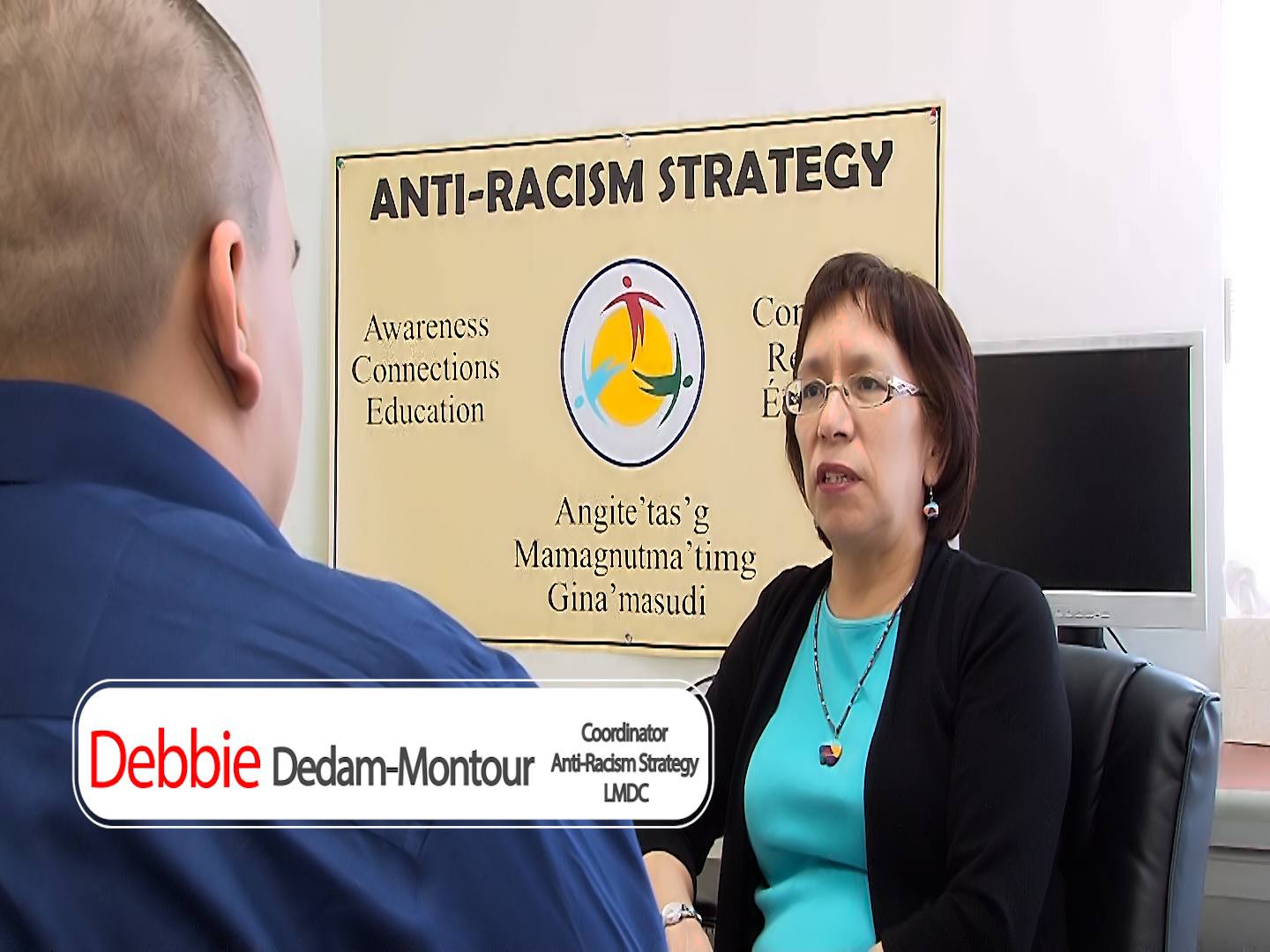
However, Bernadine is one of very few people working in Campbellton. There are several factors that influence whether Mi’gmaq workers in the region are hired or not. Racism is one of them. The Listuguj Mi’gmaq Development Center, LMDC has initiated an Anti-racism campaign with the objective to create awareness on this issue.

“We did an initial survey and there was a percentage of people that said they were not victims of acts of racism”, said Lorna Sook, Executive Director of the LMDC. “But then you have further conversations with them, they will talk about various things like shopping or applying for jobs and it’s almost like they’ve gotten used to being treated differently. Some people seem to think it’s normal. They don’t necessary label different acts as racism.”

Mr Gilbert Cyr, SSHS Principal speaking at the Anti-Racism Symposium

Mr Gilbert Cyr, SSHS Principal speaking at the Anti-Racism Symposium

That “different treatment” translates into self-doubt and it discourages some people to apply for job openings. These combined prejudiced beliefs about work ethics and French language proficiency, as well as a wide-spread lack of respect for tax rights, are just some of the barriers that Listuguj workers still face.

In its 20 years of existence, the LMDC has worked to bring down barriers that prevent people being hired in or outside of Listuguj. “We have the SIPU program that helped people with multiple barriers and we guided them through that and brought them to work placement and some people are actually still working” affirms Lorna Sook. This is the program that helped Bernadine in preparing for her job. For a few years she worked in seasonal jobs until she decided to challenge herself. Her first step was to go to the LMDC and enrolled in the SIPU training Program.

Mother of two teens, Bernadine praises the program that helped her to get a permanent job. “I’m proud of myself and my family is proud of me” she declares.

“Bernadine loves her work placement, the people there are absolutely fantastic. They treat her with respect. There are places in Campbellton that will hire our people and Sobeys is one of them”, states Lorna Sook, who saw many people go through the LMDC’s program in 20 years. Many are now working in different jobs in the community and some in Campbellton.

But she would like more opportunities in the surrounding areas. It’s one step at the time. A recent Anti-racism Symposium held in Listuguj was attended by general public and students from Listuguj and Cross-Point schools was another step in dealing with this sensitive issue at a community level. For Debbie Dedam-Montour, coordinator of the Anti-Racism Symposium “the event was successful with great community and youth participation.”

These youth are the ones that will be looking for jobs in the future. If they look for a job in the Bakery at Sobeys, maybe Bernadine will be there to train them. Or if they go grocery shopping they may see her proud of her personal achievement in breaking the barriers that stop employment integration in Campbellton.

Job integration is good for business

The employment demand in Listuguj is higher than the jobs available and neither the LMG or local businesses can offer a job to all Listuguj working-age members that in 2011 represented almost 1,400 people. The same year the Listuguj labor market was composed of approximately 30 businesses but more than 60% of employment was created by public services such as schools, social services, local government departmental programs and is the main employer.

On the other hand hiring and integrating Mi’gmaq workers into the regional labor market is good for business as the Mi’gmaq contribution to the regional economy continues to grow in importance.

People in Listuguj believe that their economic contribution should be reciprocated with job opportunities.

Inspiring Mi’gmaq Writers

In an effort to promote Mi’gmaq stories — and to encourage the writing talent in the area — the Chiefs of the three communities represented by the Mi’gmawei Mawiomi Secretariat (MMS) created the Mi’gmaq Writer’s Award.

It officially started in 2008, with only one winner. Since then, the prize has been split in two — $500 for a “17 and under” winner, and $1,500 for a “18 and older” winner.

“[The Chiefs] want the knowledge of our culture to be preserved in the language, through stories,” said Juliette Barnaby, the Office Manager at the MMS.

Submissions are judged with simple criteria in mind. First of all, a story has to be written well. Writers have to be recognized band members. And the big question judges ask is, what’s the relevance? “[The goal] is to capture relevant Mi’gmaq content, such as tradition,” said Barnaby.

Barnaby used examples such as stories from elders, or traditional land use. But “relevant Mi’gmaq content” is open to interpretation. A story about a community member living in a major city elsewhere in the world could easily win. “To me that would be a fabulous story,” Barnaby said. “To explain to somebody who lives on a reserve, the struggles of people that live off reserve.”

Barnaby said the submissions over the years have been great. “I don’t know if I would say there’s one that would stick out, in particular,” she said. “Because … obviously they’re very very good, because they won.

Submissions for 2015-2016 are due April 29.

As a past recipient of the Mi’gmaq Writers Award, I feel as though that opportunity gave me the confidence to make my writing public and to share it with my Mi’gmaq brothers and sisters. It had reawakened the creative writing flame inside me, and since then I have been inspired to create and write more, specifically spoken word poetry and short stories. I have since also given myself a goal of writing a novel in the next few years. Story is powerful, and it’s up to us, as Mi’gmaq people, to tell ours.

– Killa Atencio-Mitchell,
Author of Guided by the Moonlight


When writing I am able to express the things I’ve always wanted to say and to have discussions that do not always occur naturally. The Mi’gmaq Writer’s Award gives Mi’gmaq young and old the opportunity to do that as well. My own piece “White Feather Speaks” allowed me to share my feelings and findings with my community on the seldom spoken topic of the Two-Spirit. This award carries on the long practiced tradition of story telling and allows us all to grow through the words and experiences of our people.

– Duane Isaac,
Author of White Feather Speaks

Migmaq Writers Award Poster


Healing with traditional medicine

The healing power of plants are still available for those who need them and know how to use them. That was in essence the spirit of the workshop held in Listuguj on March 21 and 22. Elders Joe and Judy Googoo from Wagmatcook, Mi’gmaqi Unama’gi District, (N.S) and Doreen Bernard from Shubenacadie, Mi’gmaqi Signepgnegatig District, (N.S.) were sharing their knowledge of the plants -knowledge of thousands of years old.

The workshop’s focus is to bring back the use of traditional medicine, a practice that is endangered. Many of the herbs the Elders presented are available within the surrounding areas and could be processed into infusions (tea), decoctions and healing salves.

The two-days workshop was organized by the Listuguj Families First Services and attended by around 25 peoples interested in learning about traditional use of the minerals and herbs the land provides.

Derek Barnaby, a guest speaker on the second day of workshops, spoke of his experience with medicines and what his driving force was. The workshops finished with a Water Ceremony at lake Gospem on March 22.
The attendance of community and non-community members was exceptional and many said that they feel there needs to be more workshops like this. The Elders showed their interest to come back when the weather is permissible to let attendees to join along to gather medicines.

Listuguj Veterans have a place of their own

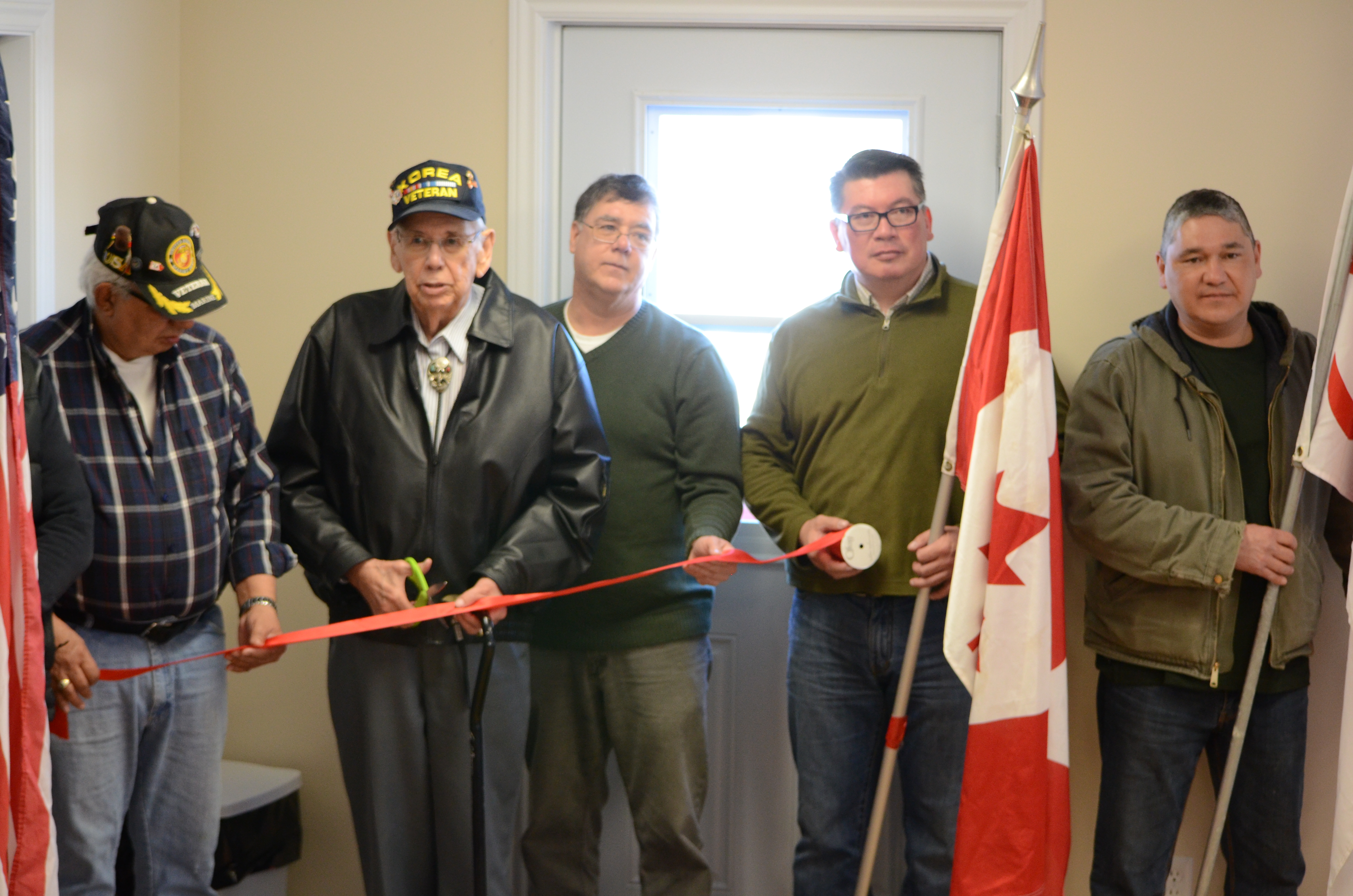
Dean Martin made a point to cut new keys before the event.

When the semi-grand opening of the Veteran’s Lodge was held on March 24, 2016, Martin went around and gave all the veterans a key of their own. “Here’s the key to the building,” he said to them. “This is our building.”

Martin is the On-site Housing Construction Coordinator for the LMG, and has also served in the American Military. “They were happy,” he said later. “Like ecstatic, relieved.”

Over the years, veterans in the community have had to find other places to meet. The locations weren’t always ideal – especially for some of the older veterans. Now, they no longer have to wait for someone to unlock the doors, so they can sit down together. They can meet whenever they want, even just to hang out and share stories.Veterans 3

The building itself is finished, so now it’s on to the next step – making the place feel like home.

People are already planning the mementos they want to bring in. Some have likely been imagining the inside for years.

In 2013, the plan was made to create a space for the community’s veterans.

Through donations, volunteer time – namely Adrian Barnaby and Dale Vicaire – and labour from the LMG during down time, the Veteran’s Lodge was built with barely any money.

It may have taken a little longer to build than planned, but now it truly belongs to the community.

“There’s no mortgage on it,” Martin said. “It’s done, it’s paid for, it’s ours.”

Veterans 2

Winter Carnvial at AGS

AGS students got to take a break, even if it was too cold for the outdoor plans.

The Winter Carnival was held on March 3rd and 4th. And while the two days included activities like watching movies and playing basketball games, the events also had other benefits for the Elementary and Middle School kids.

Jean Isaac is one of the teachers responsible for organizing the events for the Middle School students.

“We wanted to challenge them,” she said.16-03 AGS Winter Carnival21

The students all began in their homerooms, and then moved to different classrooms, for 30 minutes at a time. Some of activities required math skills, or concentration. Others had benefits that weren’t quite so obvious.

The day was deliberately planned to encourage the students. They had to interact with some of the teachers they haven’t had classes with yet. For one game, they had to get in front of the group, even if they are a little shy.

Jean has found that smaller groups helps encourage the kids to interact. A little competitive edge helps too.

Jean supervised games of “Heads Up.” The game requires one student to hold a phone to his or her forehead. The group can see a word on the screen, and they have to act it out. The person holding the phone has to guess what the word is. Guys played against the girls for “bragging rights.”

“They were laughing, they were engaged. They were sharing, they’re helping each other, which you don’t see everyday,” Jean said.