Native spirituality gaining interest in Mi’gmaqi

Driving around Listuguj (Busteed area) last week you could see a group of volunteers working the tipi poles, bringing firewood and preparing the site for the four-day ceremonies organized by Families First Support Services.

“We have many programs, and over the years many people asked us to do workshops about traditions, ceremonies, traditional medicine and teachings,” said Christine Metallic, Community and Cultural Support Coordinator for the FFSS.The ceremonies we are preparing now is to respond to these needs.”

Among the ceremonies there is the Sweat Lodge, a purification ceremony where participants enter a dome shaped lodge constructed of willow and covered with material to provide a semi-tight enclosure and complete darkness. The Lodge represents the mother’s womb.

When the ceremony starts the Elder pours water on the heated rocks (Grand Fathers) and participants pray for themselves, their families, their communities, they chant and take turns to speak. The duration of this ceremony varies depending of the number of participants, the Elder who leads it, and the reason for the Ceremony.

Taking part in this sacred ceremony has different impacts on different people.  Those participating for the first time usually feel a resurgence of strength and connection with their identity, and for some it’s the beginning of a journey of healing.

“Sweat Lodge is a sacred place where your whole body gets cleansed and what you feel inside is incredible” said Frank Augustine an Elder from Elsipogtog who came to Listuguj to lead the ceremonies with his wife Josie. “There are things you may see, and you may receive teaching because there are spirits there to help you if you care to listen.”

Elders Frank and Josie Augustine from Elsipogtog

Elders Frank and Josie Augustine from Elsipogtog

Elders Frank and Josie, married for over 50 years, travel across Canada and Mi’gmaqi carrying these teaching. Frank was around 40 years old when he decided to take the spiritual journey that changed his life for the better.

“We see people following traditional teachings and Native spirituality and we see how their lives had changed” says Christine Metallic, whose experience as a community worker in different communities. “Looking at non-native ways, methods of healing like therapist, meditation, Tai Chi or Reiki are not the only solutions. We need something that works for you, and native spirituality reach us deep and at different levels.”

Following Native spirituality is all about faith. All religions of the world have their ceremonies and protocols that guide social behaviors, practices, determine sacred places, and provide the worldview with teaching about human’s relationship with the world around, above and below.

If in the past the practice of Indigenous spirituality were forbidden, outlawed and associated to devils or superstitious, nowadays there is a certain acceptance.  In Mi’gmaqi, and across Canada, interest has been growing.

“Twenty years ago there was a lot of hard work put into bringing back our teachings,” Josie said, while preparing the lodge for the ceremonies. “A lot of seeds were planted and now we see the seed popping up.”

“I see more interest in Listuguj” said husband Frank. “When we used to visit there was a handful of people. Now we see more people. We see that there’s a thirst for our spirituality.”

There are some people who took part in native ceremonies here for the first time.

On Friday afternoon, at around 6 pm. Ala’suinu Barnaby, 11, ended his 24-hours fast while other men and women were continuing theirs. He decided to do his fast with support from his parents on site. “Ever since my auntie Tanya did her four-day fast a few years ago I’ve been wanting to do it as well,” he said. “I also did it because I just lost my uncle Henry (Vicaire) and I did it for him. I did a lot of praying in the Sweat Lodge before I went into my fast. I felt successful, I felt good and proud of myself. It wasn’t easy but I learned a lesson: patience. I think anyone who has a chance should do this ceremony.”

Maybe at the Listuguj Pow Wow this year we will see more Sweat Lodges and we may see again the Sacred fire lit for all those who want to pray for their families, for themselves, and the communities.  After all it’s about belief and traditions that are now available in Listuguj and in neighboring Mi’gmaq communities.

Little gestures to protect Mother Earth

There is a new Ranger in town and his name is Ayden Barnaby.  An Earth Ranger that is.

A curious eight year old, Ayden visited the Earth Ranger website, where school age kids find tips and missions on how to protect animals and Mother Earth. His mission is to collect and recycle 20 batteries, and to dispose them properly.

“I choose to collect batteries because when they are thrown away to the garbage they end up on the landfills where batteries will leak their chemicals into the ecosystem” said Ayden.

The Earth Ranger missions ended up involving kids, families, friends and communities.  In order to achieve his mission he went door to door in hison hi neighborhood. He asked his friends, and when he got messages from community members, his parent would drive them to get the batteries.

When Justin Caldwell of CHRQ started to air Ayden’s message requesting batteries he got more calls.  Within two weeks of his mission, he collected almost 700 batteries that he took to the GMRC office, where there is a disposal box that is shipped to a recycling facility every week.

“I like to help animals, and the chemicals of the batteries are bad for the Earth” said Ayden that takes seriously his Earth Ranger mission seriously.  His goal now is now to collect 1000 batteries before taking on his new mission: protect the bees.

Listuguj mourns death of Chief of Police Henry Vicaire

Listuguj Chief of Police Henry “Hank” Vicaire was rushed to the Campbellton Regional Hospital on Friday the 13th under emergency circumstances, but was unable to recover.  He passed away several hours later.  He was 50.

On May 18, at around 10.30 a.m.. various delegations of Police, SQ, RCMP, Firemen, Ambulance technicians from around Listuguj, and a representatives of Henry’s Bike Club, gathered in front of his house. A solemn march to St. Anne’s church followed, where political banners were covered and painted with the number 21, in respect to the badge of the Chief of Police.

The Church was packed and the mass started with the Spirit Bear singers chanting the Mi’gmaq Honor song.  Native and non-natives families and friends of  Henry “Hank” Vicaire gathered to pay respect to a person that the eulogies described as a humorous, sensitive, respectful and a talented human being.

Henry Vicaire was born in Campbellton, N.B. in 1965. He attended the Justice Institute of British Columbia (JIBC) where he earned his policing certification in 1994. He served as a Listuguj K-9 officer from 2002 to 2010 with detector dogs Echo and then Bonzai.  He became Listuguj Chief of Police in 2012.

Chief of Police Vicaire had a varied background before becoming Chief of Police.  He was a woodsman, a carpenter and an ironworker.  Listuguj members know that Chief of Police Vicaire was a motorcycle enthusiast and loved to ride his Harley Davidson.

Henry was the son of Maggie Isaac and Henry Vicaire Sr., and a proud member of Listuguj First Nation. He leaves behind his wife Samantha and four children between the ages of 12 and 28.

AGS Science Fair

Families First prepares Sweat Lodge

“We’re always getting a request to do more culture related programs,” said Christine Metallic, the Cultural Coordinator with Families First.

Six weeks of information sessions just finished on May 4th. All the sessions were leading to the upcoming fast.

“We started off with the medicine gathering … and [identified] what they’re for, and holistically how you can start taking care of yourself,” Metallic said.

All the sessions were aimed at different ways of taking care of yourself, with a holistic understanding in mind.  “As Mi’gmaq people, what ceremonies are out there,” Metallic asks.

Some of the ceremonies that are being practiced closely mimic the land, as the snow melts away.

“The fast – it’s about shedding stuff from the past, and just being able to move on,” said Metallic. “Spring is the time a lot of ceremonies take place. Spring and summer. Our highest ceremonies and our Sweats are taking place.”

This is the first time Families First is hosting this fast, but it is certainly not the first time this fast is being held.

“I have family members that have been fasting forever,” Metallic said. “We’ve been fasting in our territory – we just don’t talk about it. We just don’t come right out and say this is what we’re doing.”

But for whatever reason, right now seems to be a good time. While there are obstacles in just about anything you try to do, Metallic said these last few events have “been a breeze.”

“People are actually coming out, wanting to volunteer, wanting to learn,” she said.

The final session ended with Karen Kimbell and her knowledge of herbal medicines.

If interest continues, Metallic said she could see sessions such as these being available quarterly. It depends on demand.

“Every program that’s based in Families First is based on our client’s needs.”

The sweats are open to anyone. But it’s always asked that people refrain from alcohol and drugs – even for the days leading up to the Sweat Lodge.

“While we have people who are fasting one, two, or three days, not everybody is going to be fasting,” Metallic said.

Usually, when someone starts a fast, they go into a sweat first. And they finish their fast by going in to another sweat. Since people will be fasting for different lengths of time, organizers plan to have a sweat each morning.

Volunteers are also definitely welcomed. “We’re gonna need help in preparing the area. Building the teepees, the Sweat Lodge, keeping the area clean,” she said. “It ends up becoming a workload.”

Grass fire contained, despite strong winds

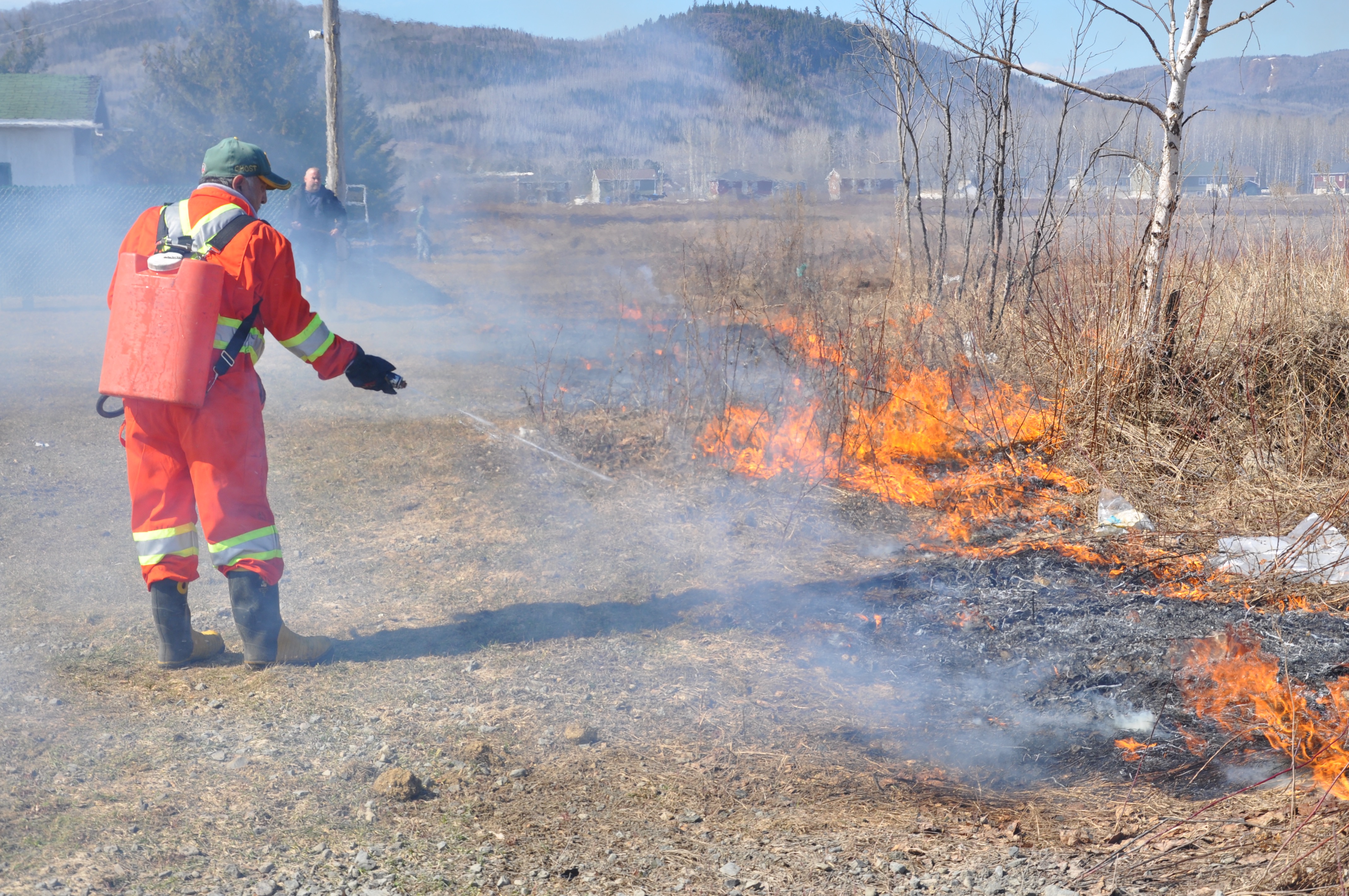
Fields are drier in the spring than you may think. The fire on April 30th was proof. A fire began in in the fields located in and around Dundee Road.

“By the time the Fire Department got there – even with the quick response – there was damage done to the property,” said Peter Arsenault, the Director of Public Security. “They fought it quickly, but it also moves quickly, because of the wind, the breeze picks it up and fire generates rather quickly with dry fuel like that.”

A shed was burned, as well as portions of fences, but no one was injured. However, there have been some concerns with some Elders and respiratory difficulties.

There are unsubstantiated reports of someone on an all-terrain vehicle, dropping matches. As of now, it is not believed the fire was set intentionally. Often matches dropped on walking trails, or cigarette butts grow into large fires around this time of year.

“I think it’s someone along the lines of not realizing the consequences of their actions,” said Arsenault. “I don’t think it was their deliberate action to set somebody’s property on fire, but as a result – that is what happened.”

Unfortunately, there are always fires in the spring. In the past, some Firemen have even been injured as a result. In some areas, grass fires often get out of control after being deliberately set by people who believe it is good for the soil, when the opposite is actually true.

“It has environmental impacts,” Arsenault said. “It’s also bad for our groundwater. Plastics burn, and they seep into the soil, and eventually go down into the groundwater – the very water that we drink.”

In an attempt to curb the damage caused by these fires, the Fire Department has been conducting controlled burns, to create a buffer between dry areas, and people’s property. It is the only tool available to help limit the damage.

The only tool other than raising awareness.

Chaleur Terminals in court May 17th

Chaleur Terminals Inc. and the New Brunswick government will be back in court Monday, May 17th.

The previous two dates, March 14th and 15th, were taken up entirely by the Mi’gmawei Mawiomi Secretariat (MMS) lawyers, with all the testimonies and documentation that had been prepared.

Troy Jerome, Executive Director of the MMS, said that while it’s impossible to tell what the outcome may be, he felt encouraged by the first two days.

“We believe, at least, the court was listening to what we had to put forward,” he said.

This is the first “duty to consult” case in the province of New Brunswick. The judge  asked for legal precedents, but none exist. There are others across the country, of course.

Based on those cases, Jerome believes the application has solid ground to stand on.

“Consultation is not just there for the Aboriginals to let off steam,” Jerome was told by a lawyer from western Canada. “It should be meaningful, and it should have a reason.”

Meaningful consultations should include involving, and working with the concerns of the First Nation communities.

People are encouraged to attend, and sit in the courtroom on May 17th if possible.

“[We] want the lawyers, and the judge, to see Mi’gmaq citizens sitting in the courtroom, so they may think, ‘this is important to these people,’” Jerome said.

The Diamonds and Pearls Mother’s Day Social

The Diamonds and Pearls Mother’s Day Social was held Saturday, May 7th, at the Listuguj Community Development Center (Bingo Hall). Doors opened at 5 p.m and supper, which consisted of chicken, rice vegetables and salads (made by Elders Jean Martin and Donna Wysote) was served at 5:30 p.m.

Patty Martin was the Master of Ceremonies. The fundraiser event’s agenda was a mix of live performances, video sketches, door prizes as well as a fundraiser basket. Guest singer ‘Paul Jenson’ was also in attendance.

The Diamonds and Pearls Mother’s Day Social event made proceeds amounting $5,000.00; which was divided  between the Elder’s trip to St Anne De Beaupre and The Veteran’s Lodge. ($2,500.00 Each) A gift basket was also raffled during the night to raise funds for Carter Cyr. Proceeds for Carter amounted to $1,020.00, and an additional S2,000 was donated from the St Anne’s Committee and Tina Barnaby.  St Anne’s also donated S1,500 to Zaccari Barnaby.

All in all it we hope it was a memorable event for the mothers, the organizers are glad to have raised proceeds for the community.

Free to buy beer in Listuguj

recent ruling on cross-border trade allows New Brunswickers to buy beer in Listuguj or Cross-Point without fear of being charged. 

The ruling lifts the restrictions imposed by the N.B government that charged Gérard Comeau for importing more than five cases of beer into the province. The government of N.B. has until the end of the month to appeal the decision.

During the days following the ruling, there were reports that the sales of alcohol in Listuguj and Cross-Point stores increased, as the prices of beer and other alcoholic beverages are cheaper in Quebec than N.B. Christine Bujold, cashier at the Restigouche Drive-Thru – a Listuguj store located on the Interprovincial Boulevard – noted that there wasn’t an increase in the number of clients. 

“It’s almost the same,” she said. “But now instead of buying two or three cases of beer, they fill their car trunk.”

Canada is  a country that signs international Free Trade agreements with countries around the world. Economic Development Minister, Navdeep Bains, called the decision a “positive development.”

This legal battle for the recognitions of the Constitutional right to cross-border trade is a reminder of First Nations legal battles to implement the Jay Treaty signed in November 1744 which reaffirmed “that First Nations could cross the border without harassment and not pay tax or duty on goods.”  The implementation of the Treaty was challenged many times.

Gone Fishing

Boats have already been heading out on the water for the 2016 fishing season. They go for days at a time, to where you can’t see land in any direction.  The snow crab season opened mid-March, and the shrimp season started in April.

This marks the 15th season Listuguj has been participating in the commercial fisheries. With two boats entirely run by First Nations crew and 12 boats in total, the operation has been growing steadily. “It was a learning curve for everybody,” said Chris Metallic, the Commercial Fisheries Coordinator with the Natural Resource Directorate. “Although we had been participating in fishing salmon and other things, we still had to adjust to the commercial aspect of the fishery.”

In 1999, the Marshall Decision reaffirmed the Mi’gmaq right to fish in the Supreme Court of Canada. After that, Listuguj began taking the steps to enter the commercial fishery. Among the first community members to be involved was Blayze Isaac who started as a deckhand.

As a kid he would often head down to the beach with a fishing pole, but he never imagined it would be a job.  “I was a land lover, kind of thing,” he said.  He had been working in the woods when the opportunity to take a deckhand course  came up in 2001. He took it, and went out on the water for the first time.

First Nation fishing operations are run a little differently than the privately owned operations founded at Sainte-Thérèse-de-Gaspé, or elsewhere in the Gaspesie. The boats and licenses are communally owned —  which non-native fishermen sometimes don’t quite understand.

“It doesn’t go to one person, it doesn’t go to one family. Unlike non-native fishermen — their whole family benefits, whoever they hire,” said Metallic. “That’s not the case here for Listuguj. What we do is we hire people from different families, and all different families benefit from it … It’s a communal license, meaning it belongs to everybody.” But good jobs have been created.
Among the highest around. And 62 people are  employed during the season. Listuguj, combined with other First Nations fishing in the region also create jobs for local people in Matane, Fox-River, Ste Therese, etc.  Ways to expand the quotas are also always being explored, but as of now, the Listuguj Fishery holds the largest quota for snow crab and shrimp on the east coast says Metallic. Other species, like halibut and turbot are also fished. This is the second year in an attempt to grow scallops as well.

This is a significant change from when Isaac first headed out on a crab fishing boat, 15 years ago.  He’s now Captain of the Maqatgwig.   Isaac admits that the first year as a captain was stressful — taking care of everyone, and hoping to find the right spots to set traps. Now, into his third season, it’s second nature, he said.

As the captain, he often stays on the boat when it’s docked, and lets his crew go home. And even though the job is hard on the body, he still loves it. “You’re getting paid for something that you like,” he said over the phone before one of the few occasions during the season when he gets to go to Listuguj.

He plans to take a break for a few days, and then “head back home,” he said.  “Well, not home, but to my boat. Back on my boat — it’s pretty much home to me.”


Protect the fishery for future generations

By Dr. Fred Metallic,
Director of Listuguj Naturals Resources

The Mi’gmaq have been fishing within Gespe’gewa’gi territorial waters for countless generations and more recently, the courts and government have begun to recognize Mi’gmaq have a right to access fishery resources and to make a moderate livelihood. What does this mean? Even though we harvest approximately 1.7 million lbs. of crab and 4.5 million lbs. of shrimp (estimated gross revenue of 8-9 million dollars with over 60 direct jobs in Listuguj) the development of the fishery goes beyond making a moderate livelihood.

The development of the fishery aside from its economic value is also important from a cultural and political perspective. We see ourselves as fishermen and fisherwomen, as Treaty quota holders with a cultural responsibility to protect the fishery for future generations.  And even though the fishery generates revenues for much needed community programs (from health to education) the fishery is a source of pride, identity and self-determination.

Self-determination in the sense that we are re-establishing our place within the fishing Industry as a major player and our involvement goes beyond harvesting. We are looking to be more involved in the overall management and governance of fisheries resources found within our territorial waters. The development of the fishery means we are contributing to Listuguj’s goal of self-determination.