



Every year the Powwow seems to get a little bigger. But that’s not really a priority for the coordinators.
“Our main goal is not to be the biggest, or the best Powwow,” said Lita Isaac, who has been involved since the very first Powwow in 1993. “It’s just for people to get here safely, enjoy their weekend. Dance. Drum.”
That’s a big enough job. Keeping people hydrated alone required over 170 cases of water, which had to be requested — and donated — from local businesses.
“It’s a lot of hard work. We have a small committee,” said Isaac. “But people will approach us and ask, ‘can we help?’”
The whole weekend runs on volunteers. Whether it’s in the weeks and months leading up to it, or those filling all the small, but demanding jobs. Everything from making coffee to directing traffic needs someone giving up their time.
“The Powwow belongs to the community,” said Isaac. “When people step up and offer to help … it might be something small, but it all counts.”
Laura Arsenault has been involved with the Powwow for seven years. She’s now one of the coordinators. “It’s just something for me that I would donate all my time to — even if it was yearlong, I’d still do it,” she said. “I’m passionate about. It’s the only thing I really volunteer for.”
While she spent this year mostly occupied with the vendors, Arsenault’s favorite job is working the canteen. She gets to meet new people and catch old friends visiting home.
A lot of people plan their vacations around the Powwow, and new people people discover it every year.
This year, over 500 people were fed moose, salmon and fiddleheads on Saturday alone. Isaac says being able to feed everyone is their way of thanking those who come and support Listuguj, and the Powwow.
“It’s building up the pride,” said Isaac.“If somebody leaves the Powwow with a feeling of experiencing a ceremony at the sacred fire, or just praying at the sacred fire, or enjoying the drumming and dancing. Or going to the native crafts and buying something made by somebody from a New Brunswick First, or Quebec, or Listuguj — it’s wonderful … Or just enjoying an indian taco. Leaving with something in their bellies or their heart or soul, it’s the best feeling for us. That’s our aim.”

It’s nice to feel that with the dances and the presence of the Grand-Father-the-Fire, you are still honoring the spirituality of Indigenous people here. AFN Chief Perry Bellegarde said: “despite colonization they couldn’t kill us and we are still here, alive”. These strong words, speaks about the ongoing death and life struggle that Indigenous peoples of Turtle Island are facing for many centuries.

At the first Powwow there were few regalia, few eagle feathers and now we see more drums, more dancers, more children at the Powwow. This mean that people are coming back to their culture and it makes me proud. I come here every year since the first Powwow and they treat us good. I always want to come back.

This is my first powwow and it’s nice to sees Natives, Acadians, French and English to meet at the beat of the drums. This is a family gathering. I feel like the Earth vibrates when I see a community that chants, dances and respect Mother Earth.

This was my first time dancing with my regalia and in my home community. The support of friends and family was overwhelming and makes me feel proud. Looking at them was like looking at a rainbow with all their colors and they were around the circle. This is a new road for me, physical and spiritual.

Listuguj received a special guest during the Powwow weekend. Perry Bellegarde, the Assembly of First Nations National Chief, came to the community for the first time and delivered a vibrant speech at the Powwow.
“I got a really nice invitation from Chief Darcy to be with him and his community,” he said. “I’ve never been to Listuguj before. So when I saw him at our last AFN AGA in Niagara Falls two or three weeks back I said, ‘Hey let’s make it happen.’”
His visit started with a breakfast at the Community Center (Bingo Hall) where LMG Councillors, Directors, Gespeg Chief Manon Jeannotte, as well two members of Parliament from the region, Hon. Remi Masse and Rene Arsenault, Campbellton Mayor Stephanie Anglehart-Paulin and N.B. Aboriginal Affairs Secretariat, Patrick France were all in attendance.
There were several presentations during the breakfast. Councillor Lloyd Nicholas, Alcon, Officer Trapper Metallic and Chief of Police Peter Arsenault from the Listuguj Police Department spoke on the difficulties that the department has been experiencing due to a lack of funding and the tiring amount of hours each officer endures.
There was also an announcement of a 100,000$ funding grant from Aboriginal Language Initiative Program from Heritage Canada to help with revitalizing the Mi’gmaq Language in Listuguj. This support will help the different efforts of the community to create awareness on the Mi’gmaq language situation, provide classes, stimulate the use and transfer the knowledge of the language to the non-speakers.
After the meeting, the dignitaries went to the Powwow grounds for the Grand Entry where Chief Bellegarde wore his tradition Plains Cree headdress. The National Chief, elected in December 2014, is from Little Black Bear, Saskatchewan.
The morning started off with a blue sky bursting through what little clouds we had, a beautiful day to Powwow. After the Grand entry National Chief Bellegarde spoke about the importance to preserving identity despite the centuries of oppression and struggles for First Nations. ‘We are alive’ he told the crowd that applauded him. He took the time to thank Lita Isaac and the Powwow volunteers, dancers, drummers for their efforts to bring people together every year.
After the morning’s events finished, Mr. Bellegarde gave an interview on camera to Nujignua’tegeg (see our Youtube channel) before leaving to Eel River Bar for a Sweat Lodge ceremony.


“How are you tonight?” Constable Jacob Renouf asks at a roadblock set up by the Listuguj Police Department (LPD) in front of the Education Complex. It’s near 10:00 PM on Aug. 5 — the start of the Powwow weekend. Six officers are working, instead of the usual two.
Flares, and the flashing lights notify oncoming traffic. Constable Renouf greets drivers, and explains what they’re doing – just making sure everyone is being safe. The officers quickly shine flashlights in the car, and everything is in order. A few more jokes are made, everyone laughs, and the car continues on.
“How are you tonight,” Constable Renouf asks the next car. The officers work their way through the line of vehicles that has formed, and then they pack it up. They’ll set up another road block later, but for now they’ll patrol.
Constable Renouf expects to drive the same streets dozens of times throughout his 11-hour shift. He has only been in the community for nearly a year. But he was on duty this time last year. He worked for the Gesgapegiag Police Department, which provided extra help in the past. No other police departments were needed this year. And the Powwow continues to grow.
Sgt. Detective Trapper Metallic has been with the LPD for over 15 years. He grew up here, got a summer job with the LPD, and got his training in Regina at the RCMP Academy, Depot Division.

Sgt. Detective Trapper Metallic has been with the Listuguj Police Department for 15 years.
There were a couple years in his career, around Powwow time, when he would see an influx in incidents. “Then we started to put some more guys on patrol, and start making it a regular thing annually. Then those stats start to go down.”
Police Chief, Peter Arsenault said that the incidents this year were “almost garden variety.” “Everything went well,” he said.
While some may see operations like a road block as a nuisance, Arsenault hopes they recognize the true purpose. “I’d like to think that they’re aware that we have their best interest in mind,” he said. “Everyone is entitled to safety.”
Like most of the officers on duty, Sgt. Detective Metallic is also working extra hours, after his regular four-day schedule, through the night. “To work extra hours is nothing,” he said. “It comes with the territory. Whether you’re 15, 20, 30, 40 – however many years of service you have – you come and work the extra hour, just to make sure that nothing happens. It’s priceless.”

The 23rd annual Wellness Fair kicked off in the usual way, with a march from Subway to the Powwow grounds at 8 AM. As always, the Wellness Fair was a family event, equipped with an inflatable playground, and breaks for games, like a fair-wide “rock, paper, scissors” tournament. Organizer called it one of the best attended Wellness Fairs in recent years.
“One Wellness Fair is never the same as a previous one,” said Sheila Swasson. Haven House hosts the event.
This year, many aspects of physical and mental wellness were addressed, but it had a clear focus on language. Many presenters in the morning spoke entirely in Mi’gmaq. Others spoke partially in Mi’gmaq.
“If we don’t start working toward revitalizing our language, within 30 years, there will be no Mi’mgaq speakers in Listuguj,” said Swasson.
Lorna Sook, Listuguj Education Director, told the crowd about the struggles of the Listuguj Education Directorate in finding a way to address the threats facing the language.
Sook eventually attended a conference at Mount Allison University, where she heard that the only way to save a language is through immersion programs. And immersion programs will only work if they are complete. “I came back with that message, frightened,” said Sook. “Having to make a decision on relocating the Mi’gmaq Immersion Program out of the Gitpu School, and it will be located in a section the Education Complex.”
The Immersion classes will be isolated, in an attempt to reduce the tendency to switch back to english. After a certain point, people will only be allowed to speak Mi’gmaq.
Like every year, the Wellness Fair had many presenters under the big tent, and lots of gifts to give away. Presenters spoke on a variety of topics related to all aspects of “wellness.” Denny Isaac, of the GMRC spoke about the importance of water. Dr. Fred Metallic was able to keep with the Mi’gmaq language theme, while also giving a first-hand account of how preventing violence can apply to different levels. He told the story — partially in English, and partially in Mi’gmaq — of his doctoral thesis, and the battle to write it in Mi’gmaq, and defend it in Mi’gmaqi.
He referenced a banner “Family violence is not a Mi’gmaq way of life” carried in the march earlier that day. “Well neither is institutional violence a Mi’gmaq way of life,” he said. “To insist that indigenous students only speak English or French is a form of violence.”


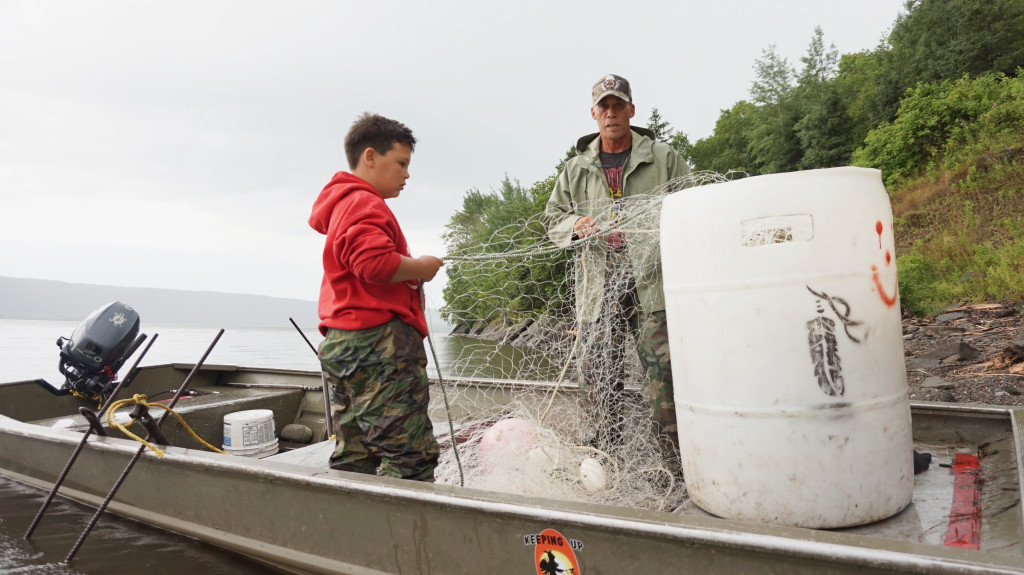
Tanner Sage Barnaby, the son of Tara Barnaby and Robby Ouellette, has been salmon fishing for the last six years and he’s only twelve. He leaves the quarry in the middle of a rainy afternoon and when he arrives to the fishing area he slows down the motor to set the net. A very attentive boy, Tanner drives the boat with the seriousness that his tasks require.
As the rain continues to fall, he stops the boat and initiates a conversation with Aurele Isaac, his mentor. They talk about the places where other fisherman set their nets. “We have to respect them,” he says. “If you see that one person has a good catch on his place you just can’t come the next time and occupy his location. We have laws and we have to respect them,” he says to Tanner.
This friendship started when Aurele met Tanner one day. He noticed his interest in the outdoors and he asked if he wanted to fish salmon. After Tanner accepted, Aurele talked to his mother and told him to be ready early in the morning. When Aurele went to pick him up at 6:30 am he was there, waiting at the door.
Six years later they are still fishing together. “I accepted his invitation because Aurele teaches about my culture and he also speaks to me in Mi’gmaq. I like that, I want to keep our traditions going,” said Tanner with a sincere tone.
Aurele grew up fishing, working in the woods, learning the traditions with his father and everything was said in Mi’gmaw. Now it’s his turn to pass them on. “I find it important to pass on the tradition because if we don’t, who will exercise it, who will pass it to the next generation, who will defend it when threatened?” he maintains.
There are few young fishermen on the river today, but not enough to secure a wide practice and knowledge of the tradition of fishing. “Very few of my friends fish for salmon” said Tanner who seems happy on the river. “I learned to drive the boat, clean the net, grab the floats, pull anchors, check the net, use the pole, clean the salmon and to give away my first catch”, he declares. For any young person these skills take time and practice to learn. “Now, I don’t have to tell him what to do,” says Aurele who feels content to see Tanner learning the skills that allowed the Mi’gmaq to get their sustenance from the river and to maintain the respect for Plamu.
As a kid, Aurele’s father, Isaac Isaac, “Isaacjij” taught him salmon fishing, moose and deer hunting, and ice fishing. His older brother, uncles and other adults also passed on to him that traditional knowledge. He used to spend two weeks of the Christmas holidays in the woods. Today children have fewer teachings and it worries Aurele. “When I was a kid I had access to a lot of traditional activities and now I feel there isn’t enough of that for the children. My father told me ‘I will not always be here so you need to learn all these things because you are a Mi’gmaq.’ So it’s up to us men to pass on our traditions,” affirms Aurele.
After the fishing season, Tanner and Aurele will team up again for partridge hunting, rabbit snaring, moose hunting, ice fishing. “Aurele is a good friend who teaches me a lot. He’s a good teacher,” says Tanner who is in Grade 7 at AGS. “Most of my friends don’t go fishing. I only know one kid that goes salmon fishing with his grand-father.”
“I’m amazed by the number of kids who are interested in fishing but sadly for one reason or another their dads don’t take them to the river,” said Aurele who also fishes with his daughter Ariel. “Our traditions are getting weaker and we need to share our knowledge and bring more kids out because they will be the ones defending our rights. They need to practice traditions to exercise rights. Some communities have negotiated their fishing rights and I don’t it want to happen it here.”

The 2016 National First Nations Youth Summit on Wellness, held in Niagara Falls, Ontario, hosted over 200 First Nation youth from communities all across Canada. Marcy Jacques, Jill Martin and Tyler Morrison represented Listuguj at the event to learn how other First Nations youth are dealing with different issues in their communities.
The focus of the summit was clear — the well being of First Nations Youth across Canada. The Co-Chairs that spoke on Mental Wellness expressed that First Nations Youth do have belonging and purpose, and they are not forgotten.
“Those are our future leaders” said Bobby Cameron, Regional Chief for the FSIN. “We encourage them and acknowledge them. They’re all valuable, they’re loved and cared for.”
The facilitator Stan Wesley opened the Summit enthusiastically, calling for a culture of doing the very best you can. “What I tell people, is that when they’re struggling to figure out what they truly want to do, I challenge people — all people — to be good at everything you do, up to this point and forward.”
Nearly a dozen speakers — all renown in their area of expertise — presented to the audience throughout the day. Two conference rooms needed to be joined together to hold an unexpected number of participants. “We prepared for around 150 youth and had almost 300 registered before the event,” said Andre Bear, who became one of two newly elected Co-Chairs of the Assembly of First Nations Youth council on July 10. “We’ve heard great feedback from the attendees and we were also given a lot of advice on what we can do better for next time.”
The underlying theme of the entire weekend was the importance of wellness in the community — physical wellness, just as much as mental wellness. “Your garbage is my garbage,” said Chief Cadmus Delorme of the Cowessess First Nation, who spoke of the power of encouraging others, uplifting your peers with positive humor, and the fact that one problem within the community can cause an imbalance.
Before lunch “The Youth Walk of Hope” arrived, with weathered shoes, and reflective vests . They had completed their month long journey from Attawapiskat, northern Ontario, to speak with the AFN leaders, which held its 37th Annual General Assembly later that week in Niagara.
Patrick Etherington Jr. (Moose Cree Nation), spoke on behalf of the walkers of the recent struggles happening in the community of Attawapiskat. “I’m very proud of them man” said Etherington “They broke down their barriers that we all have, especially on more isolated reserves up north”
After the morning’s presentations, all attendees were treated to a catered lunch and “Pow-wow Bootcamp” created by Santee Smith and assisted by Joshua DePerry (AKA Classic Roots). The bootcamp is a high-energy Pow-wow/ Dance training class. Santee Smith wants to promote dance, physical fitness and life affirming body expression while incorporating culture.
The whole Summit lasted one day, and was a welcomed overload of information for those who attended.
“This inaugural gathering showed me that we can create a meaningful change for the lives of all First Nation youth,” said Jill Martin. “Each and every one of us has a voice that needs to be heard.
 Formerly titled the Nujignua'tegeg - The Wi'gatign is a multi media community newsletter for Listuguj First Nation.
Find our printed issues within the community. We print once a month.
