Grass Dancer: Craig Isaac

Craig was 20 years-old when he first danced at a Pow Wow. He had been watching closely as he traveled the circuit for awhile, but he hadn’t participated until one day in Nova Scotia.

“I was a nervous wreck the whole time,” he said. “I think it was like that for the first full year.”

The first Pow Wow he danced at typically takes until 11 p.m. to get to the adults.

“You know it’s coming up, It’s like a high school speech eh,” he said. “ ‘I’m next, I’m going to be next, I’m going to be next.'”

“My coordination was horrible. I was off beat. I was stiff. But I mean – that’s most people. When you start off when you’re 20 years-old, you’re not just going to come in to it. As oppose to – you see some little kids starting off for the first time, and they just nail it right away.”

There was never any question of whether to continue or not. A drummer gave him some advice. He told him to attend some of the larger Pow Wows. Once you do that, the others don’t seem like such a big deal. He went to Schemitzun – one the biggest in North America at the time.

“When you first walk out on to the dance arena – it’s a good feeling when you look around, and you see 30 other grass dancers. Especially the ones that you’ve been watching for years.”

It wasn’t long before people began approaching Isaac, telling them that they enjoyed watching him.

“Just that stuff alone makes it all worth it,” he said. “You feel good yourself. It’s like anything else, when you’re about to do it – you’re nervous. Once you’re into the song – that all goes away.”

POW WOW

“Just Pow Wow alone I think is something that’s good for your spirit, your mind, your body,” said Isaac. “Song and dance no matter what style, if it’s hip-hop, R&B, when you hear a good song, it makes you feel good, right. Same thing with Pow Wow. When you’re dancing, it makes you feel good, it makes the ones watching you feel good.”

But Pow Wows are more than just dancing for Isaac.

“It’s something that I think brings families together,” he said. “Especially for me and my daughter.”

From April onward, they spend as many weekends as they can traveling. His daughter has been dancing since she could walk. And they often travel with the same group. They call them their “Pow Wow family.”

“It’s basically a big family you know, and everyone looks out for each other, and everyone helps each other out,” he said. “The kids love it, because they get to see each other every weekend. When you come home you know you’re going to see them again in a few days.”

They attend a variety of Pow Wows, both traditional and competition.

For Isaac, he enjoys the relaxed nature of a traditional Pow Wow and dancing just for the people, but he really likes competition Pow Wows.

He places often, even as an “old style” dancer.

OLD AND CONTEMPORARY

Isaac is a grass dancer.

“It’s a dance that comes from the plains tribes. And it’s basically a dance that mimics patting down tall prairie grass,” Isaac said. “Like most of the dance styles at Pow Wows – they started to spread out across the nations.”

Like other dancers, Isaac started in the “contemporary style” and transitioned in to more of an “old style.”

“They’re both challenging in their own way,” he said.

Isaac explained that “contemporary” dancers will often incorporate all sorts of dance moves, including modern popular dance ones. It’s limited only by your creativity, he said.

“Old style is less flashy, more on the spot,” Isaac said. “Everything you do on one side, you do on the other side. It’s more smooth moving.”

And while “old style” may stay closer to a standard set of footwork, Isaac said there’s still plenty of room for individuality.

“You can transition them in your own style.”

Isaacs preference is purely aesthetic.

“I like the look of the smooth footwork.”

Isaac agreed that “old style” dances are sometimes overlooked at competitions. But an experienced judge will know what to look for. And more and more dancers are being drawn to it. He said it is “making a big comeback.”

So far this year, Isaac has placed at the majority of the competition Pow Wow’s he has attended.

The nervousness may have worn off, but the excitement definitely hasn’t. Isaac intends to keep traveling with long-time friends and family for awhile to come.

Jingle Dress Dancer: Cheyenne Isaac

You can do everything right, and still not place in a competition Pow Wow. Especially if you dance “Old Style.”

Cheyenne Isaac has been dancing since she was seven years old, and grew up traveling to all sorts of Pow Wows with her father – a champion dancer himself. She calls herself “very competitive.”

“I know when I screw up,” she said.

She dances an “Old Style” Prayer Dance – which is often called a “jingle dress dance.”

Isaac says there are two main distinctions in all the different dances at a Pow Wow – “Contemporary” and “Old Style.”

“Contemporary” is the flashier of the two. The movements draw can even from modern dance moves, and the regalia is more colorful.

“Old Style” stays closer to a set of footwork, is more subtle, and has a more reserved look.

“I feel that the old style shouldn’t go unrecognized,” Isaac said.  “It’s still just as beautiful. And really – it’s where the dance originated. That was the first raw steps of each dance form before it became something else.”

Isaac says there are also two types of Pow Wow’s – competition and traditional.

The east mostly has traditional Pow Wows, where the focus is more on dancing for the people.

Isaac enjoys both for different reasons, but enjoys the pressure from a competition Pow Wow.

“It helps me try to get better at what I’m doing. But sometimes it messes with you – if you don’t place.”

23rd Annual Pow Wow

There are tons of headaches when organizing something as big as the Pow Wow.

There’s food and water to find, dancers and drummers to register and coordinate, vendors to verify and ensure have taken their safety course, and many many volunteers to find for important jobs.

But it’s all worth it for Lita Isaac and Marilyn Jacques – two coordinators who have been helping since the very first Pow Wow, 23 years ago.

The goal is simple – make people feel safe and welcomed.

Jacques and Isaac hope  everyone will leave with something, whether  a gift or just a positive experience.

IMG_4392

Two long-time organizers, Lita Isaac and Marilyn Jacque.

“Even a free coffee makes you feel good,” said Isaac.

They can both talk at length about plans to make people feel welcome and appreciated.

From children to elders, to dancers  and strangers – no one is forgotten.

“Friday night is for the elders,” said Isaac. “Saturday night is for the dancers and the drummers.”

It all starts with a sacred fire Thursday morning. Friday is the Wellness Fair, and there’s music that night.

Saturday starts with a big breakfast under the tent, before Grand Entry at noon. The dancing and drumming continues that night, after a traditional feast.

Sunday morning everything is cooked, so that campers waking up late still have something to eat.

For Isaac and Jacques it’s automatic to help make the Pow Wow happen.

“I just call it my medicine,” said Jacques.

“I wouldn’t want to be anywhere else,” said Isaac. “In fact, there’s times when I forget to go home.”

Seeing anyone happy and comfortable is reward enough for the organizers. But it’s extra satisfying when they see kids involved. They’re drawn to it, they say. They’re guaranteed to be around, especially when the tent arrives.

“They’re feeling part of this,” said Isaac, proudly.

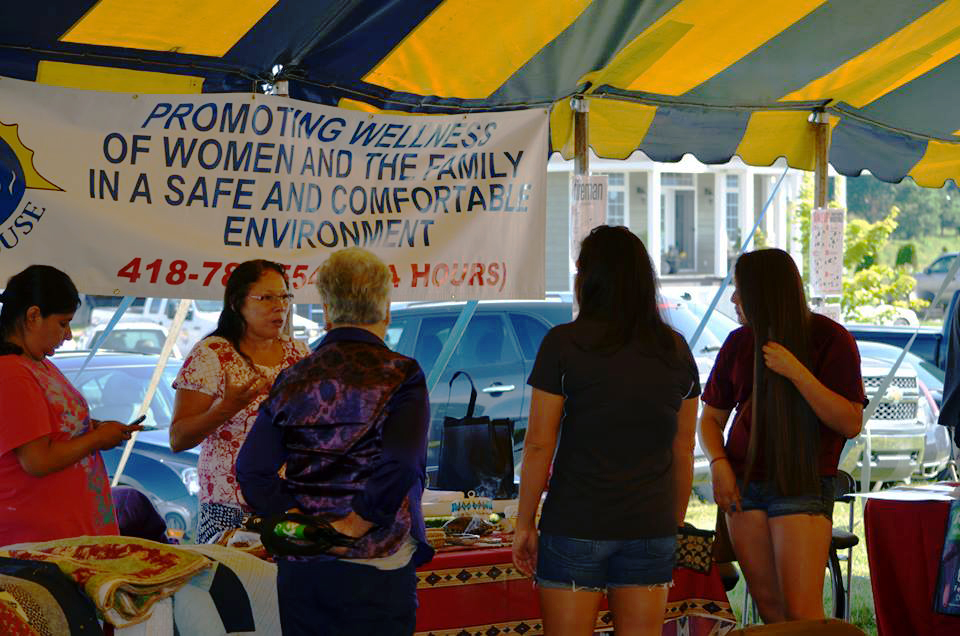
2015 Wellness Fair

The Wellness Fair started the year after the Pow Wow, and it’s now held the Friday of Pow Wow weekends. This is its 22nd year in a row.

150 people estimated to attend – that’s the amount of shirts they buy. And they know it’s growing.

It all starts with a march from subway to the tent, where there are presentations, and then kiosks from various local organizations open up.

“We have a vast amount of resources in our community,” said Sheila Swasson. “And this is their opportunity to  showcase what they do.” 

The fair is hosted by Haven House, which has a mandate that includes creating awareness for family violence prevention.

The keynote speaker is Tuma Young, from Cape Breton University.

“I think he’s focusing on technology, and the impact that it’s having on culture,” said Swasson.

Dominque Loyer, a Naturopath originally from Listuguj will be presenting.  Families First and the Anti-Racism Strategy will also be giving presentations.

Swasson feels the fair is appropriately named – it’s all aimed at “wellness.”

“Every aspect of it,” Swasson said. “And it’s a personal thing … I always think of it [as] a journey.

It’s not a destination, so it’s something that you’re continually working at, and we’re all at different places along that way.”

Swasson hopes people will find something to improve their wellness, in any  way.

“Take what you need, if you don’t need it – leave it behind.”

Windfarm Groundbreaking

The official groundbreaking ceremony at the Mesgi’g Ugju’s’n Wind Farm was on June 22. Nearby Chiefs and councils were in attendance, along with members of Innergex Renewable Energy, nearby mayors and MLAs, the Assembly of First Nations Regional Chief Ghislain Picard, elders, and the Quebec Minister of Aboriginal Affairs Geoffrey Kelley.

“We did it in an aboriginal way,” said Troy Jerome, the Executive Director of the Mi’gmawei Mawiomi Secretariat. “We wanted to make sure the Mi’gmaq were incorporated into it. We had a group of young drummers sing the honor song.”

Jerome reported between 150 and 200 people in attendance, with shuttles bringing people from Listuguj, Gesgapegiag, and Gespeg to the site in the Avignon Regional County Municipality.

There were lots of reasons to celebrate.

Technically, it’s the symbolic start of construction. The land has already been cleared, and 28 Mi’gmaq workers are already there daily. But construction of the actual towers are just about to begin.

By the end of the season, 47 bases will be constructed.

“We have to put about 40-50 cement trucks in each of those bases, full of cement,” said Jerome.

The plan is to also burying cables this year. Next year the towers will be erected, and turbines will be installed.

This year also marks the completion of training – a major priority for the team.

“Our guys are recognized to work in Quebec now,” said Jerome.

The Commission de la Construction du Québec prevented many Mi’gmaq works from working in the province, even if they were experienced.

“By the partnership with them, we’ve managed to get people to take the exams, and when they go and write the exams, they’re passing,” said Jerome. “They’re already experienced, they just didn’t have the certification in Quebec. Now they’re certified.”

Jerome said the lists have already been made for the different trades during the construction phase, and more people will be hired as time goes on. However, there is still some training for young people who wish to be involved with the maintenance of the windmills for the next 20 years.

Jerome is careful not to credit luck – because a lot of hard work has been put in – but a lot of elements of the project are lining up nicely.

“Things are coming along – the right time at the right place, good relationship with the region, with the government on this particular project,” said Jerome.

The next major milestone for the project will be September 2016, when the blades start spinning, and the two-month testing period begins. By December 2016, everything should be operational and feeding electricity to the main grid – enough to power 27,000 homes.

In the meantime however, there is a big job – finding consensus on how the profits will be distributed.

“The first thing we want to do is put a time line on the table,” said Jerome.

A consensus building team is being put together to work with the communities. The goal is to come up with a plan, spend three months making sure all the community members are aware, and then sign off – all before any profits are generated.

The process will begin right after the summer elections in Gesgapegiag, and Gespeg – both of which will result in governments serving four year terms.

Welfare Suspension Resolved

Chief Scott Martin sent an open letter to the Department of Social Development of N.B over potential suspension of “welfare” payments to registered band members who receive Per Capita Distribution payments from the Settlement Agreement.

The matter is expected to be resolved.

In his letter, Martin clearly that withholding benefits is illegal.

Specifically citing Article 2 (2.4 and 2.5) of the Settlement Agreement, which states that no funds paid to Listuguj members “shall be factored into or considered in any negative manner in the determination of any amount of funding for any programs  or services of Canada.”

Martin said that any attempts to withhold “welfare” payments due to PCD payments will be challenged legally.

Valerie Kilfoil, the Communications Director with the New Brunswick Department of Social Development said on July 8 that the department was in touch, and the matter would be resolved. A letter confirming this was still in transit at that time.

It is unclear if similar actions will be required with other provinces.

Graduation – Honors and Awards

Nadia Wysote – 2015 Role Model of the Year

Chief’s Message (July 9)

Things are finally starting to slow down a little around the LMG.

“I’m happy with the process which was done with the settlement agreement,” said Chief Scott Martin.

The bulk oif PCD payments have been processed so far, and LMG staff are able to start focusing on other matters.

Martin also said he’s happy to see some of the decisions being made within the community.

“The community spent the money wisely by investing some and buying things they needed,” he said.

Martin also wanted to congratulate all the recent grads once again.

Next up – the Wellness Fair, St. Annes Day, and the Pow Wow.