
VIDEO: Don Burnstick
While in Listuguj, Don Burnstick sat down with Nujignua’tegeg’s Tyler Morrison to talk about his career and the power of comedy.

While in Listuguj, Don Burnstick sat down with Nujignua’tegeg’s Tyler Morrison to talk about his career and the power of comedy.

It may have been too dangerous to visit the windfarm, because of a snow storm, but the celebration went on anyway.
It had been set for years – December 1st, 2016 was the day to commemorate all the work that went into making the Mesgi’g Ugju’s’n Wind Farm a reality. It is now running at full capacity.
It is projected to bring in $200 million over 20 years for the Mi’gmaq.
The day also marked Troy Jerome’s resignation from the Mesgi’g Ugju’s’n Wind Farm Board. He jokes that he’s going out on a high note, like George Costanza on Seinfeld.
“I put myself into that project – my life – for eight years,” he said. “It was part of my life – too much a part of my life, I would say maybe – and it was nice to be able to go to the Chiefs and say thank you, and release me.”
He officially stepped down as of 8 p.m on December 1st. In his mind, it was the appropriate time to do so. With the farm transitioning entirely into the day-to-day operations and management, his expertise are no longer needed.
“When you look back to what we set out to do in the early days, you look at our project plan … it’s kind of bizarre that what we set out to do is practically what happened,” he said. “It doesn’t happen too often.”
Jerome also stepped down as Executive Director of the Mi’gmawie Mawiomi Secretariat (MMS) in July. Like Jerome, the MMS – with the windfarm and agreements now in place – has little to do with the farm going forward. As the new Executive Director, Tanya Barnaby, describes it, the MMS is a political and administrative entity, taking direction from the Mi’gmawie Mawiomi. It’s goal was to generate own-source revenue for the Mi’gmaq, not necessarily be in the windfarm business.
“In that sense, it could have been a windfarm, it could have been a lollipop factory, it wouldn’t have mattered,” she said. “We needed to create revenue in our communities to begin to take over the management and governance of our territory.”
It is all laid out in the Nm’tginen. Generating revenue is the first step in being able to fund things like education.
“When we say repatriating, it doesn’t mean kicking everyone off,” said Jerome, who has gone on to create Senti Aboriginal and Environmental Services. “It’s about us having jurisdiction on our lands, us accessing our resources, and us taking care of our children.”

When the shelter first opened in 1991, Sheila Swasson – the Director at the time – remembers the misconceptions.
A police officer once came to the shelter, with information about a woman at risk. He didn’t know if the shelter could do anything, because the woman hadn’t been physically assaulted yet.
“It just goes to show you that at that time, the issue of family violence was in existence, but yet, maybe the scope of it wasn’t fully understood,” she said.
Swasson, the manager of the shelter today, has worked at the shelter for 23 of its 25 years in existence.
“[The Police] didn’t look into when a woman is threatened, when she feels that her well being is threatened, or financial abuse, or emotional abuse, sexual assault – all these things,” she said. “I believe we’ve done a lot of work in that area, where we’ve increased that awareness, through education in our community.”
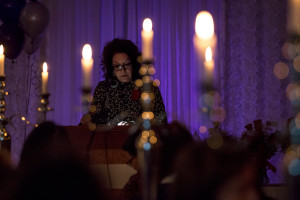
Victoria LaBillois speaking at the Haven House 25th Anniversary.
On December 6, the 25th anniversary of the Haven House was celebrated at the bingo hall. It was intended to be “something different.”
With the performance of a skit by Anita Olsen-Harper, a cabaret singer, and the honoring the council that helped bring Haven House into existence over two decades ago, the evening certainly went above and beyond. It was meant to pay tribute to the shelter, and everyone involved.
Over the years, the staff have had their share of emotional moments.
“There are moments that are difficult,” said Swasson. “But then there are moments that are at the other end of the spectrum – where we see the personal growth, and we also see the healing that [clients] overcome while here, or while working with us. Where they feel empowered to make a better life for themselves.”
Swasson sees many former clients out in the community, but one – who also attended the 25th anniversary – comes to her mind.
“When I see this woman in our community, and she’s doing so well, I’m just like ‘wow,’” Swasson said. “I would like to feel that we’ve contributed to that as well, in some small way we made a difference. “
Check out some of the original documents:


Don Burnstick uses humour and performance to provide a holistic approach to healing. He was invited to Listuguj for National Addictions Awareness Week, to talk about well-being, sobriety and anti-violence.
His opening statements were sobering. His history with violence, drugs and alcohol shaped who he is today.
“I remembered looking at myself in the mirror, you know, and I was living on the streets, I was dirty. I just had a fight that night before, I was beat up. I was really sick, physically, emotionally, spiritually – I was just sick,” he said.
When he started considering suicide, he changed. The exact opposite happened.
“The value of my life kind of came alive,” he said “I used to do whatever it took to get high, and to get drunk. I had to shift that energy, and do whatever it took to get sober.”
Shifting that energy is exactly what he has been doing for 20 years. He’s been using his talent to bring light to issues like missing and murdered indigenous women.
While in Listuguj, he shared his own struggles with substance abuse and family violence.
“My first year was just to get myself sober and maintain it. The second year it was about training, going back to school,” he said. “The third year I was told to go and train my voice because back then there was no young sober native males.”
Starting out Burnstick was often met with criticism. People would say, ‘You shouldn’t be talking about that stuff, not all of us are drunks.’ But he’s also found that talking about it in the open inspires others. He’s been told his words have saved lives. Even with his counselling background, he’s found comedy to be the best tool to help.
“Comedy comes from pain,” Burnstick said. “I’ve learned how to take some of these trying thing that happened to our people (and to me) put it on stage, and if people are willing to laugh about, their willing to talk about it.”

You may have noticed a giant electronic billboard in Listuguj recently. Hopefully you learned something from it as well.
On November 29, 2016 Listuguj had the new electronic message board installed, complements of Listuguj Community Social Services.
Over the past few years Listuguj Community Health Services (LCHS) has been working on getting the electronic message board. The idea had been pitched to Health Canada for years. It was finally able to move forward this year.
“I wanted the community to see all of the possible programs and activities that are being offered,” said Donna Metallic, the Director of the LCHS.
The message board is centrally located, in hopes that everyone in the community will see it regularly. It will help keep people informed – 24 hours a day, seven days a week.
The idea isn’t entirely new.
“The first time I went to Mashteuiatsh up north they had a message board when you enter their community”, Metallic said.
Directly under a beautiful statue – a monument welcoming people to the community – there’s screen, with a feed of all the activities going on. It was only for one directorate. Metallic immediately recognized how useful it could be for Listuguj. For all of Listuguj.
“I thought, ‘This is beautiful.’ It’s a beautiful way to showcase the happenings in the community,” she said. “What better way than to display it on a board in the middle of the community.”
The sign came from Pattison Sign Group in Edmunston, New Brunswick. The sign was made in Edmunston, and delivered and installed, with the help of Mic Mac Electric.
Metallic used a similar sign in Kanehsatake. It was modified to showcase the LCHS logo.
“I wanted to be able to have that on the sign,” she said. “I also wanted to showcase that the Health Center is an accredited organization, and it was a lot of work with staff and accredition coordinator that put us on the accreditation path of quality services that we provide to the community.”
The sign adds another level of communication for the community.
“I would like to see each of the directors use that sign to promote their activities,” Metallic said. “I want it to be used as much as possible, so that when you’re driving by – at any given time – then you will know what is going on.”
The sign will start to generate revenue starting January 9, 2017 for any additional information please contact the LMG IT/Communications department at sign@listuguj.ca

 Formerly titled the Nujignua'tegeg - The Wi'gatign is a multi media community newsletter for Listuguj First Nation.
Find our printed issues within the community. We print once a month.