
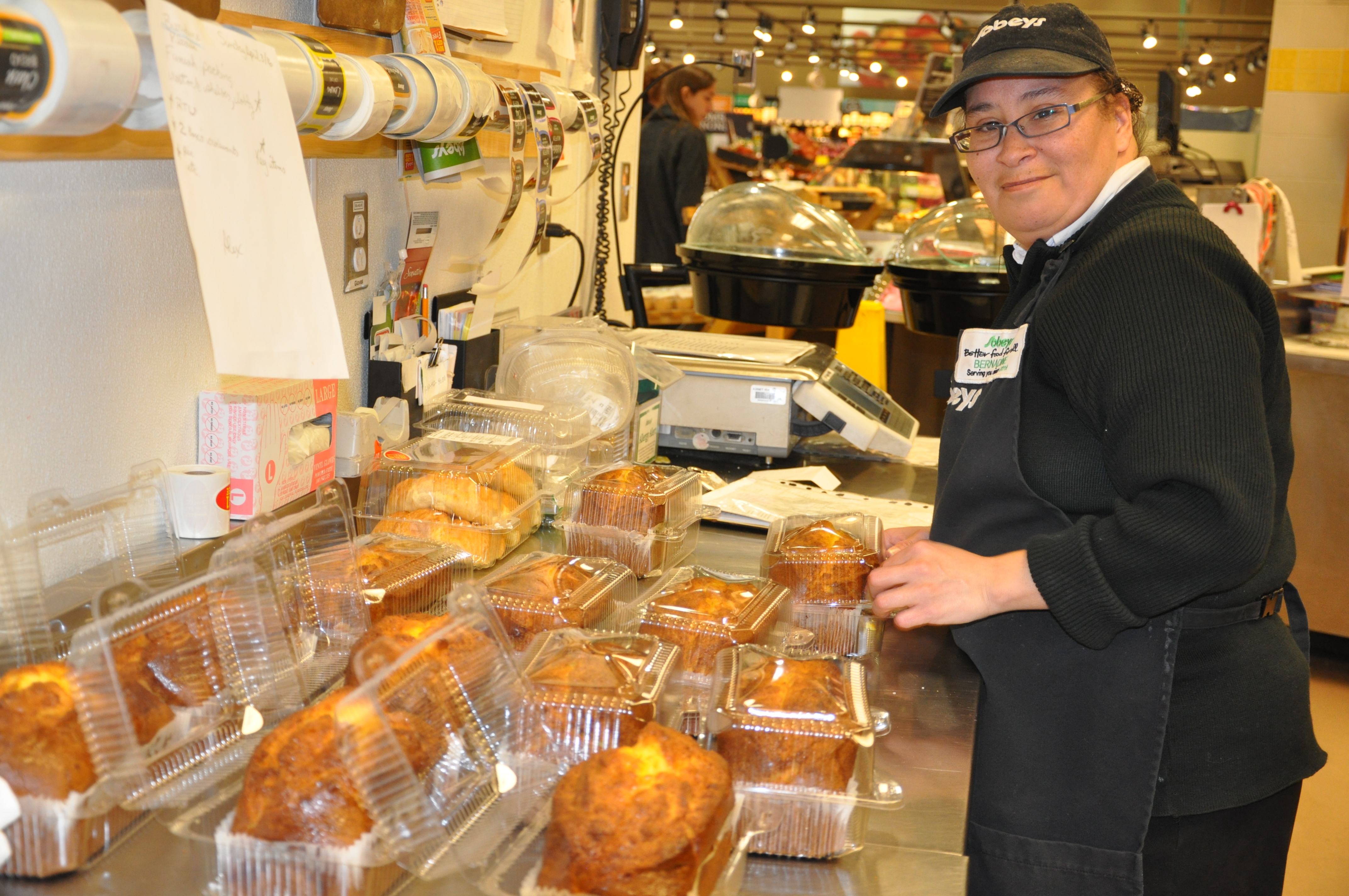
Shopping in Campbellton is business as usual until you go to the bakery section at Sobeys and get attended to by Bernadine Barnaby, a Mi’gmaq from Listuguj. Even if Listuguj injects millions of dollars into Campbellton’s economy, it’s rare to see a Mi’gmaq working in the retail services there. “It’s a piece of cake,” said Bernadine talking about her one-year experience at the Sobeys bakery.
However, Bernadine is one of very few people working in Campbellton. There are several factors that influence whether Mi’gmaq workers in the region are hired or not. Racism is one of them. The Listuguj Mi’gmaq Development Center, LMDC has initiated an Anti-racism campaign with the objective to create awareness on this issue.
“We did an initial survey and there was a percentage of people that said they were not victims of acts of racism”, said Lorna Sook, Executive Director of the LMDC. “But then you have further conversations with them, they will talk about various things like shopping or applying for jobs and it’s almost like they’ve gotten used to being treated differently. Some people seem to think it’s normal. They don’t necessary label different acts as racism.”

Mr Gilbert Cyr, SSHS Principal speaking at the Anti-Racism Symposium
That “different treatment” translates into self-doubt and it discourages some people to apply for job openings. These combined prejudiced beliefs about work ethics and French language proficiency, as well as a wide-spread lack of respect for tax rights, are just some of the barriers that Listuguj workers still face.
In its 20 years of existence, the LMDC has worked to bring down barriers that prevent people being hired in or outside of Listuguj. “We have the SIPU program that helped people with multiple barriers and we guided them through that and brought them to work placement and some people are actually still working” affirms Lorna Sook. This is the program that helped Bernadine in preparing for her job. For a few years she worked in seasonal jobs until she decided to challenge herself. Her first step was to go to the LMDC and enrolled in the SIPU training Program.
Mother of two teens, Bernadine praises the program that helped her to get a permanent job. “I’m proud of myself and my family is proud of me” she declares.
“Bernadine loves her work placement, the people there are absolutely fantastic. They treat her with respect. There are places in Campbellton that will hire our people and Sobeys is one of them”, states Lorna Sook, who saw many people go through the LMDC’s program in 20 years. Many are now working in different jobs in the community and some in Campbellton.
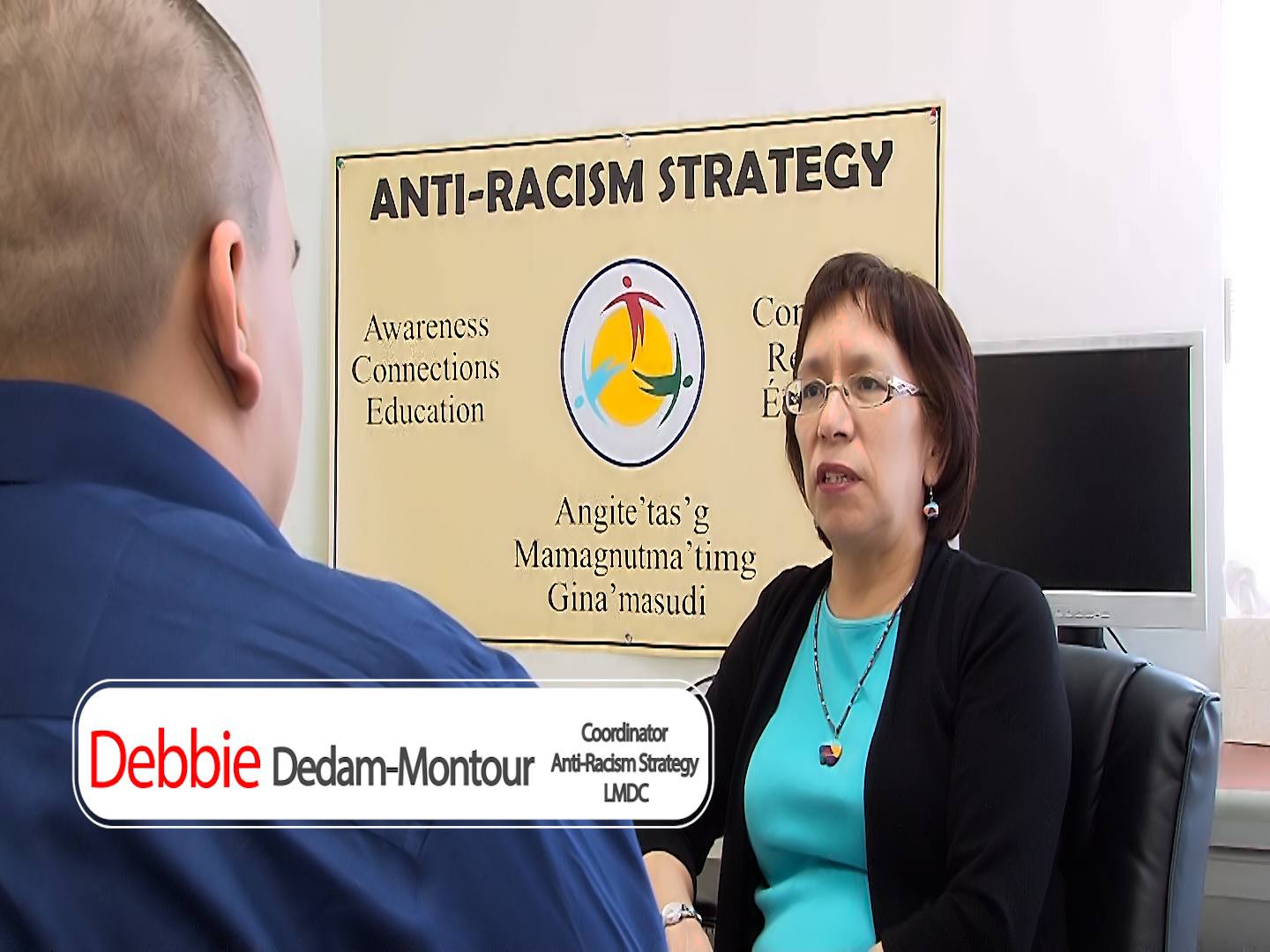
But she would like more opportunities in the surrounding areas. It’s one step at the time. A recent Anti-racism Symposium held in Listuguj was attended by general public and students from Listuguj and Cross-Point schools was another step in dealing with this sensitive issue at a community level. For Debbie Dedam-Montour, coordinator of the Anti-Racism Symposium “the event was successful with great community and youth participation.”
These youth are the ones that will be looking for jobs in the future. If they look for a job in the Bakery at Sobeys, maybe Bernadine will be there to train them. Or if they go grocery shopping they may see her proud of her personal achievement in breaking the barriers that stop employment integration in Campbellton.
The employment demand in Listuguj is higher than the jobs available and neither the LMG or local businesses can offer a job to all Listuguj working-age members that in 2011 represented almost 1,400 people. The same year the Listuguj labor market was composed of approximately 30 businesses but more than 60% of employment was created by public services such as schools, social services, local government departmental programs and is the main employer.
On the other hand hiring and integrating Mi’gmaq workers into the regional labor market is good for business as the Mi’gmaq contribution to the regional economy continues to grow in importance.
People in Listuguj believe that their economic contribution should be reciprocated with job opportunities.

In an effort to promote Mi’gmaq stories — and to encourage the writing talent in the area — the Chiefs of the three communities represented by the Mi’gmawei Mawiomi Secretariat (MMS) created the Mi’gmaq Writer’s Award.
It officially started in 2008, with only one winner. Since then, the prize has been split in two — $500 for a “17 and under” winner, and $1,500 for a “18 and older” winner.
“[The Chiefs] want the knowledge of our culture to be preserved in the language, through stories,” said Juliette Barnaby, the Office Manager at the MMS.
Submissions are judged with simple criteria in mind. First of all, a story has to be written well. Writers have to be recognized band members. And the big question judges ask is, what’s the relevance? “[The goal] is to capture relevant Mi’gmaq content, such as tradition,” said Barnaby.
Barnaby used examples such as stories from elders, or traditional land use. But “relevant Mi’gmaq content” is open to interpretation. A story about a community member living in a major city elsewhere in the world could easily win. “To me that would be a fabulous story,” Barnaby said. “To explain to somebody who lives on a reserve, the struggles of people that live off reserve.”
Barnaby said the submissions over the years have been great. “I don’t know if I would say there’s one that would stick out, in particular,” she said. “Because … obviously they’re very very good, because they won.
Submissions for 2015-2016 are due April 29.
As a past recipient of the Mi’gmaq Writers Award, I feel as though that opportunity gave me the confidence to make my writing public and to share it with my Mi’gmaq brothers and sisters. It had reawakened the creative writing flame inside me, and since then I have been inspired to create and write more, specifically spoken word poetry and short stories. I have since also given myself a goal of writing a novel in the next few years. Story is powerful, and it’s up to us, as Mi’gmaq people, to tell ours.
When writing I am able to express the things I’ve always wanted to say and to have discussions that do not always occur naturally. The Mi’gmaq Writer’s Award gives Mi’gmaq young and old the opportunity to do that as well. My own piece “White Feather Speaks” allowed me to share my feelings and findings with my community on the seldom spoken topic of the Two-Spirit. This award carries on the long practiced tradition of story telling and allows us all to grow through the words and experiences of our people.


The healing power of plants are still available for those who need them and know how to use them. That was in essence the spirit of the workshop held in Listuguj on March 21 and 22. Elders Joe and Judy Googoo from Wagmatcook, Mi’gmaqi Unama’gi District, (N.S) and Doreen Bernard from Shubenacadie, Mi’gmaqi Signepgnegatig District, (N.S.) were sharing their knowledge of the plants -knowledge of thousands of years old.
The workshop’s focus is to bring back the use of traditional medicine, a practice that is endangered. Many of the herbs the Elders presented are available within the surrounding areas and could be processed into infusions (tea), decoctions and healing salves.
The two-days workshop was organized by the Listuguj Families First Services and attended by around 25 peoples interested in learning about traditional use of the minerals and herbs the land provides.
Derek Barnaby, a guest speaker on the second day of workshops, spoke of his experience with medicines and what his driving force was. The workshops finished with a Water Ceremony at lake Gospem on March 22.
The attendance of community and non-community members was exceptional and many said that they feel there needs to be more workshops like this. The Elders showed their interest to come back when the weather is permissible to let attendees to join along to gather medicines.


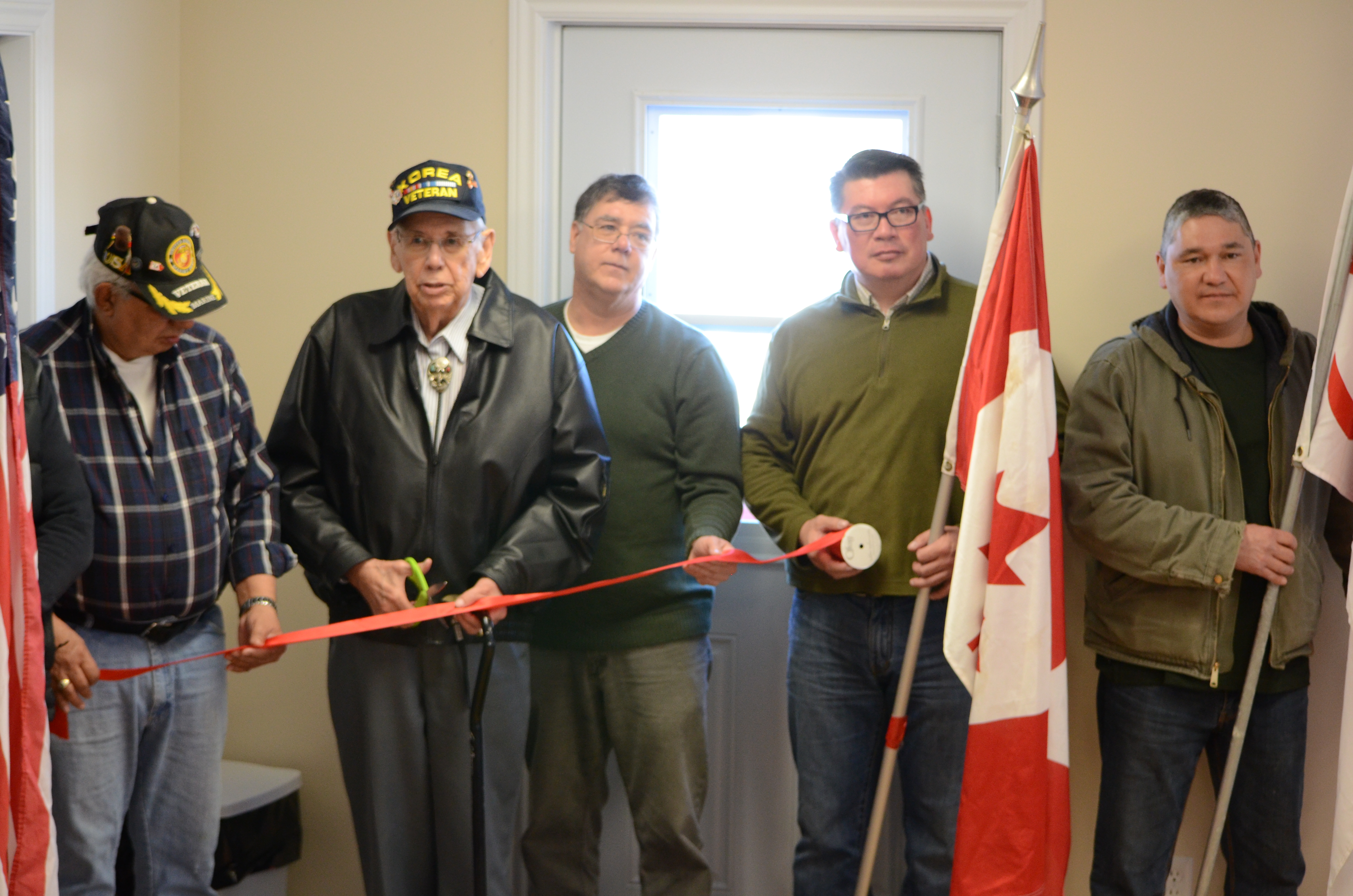
Dean Martin made a point to cut new keys before the event.
When the semi-grand opening of the Veteran’s Lodge was held on March 24, 2016, Martin went around and gave all the veterans a key of their own. “Here’s the key to the building,” he said to them. “This is our building.”
Martin is the On-site Housing Construction Coordinator for the LMG, and has also served in the American Military. “They were happy,” he said later. “Like ecstatic, relieved.”
Over the years, veterans in the community have had to find other places to meet. The locations weren’t always ideal – especially for some of the older veterans. Now, they no longer have to wait for someone to unlock the doors, so they can sit down together. They can meet whenever they want, even just to hang out and share stories.
The building itself is finished, so now it’s on to the next step – making the place feel like home.
People are already planning the mementos they want to bring in. Some have likely been imagining the inside for years.
In 2013, the plan was made to create a space for the community’s veterans.
Through donations, volunteer time – namely Adrian Barnaby and Dale Vicaire – and labour from the LMG during down time, the Veteran’s Lodge was built with barely any money.
It may have taken a little longer to build than planned, but now it truly belongs to the community.
“There’s no mortgage on it,” Martin said. “It’s done, it’s paid for, it’s ours.”

 Formerly titled the Nujignua'tegeg - The Wi'gatign is a multi media community newsletter for Listuguj First Nation.
Find our printed issues within the community. We print once a month.