Another Act of Resistance

When representatives of the Listuguj Mi’gmaq Government and the Government of Quebec were talking on the phone, Listuguj loggers were already on the highway 132, ready to defend the exercising of Mi’gmaq rights.

The day before, Quebec had declared the wood harvested by the loggers  “illegal” and closed the market for these logs.  The GDS mill, the first main buyers, was instructed not to buy these logs because no stumpage fees were paid for them.

Listuguj loggers have access to 40,000 cubic feet of forest to cut.  This includes the 15,000, cubic feet from a previous agreement with a provision exempting stumpage fees.  Not really exempted but paid by Quebec itself.  Now, Quebec wants Listuguj loggers to pay the stumpage fees on the other 25,000 cubic feet.

As the meeting started, the politeness faded and strong positions were taken on both sides. Quebec insisted on the payment, and Listuguj defended its Aboriginal right.

Chief Darcy Gray firmly expressed that “it’s not an option. We honor our people and we affirm that this is our territory and natural resources, and you stand in our way. Mi’gmaq people won’t pay taxes to access the resources of its territory.”

Geoffrey Kelly, Minister for Aboriginal Affairs insisted on payment before opening the market to Listuguj loggers.
“For most of the loggers, it’s their only income” said Alexander “Popoff” Morrison, the elected representative of the loggers.  His working crew includes four individuals that support families of three or more.  There are around 64 people working in the logging operations, and they and their families are all impacted by the outcome of the meeting.

As the meeting progressed, Chief, Councillors, the Director of Natural Resources and the logger’s representatives discussed the condition from Quebec — “Pay stumpage fees and we will open the market.”  The meeting was suspended for 20 minutes to deliberate, and when communication was reestablished, Listuguj response was unanimous in a diplomatic tone and very spirited tone from Councillor Wendell Metallic  — “This is Mi’gmaq territory and we don’t pay no fees for our natural resources.”

Quebec was also reminded about Mi’gmaq determination, and the many battles Listuguj has had to reaffirm and exercise its rights, including the 1998 blockade for the same issue.  Quebec requested a pause to the meeting.

Back at the highway, loggers and supporters were waiting and ready to block the road and stand up one more time.  But this time, Chief and Council were supporting the loggers.

The logging operations for the 40,000 cubic feet represents around six months of work, enough time to access the unemployment program for seasonal work.  These operations are mostly non-mechanical. Around 20 timber jacks, 40 guys with chainsaw and 25 guys hauling logs. Most of them went through the training provided by Listuguj Natural Resources and are certified chain saw operators, complying with security and safety regulations.

“In the past Quebec had issues with the security, safety, and harvesting practices.  In the last two years we have improved our standards to follow Quebec regulations”, said Listuguj Natural Resources Forestry Engineer Martin Cummings.
These concerns were resolved and the issue of  “paying stumpage fees as a condition to get a license was never raised in the past,” said Dr. Fred Metallic, Director of Listuguj Natural Resources.

Early in the meeting Minister Kelly insisted that these fees were necessary to cover the cost of fire safety, silviculture, and forestry management.  Listuguj pays between 15 to 20 thousand dollars for fire safety and they pay an engineer to manage the logging operations.

When Quebec called back after their deliberation, their tone was less adamant.  First the Minister insisted on improving the harvesting practices before announcing that Quebec would open the market.  Chief Gray agreed to open discussions, but insisted that any negotiation will be on the basis that this is Mi’gmaq unceded territory and no taxes of any form should be paid by Mi’gmaq loggers to Quebec to access natural resources.

After the meeting Chief Gray went to the highway 132 to tell the loggers about the outcome.  They celebrated, gave hoorays and high-fives.  Not long after the road was cleared, the flags were rolled back and they all went back to their families. Another battle in Mi’gmaq history.

For logger Morrison “we just bought time because the main issue was not resolved. However, I’m glad that the loggers are now consulted and supported” he said. For now, there are no further negotiations scheduled. The loggers are organizing a meeting before the Listuguj Pow-Wow.

In fact Quebec has one more time avoided talks about an important question according to Dr. Metallic.  “The Mi’gmaq tried to bring Quebec and Canada to the table to talk about the fundamental issue of land title.  We need to be able to decide and manage the sustainability of the forest not only for the Mi’gmaq but also for the Birds, the Moose, the Deer, medicinal plants, etc. It’s our home.”

Women’s voices of Migwite’tm

This year marks 35 years since the raids in 1981. But even after all this time, there are still “as many stories as there are people who fill this room,” as Victoria LaBillois said before the Salmon Feast at the Bingo Hall on June 11. This year – just like in 1981 – women of the community stood alongside the men.

Images of men standing up to Quebec Provincial Police are close in everyone’s mind, and stories of men from nearby nations coming to help are often retold with pride, but the fact that women came from other nations as well is mentioned less often. They also came to help.

Gail Metallic particularly remembers the Innu women – who came from the north shore to support the Mi’gmaq – who were “use to feeding big crowds, with very little.” She also remembers a little old lady. “My gosh — she just put everything in ship shape, and just started cooking,” Gail said.

When armed police officers blocked the bridge, a plan had already been made. Tensions were rising between the community and the Quebec Government. The Bingo Hall hadn’t been built yet, but the basement of the church was a central gathering place. When the church bells rang, everyone knew their roles. No one knew what would happen, but everyone still had to eat, and the kids still had to be taken care of. Coffee could even be found at all points.

Treena Metallic, Gail’s daughter, remembers the atmosphere and some specific events. But what she definitely remembers her mother’s reactions.

“Her anger sort of gave me pause,” Treena said.

An understanding of injustice immediately gripped the entire community. Gail was visibly angry, and not afraid to show it — to her kids, or the SQ, as she drove passed them. For Treena, this set a clear example.

“I wasn’t allowed to feel ashamed,” Treena said. “That mad was empowering … she might have been scared, but I didn’t see it. I just saw this tough chick.”

To this day Gail doesn’t doubt the appropriate reaction. Neither does the rest of the community, or the generations growing up.

“As a human, you have a choice,” Gail said. “But to do what [they] did to our people. That wasn’t acceptable.”

Fortunately, in 1981, very few even had time to doubt their reaction. As support continued to come in, everyone felt more empowered. And the actions taken by everyone at that time continue to set an example.

“It awakened a lot in us, that’s for sure,” Gail said. “We almost have to say, in a way – thank you. Because it awakened who we were.”

“It really galvanized, and it really defined who we are as a community,” said newly elect Chief, Darcy Gray, on Saturday morning at the Listuguj Wharf, with the dozens of others who gathered before the Peace Walk to the the Bingo Hall, the Salmon Feast and the inauguration of the newly elected Chief and Council. He stood in front of a line of docked fishing boats.

Mi’gwite’tm

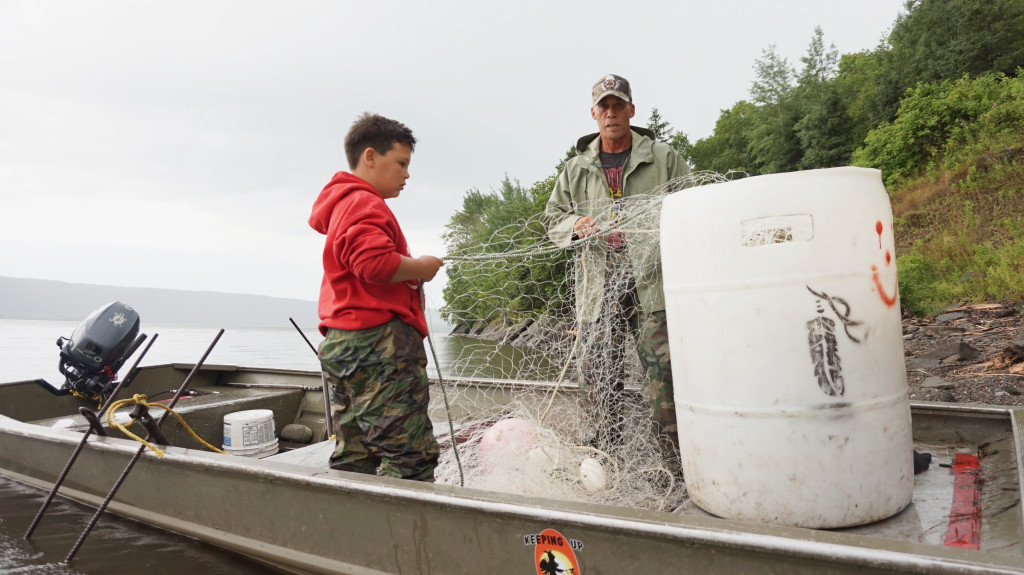
On his first fishing day, Christopher Wilmot caught one salmon. He picked up his net and then continued his day, fishing for lobster in the Miguasha area. “As a kid I learnt to fish with my father” he said. During the fishing season Christopher will repeat his routine without fear of losing his boat, his net or being charged for fishing illegally. Christopher, born in 1989, belongs to a new generation of fishermen, but he knows about the QPP and DFO raid in Listuguj.

Many people in Listuguj remember the raids. “They came three times,” recalls Rene “Cool” Martin. “The first time they came to order late Chief Alphonse Metallic – to stop us from fishing. The second time around 500 police came in, together with DFO, helicopters and boats to take our fishing gear.” The third time, Rene was driving in the community near 5 a.m. He saw the police squad on the bridge. “I blew the horn to wake up people. We organized and we drove them out.”

During these confrontations people were beaten, arrested, and equipment was destroyed or taken away. Rene was handcuffed and taken to New Carlisle’s jail with other Mi’gmaq. One of the charges was to resist authority. In fact, Rene and Listuguj resisted and Christopher Wilmot is grateful. “If nobody stood up we would not have this opportunity to fish today,” Wilmot said.

Resistance is nothing new to Indigenous Peoples and the Mi’gmaq were defending their Aboriginal rights against the diktat of Quebec government. “I remember when I was a kid, non-natives used to come to Listuguj to sell us salmon because we were not allowed to fish. So we had to buy. When we did the same – selling salmon to non-natives – the government didn’t like it.” affirms Gordon Isaac Sr. “There was a time when there were traps from Listuguj to near Maria, on both sides of the Bay. Natives and non-natives had traps, but when the government stopped the commercialization of fish, we continued fishing.”

It was during these times that Quebec set restrictive measures to dissuade Mi’gmaq from fishing. “We were fishing at night and Mi’gwite’tm nobody could smoke because the light of the cigarette would indicate our position to wardens patrolling the river and they would shoot bullets at us and come to destroy our nets” recalls Gordon who was charged 14 times for illegal fishing, fishing with a net, and fishing at night. “I beat all these charges because they don’t have the proof that I don’t have the right” he said proudly. These acts of resistance were strengthening in an unsuspected way. With unemployment rates high many people had to work in the USA often as ironworkers building skyscrapers and bridges. “We saw there how native people were fighting for their rights too and we got information, motivated and politicized” affirms Gordon.

In fact the 60’s and 70’s, the years preceding the raid, North America was witnessing the emergence of the “Red Power”, the militancy for Indigenous rights. When Listuguj was attacked, Native people from different nations showed support and even made the trip here. “ They give us confidence to fight, to resist, to put barricades and to be prepared” said Gordon.

“The lesson I learn from the raid of 1981 is to keep fishing, keep resisting because we have the right to fish,” said Rene. In fact, the long years of denying Mi’gmaq Aboriginal rights or Treaty Rights were challenged successfully many times at different levels in provincial, Canadian and international justice systems. In 1999, the Supreme Court’s Marshall decision recognized the traditional role of fishing in Mi’gmaq culture, and a right to sustain as well as earn a moderate living.

Today Listuguj manages a community owned fleet of fishing vessels creating jobs for natives and non-natives in the industry and generating millions in revenues.

“Two things happens since 1981” said Dr. Fred Metallic, Listuguj Natural Resources Director. “We strengthened our cultural revitalization and we got the recognitions of our political rights. Canada can’t discretionary interpret Indigenous rights and it can’t trample our rights without being accountable. Today we manage 10-12 vessels, with millions of pounds of fish allocations. We have in place a Rangers Program to prevent exploitation or outside interference.”

Nowadays, the Restigouche River is known as one of the bestmanaged salmon rivers in the country and agreements signed with Quebec are based on the Listuguj fisherman Management Plan. Elder Gordon Isaac adds, “Now we have our own Laws and our own wardens. Now we negotiate and sign agreements with governments, and they don’t dictate to us anymore. Now we can fish peacefully without feeling illegal and with no worries about what is going to happen to us, or to our equipment.”

Gordon doesn’t fish anymore. Today he stops at the wharf and talks to the fisherman. “Some of them keep the spirit of sharing and they give me a few salmon for my winter,” he said.

Rene Martin canoe 1

Native spirituality gaining interest in Mi’gmaqi

Driving around Listuguj (Busteed area) last week you could see a group of volunteers working the tipi poles, bringing firewood and preparing the site for the four-day ceremonies organized by Families First Support Services.

“We have many programs, and over the years many people asked us to do workshops about traditions, ceremonies, traditional medicine and teachings,” said Christine Metallic, Community and Cultural Support Coordinator for the FFSS.The ceremonies we are preparing now is to respond to these needs.”

Among the ceremonies there is the Sweat Lodge, a purification ceremony where participants enter a dome shaped lodge constructed of willow and covered with material to provide a semi-tight enclosure and complete darkness. The Lodge represents the mother’s womb.

When the ceremony starts the Elder pours water on the heated rocks (Grand Fathers) and participants pray for themselves, their families, their communities, they chant and take turns to speak. The duration of this ceremony varies depending of the number of participants, the Elder who leads it, and the reason for the Ceremony.

Taking part in this sacred ceremony has different impacts on different people.  Those participating for the first time usually feel a resurgence of strength and connection with their identity, and for some it’s the beginning of a journey of healing.

“Sweat Lodge is a sacred place where your whole body gets cleansed and what you feel inside is incredible” said Frank Augustine an Elder from Elsipogtog who came to Listuguj to lead the ceremonies with his wife Josie. “There are things you may see, and you may receive teaching because there are spirits there to help you if you care to listen.”

Elders Frank and Josie Augustine from Elsipogtog

Elders Frank and Josie Augustine from Elsipogtog

Elders Frank and Josie, married for over 50 years, travel across Canada and Mi’gmaqi carrying these teaching. Frank was around 40 years old when he decided to take the spiritual journey that changed his life for the better.

“We see people following traditional teachings and Native spirituality and we see how their lives had changed” says Christine Metallic, whose experience as a community worker in different communities. “Looking at non-native ways, methods of healing like therapist, meditation, Tai Chi or Reiki are not the only solutions. We need something that works for you, and native spirituality reach us deep and at different levels.”

Following Native spirituality is all about faith. All religions of the world have their ceremonies and protocols that guide social behaviors, practices, determine sacred places, and provide the worldview with teaching about human’s relationship with the world around, above and below.

If in the past the practice of Indigenous spirituality were forbidden, outlawed and associated to devils or superstitious, nowadays there is a certain acceptance.  In Mi’gmaqi, and across Canada, interest has been growing.

“Twenty years ago there was a lot of hard work put into bringing back our teachings,” Josie said, while preparing the lodge for the ceremonies. “A lot of seeds were planted and now we see the seed popping up.”

“I see more interest in Listuguj” said husband Frank. “When we used to visit there was a handful of people. Now we see more people. We see that there’s a thirst for our spirituality.”

There are some people who took part in native ceremonies here for the first time.

On Friday afternoon, at around 6 pm. Ala’suinu Barnaby, 11, ended his 24-hours fast while other men and women were continuing theirs. He decided to do his fast with support from his parents on site. “Ever since my auntie Tanya did her four-day fast a few years ago I’ve been wanting to do it as well,” he said. “I also did it because I just lost my uncle Henry (Vicaire) and I did it for him. I did a lot of praying in the Sweat Lodge before I went into my fast. I felt successful, I felt good and proud of myself. It wasn’t easy but I learned a lesson: patience. I think anyone who has a chance should do this ceremony.”

Maybe at the Listuguj Pow Wow this year we will see more Sweat Lodges and we may see again the Sacred fire lit for all those who want to pray for their families, for themselves, and the communities.  After all it’s about belief and traditions that are now available in Listuguj and in neighboring Mi’gmaq communities.

Listuguj mourns death of Chief of Police Henry Vicaire

Listuguj Chief of Police Henry “Hank” Vicaire was rushed to the Campbellton Regional Hospital on Friday the 13th under emergency circumstances, but was unable to recover.  He passed away several hours later.  He was 50.

On May 18, at around 10.30 a.m.. various delegations of Police, SQ, RCMP, Firemen, Ambulance technicians from around Listuguj, and a representatives of Henry’s Bike Club, gathered in front of his house. A solemn march to St. Anne’s church followed, where political banners were covered and painted with the number 21, in respect to the badge of the Chief of Police.

The Church was packed and the mass started with the Spirit Bear singers chanting the Mi’gmaq Honor song.  Native and non-natives families and friends of  Henry “Hank” Vicaire gathered to pay respect to a person that the eulogies described as a humorous, sensitive, respectful and a talented human being.

Henry Vicaire was born in Campbellton, N.B. in 1965. He attended the Justice Institute of British Columbia (JIBC) where he earned his policing certification in 1994. He served as a Listuguj K-9 officer from 2002 to 2010 with detector dogs Echo and then Bonzai.  He became Listuguj Chief of Police in 2012.

Chief of Police Vicaire had a varied background before becoming Chief of Police.  He was a woodsman, a carpenter and an ironworker.  Listuguj members know that Chief of Police Vicaire was a motorcycle enthusiast and loved to ride his Harley Davidson.

Henry was the son of Maggie Isaac and Henry Vicaire Sr., and a proud member of Listuguj First Nation. He leaves behind his wife Samantha and four children between the ages of 12 and 28.

Is the Indian Act against Indians?

Nujignua’tegeg met with Dr. Palmater. Here is an extract of the interview. The full interview will be available on our YouTube channel.

Nujignua’tegeg:  Have we – and if we did – when did we lose control of Membership Codes?

Pamela Palmater: Under the Indian act, all First Nations have had their Indian status registration of individuals and their band membership controlled by the Federal Government since the Indian act in 1876. But for tens of thousands of years long, pre-Indian Act, we were always in control of our own citizenship and what it was to be a Mi’gmaq, and who got to live in which of the Mi’gmagi districts. That was never controlled by the Federal Government so we have a long history of controlling our own citizenship, but that got interfered with by the Indian Act.

Nuji:  What is the Canada’s ideology in deciding who is or is not an Indian.

P.P: The whole purpose of the Indian Act in setting up a registration system was for the express purpose of eliminating Indians over time. They designed a formula, literally to breed Indians out of existence. Their two policy objectives are to take all of our lands and resources, but also to reduce any financial obligations that come out of Treaty commitments.  Canada associates Treaty beneficiaries with registered Indians and they figured the best way to get rid of Treaties: get rid of Indians, then they have no beneficiaries.

Nuji: What smallpox and contaminated blankets failed to do, eliminate us, do you think mathematics could do it?

P.P: That’s the thing. They only had two ways of trying to get rid of us. Physically eliminate us, scalping, sterilizations and smallpox blankets or assimilate us over time — residential schools, take away your language and culture, make you hate yourselves so that you don’t want to be a part of your community, and Indian status is the final nail in the coffin, essentially. It’s for all of those who managed to survive. The idea is to legislate them out of existence, and because of the Indian Act there is an extinction date for each First Nations where there will be no more status Indians. We will all still be here, we are the fastest baby-makers in Canada, our populations are growing, but for legal and political recognition and whether or not were allowed to identify with our communities, occupy territories have Aboriginal Treaty and Rights recognized…that will be significantly impacted by the Indian Act, if we let it continue.

Nuji: What actions are we taking now to prevent this.

P.P: There’s all of the provisions under the Indian Act that deal with status and registration there all under litigation so there each sections being challenged by a different group of individuals because of discrimination. A large number of First Nations are moving towards developing their own Membership Codes either inside the Indian Act or outside the of the Indian Act just based on their own inherent laws or through self government or similar mechanisms to take away government control and then the next step is to renegotiate the relationship based on who we say our members are.

Nuji: Why do you think it`s important to have theses conversations of membership and identity.

P.P: Because in the past the federal government interfered with our communal processes our traditional governments. Our governments were based on the will of the people. It was the people who put the leaders in place and told the leaders what to do and what not to do. We always worked towards consensus on things. Coming up with our own code is bringing it back to the people and letting the people decide, letting the people undo the harms that have been done, through colonization and the Indian Act and letting the people decide how can we go forward and heal our communities and our nation. It's critically important that we at least start having the conversations and based on whatever information, research and experiences other First Nations have had so we can learn from it.

Is racism a barrier to employment for Mi’gmaq?

Shopping in Campbellton is business as usual until you go to the bakery section at Sobeys and get attended to by Bernadine Barnaby, a Mi’gmaq from Listuguj. Even if Listuguj injects millions of dollars into Campbellton’s economy, it’s rare to see a Mi’gmaq working in the retail services there. “It’s a piece of cake,” said Bernadine talking about her one-year experience at the Sobeys bakery.

However, Bernadine is one of very few people working in Campbellton. There are several factors that influence whether Mi’gmaq workers in the region are hired or not. Racism is one of them. The Listuguj Mi’gmaq Development Center, LMDC has initiated an Anti-racism campaign with the objective to create awareness on this issue.

“We did an initial survey and there was a percentage of people that said they were not victims of acts of racism”, said Lorna Sook, Executive Director of the LMDC. “But then you have further conversations with them, they will talk about various things like shopping or applying for jobs and it’s almost like they’ve gotten used to being treated differently. Some people seem to think it’s normal. They don’t necessary label different acts as racism.”

Mr Gilbert Cyr, SSHS Principal speaking at the Anti-Racism Symposium

Mr Gilbert Cyr, SSHS Principal speaking at the Anti-Racism Symposium

That “different treatment” translates into self-doubt and it discourages some people to apply for job openings. These combined prejudiced beliefs about work ethics and French language proficiency, as well as a wide-spread lack of respect for tax rights, are just some of the barriers that Listuguj workers still face.

In its 20 years of existence, the LMDC has worked to bring down barriers that prevent people being hired in or outside of Listuguj. “We have the SIPU program that helped people with multiple barriers and we guided them through that and brought them to work placement and some people are actually still working” affirms Lorna Sook. This is the program that helped Bernadine in preparing for her job. For a few years she worked in seasonal jobs until she decided to challenge herself. Her first step was to go to the LMDC and enrolled in the SIPU training Program.

Mother of two teens, Bernadine praises the program that helped her to get a permanent job. “I’m proud of myself and my family is proud of me” she declares.

“Bernadine loves her work placement, the people there are absolutely fantastic. They treat her with respect. There are places in Campbellton that will hire our people and Sobeys is one of them”, states Lorna Sook, who saw many people go through the LMDC’s program in 20 years. Many are now working in different jobs in the community and some in Campbellton.

But she would like more opportunities in the surrounding areas. It’s one step at the time. A recent Anti-racism Symposium held in Listuguj was attended by general public and students from Listuguj and Cross-Point schools was another step in dealing with this sensitive issue at a community level. For Debbie Dedam-Montour, coordinator of the Anti-Racism Symposium “the event was successful with great community and youth participation.”

These youth are the ones that will be looking for jobs in the future. If they look for a job in the Bakery at Sobeys, maybe Bernadine will be there to train them. Or if they go grocery shopping they may see her proud of her personal achievement in breaking the barriers that stop employment integration in Campbellton.

Job integration is good for business

The employment demand in Listuguj is higher than the jobs available and neither the LMG or local businesses can offer a job to all Listuguj working-age members that in 2011 represented almost 1,400 people. The same year the Listuguj labor market was composed of approximately 30 businesses but more than 60% of employment was created by public services such as schools, social services, local government departmental programs and is the main employer.

On the other hand hiring and integrating Mi’gmaq workers into the regional labor market is good for business as the Mi’gmaq contribution to the regional economy continues to grow in importance.

People in Listuguj believe that their economic contribution should be reciprocated with job opportunities.

Winter Carnvial at AGS

AGS students got to take a break, even if it was too cold for the outdoor plans.

The Winter Carnival was held on March 3rd and 4th. And while the two days included activities like watching movies and playing basketball games, the events also had other benefits for the Elementary and Middle School kids.

Jean Isaac is one of the teachers responsible for organizing the events for the Middle School students.

“We wanted to challenge them,” she said.16-03 AGS Winter Carnival21

The students all began in their homerooms, and then moved to different classrooms, for 30 minutes at a time. Some of activities required math skills, or concentration. Others had benefits that weren’t quite so obvious.

The day was deliberately planned to encourage the students. They had to interact with some of the teachers they haven’t had classes with yet. For one game, they had to get in front of the group, even if they are a little shy.

Jean has found that smaller groups helps encourage the kids to interact. A little competitive edge helps too.

Jean supervised games of “Heads Up.” The game requires one student to hold a phone to his or her forehead. The group can see a word on the screen, and they have to act it out. The person holding the phone has to guess what the word is. Guys played against the girls for “bragging rights.”

“They were laughing, they were engaged. They were sharing, they’re helping each other, which you don’t see everyday,” Jean said.

Exploring Mi’gma’gi

For Sheila Swasson, finding a reason to get outside during the winters has made all the difference.

Swasson can often be seen encouraging people to join her on snowshoe treks behind her house, the former Busteed land.

“Sometimes there could just be me, or there could be anywhere between 2 to 15 of us on the trails,” Swasson said. “We can do anywhere between 2 kilometers to about 4 to 5 kilometers.”

Swasson has been heading out for the last few winters, but says it has become much more organized this year. She thinks it’s great.

The treks have been bringing her back to hidden childhood spots, like “grandmother’s field,” and the camp built by the late John Dedam, where a generator powered lights that could been seen from the highway every Christmas.

But for Swasson, being active in the winter is important for many reasons.

“Many years ago, I was suffering from seasonal depression,” she said. “The winter months seemed so long, so cold, so bleak. But now I pray for this — when it starts to snow, because I know the trails are going to get a good boost. We get to go outdoors and play in the snow, and you know, enjoy each other’s company.”

Swasson said some of the others have reported the same benefits from their winter exercise. She encourages everyone to try it.

“This is free. Just get your snowshoes and head out.”

LMDC Career Fair

Listuguj students had the opportunity to explore future plans on Feb. 24. The LMDC organized a career fair, and invited a mix of professionals to represent their fields. 

The hope was to create an event that was engaging.

“Not just to go around to the tables and pick up pamphlets,” said Bobbi Madahbee, the Re-Investment Manager with the Listuguj Education Directorate. “We wanted them to actually get interactive with them.”

NBCC had two simulators with joysticks set up. Students got to try their hand at running excavators.

“The young people are use to video games, but when they started on the simulator there was a little difficult at first,” said Constance Sewell, the Aboriginal Student Advisor for NBCC in Miramichi and Moncton. “So I could see a little frustration, but they did really well.”

A survey beforehand helped the organizers gage interests. They invited guests, and planned presentations accordingly. The second half of the visits were intended to directly address the students interests. Panelist spoke about Education and Business in one classroom, and Health and Law in another.

“We were really surprised at some of the outcomes,” said Madahbee. “A lot of the kids want to go into entrepreneurship.”

Other popular fields identified in the survey were graphic and video game design. Davinci College was present to explain some of their programs.

Fashion, and design were also identified as big interests. Whitney Dedam, from Listuguj, had a table. She works as a hair stylist in Moncton, and is now the only educator with Johnny B Hair Care in Canada. The training took her to Los Angeles.

And aside from trying to help students learn a bit more about careers they may be interested in, the organizers of the career fair also wanted to provide the opportunity to learn about other careers that may be in demand.

Representatives from the MMS offered information on careers needed for the Mesgi’g Ugju’s’n Wind Farm.

As much as the fair was for kids to learn more about what they were already interested in, it was also to help expose them to the many careers out there. Especially for those who don’t know what they want to do yet. 

“Not knowing – there’s no need to panic,” said Madahbee. “It’s just, don’t be scared to get out there and try things and take risks, and challenge yourself. I think that’s what we really want to get across to the kids.”

Mesgi’g Ugju’s’n Wind Farm

Terri Lynn Morrison and Natalia Caplin at the LMDC Career Fair speaking about the WindFarm.

Terri Lynn Morrison and Natalia Caplin at the LMDC Career Fair speaking about the WindFarm.

“When we first started working on the wind Farm, we were focused on the construction side of it. So now that we’re going to be in commercial operation December 1st, we’re now looking at the operations, the long-term opportunities for the next 20 years, and that’s why right now we’re dong a big push to have people go out to get certified as wind turbine servicetechnicians,” Terri Lynn Morrison.

Two students are in Maine right, and will have completed their program in June. They already have conditional offers of employment. But Morrison said there is room for at least two more, and potentially more than that.

“And in the area – we have partnerships with all the other developers now, they know us, we’re very well positioned in Gaspesie, so they are open to hiring Mi’gmaq Service Technicians,” she said. “So the opportunities are there for the long term. It’s careers, it’s not just a short term construction period.”

Whitney Dedam

Whiteny Dedam at the LMDC Career Fair on Feb. 24.

Whiteny Dedam at the LMDC Career Fair on Feb. 24.

“Learn the rules like a pro, so you can break them like an artist,” is one of Whitney Dedam’s favorite quotes.

“Once you know the basics, hey, it’s your own world,” she said.

Dedam moved to Moncton to become a hair stylist.

“I didn’t know anybody there. I didn’t know anybody at all, so I was scared. I moved up pretty much blind and by myself. And as soon as school startd you get to know people, it’s just a matter of putting yourself out there and just doing it.”

She is now the manager of the barber area of her shop, and is the only official brand ambassador for Johnny B hair care.

She even taught a her first class in February, at the same school she graduated from.

Dedam struggled, and says she still “lives like a student” sometimes, but she loves what she does, and believes there’s opportunities for anyone who wants it.

“You just have to learn how to – or know – and want to put yourself out there a little bit. It’s scary. Sometimes I’m still scared.”