
LOCAL BUSINESS OWNER SPOTLIGHT – LLOYD ALCON

Lloyd Alcon has had many impressive job titles under his belt, but now he’s focusing on his businesses. He is the owner of LCA Rentals and Outdoor Services, LCA Solutions Inc., and is the Chief Executive Officer/Part Owner of Initiative Concrete Inc.

Alcon says LCA Rentals and Outdoor services began in 2019 when he purchased a tractor and started doing small maintenance jobs in the area. Alcon always knew he’d like to do this kind of work eventually, but when COVID-19 hit, with the bridge being closed, these kinds of services became a big demand.  Alcon said, “We weren’t able to access certain services, and equipment rentals was one of them. I saw an opportunity and rolled with it.” Alcon continued to purchase more equipment and hired employees to work for his business. LCA Rentals and Outdoor Services is now a successful construction and landscaping equipment and machinery rental business.

LCA Rentals and Outdoor Services offer a wide variety of services such as construction equipment and machinery rentals, land maintenance, new driveways, larger landscaping projects such as retaining walls and drainage, and much more. The company has completed many projects in the area like various renovations and new house excavations.  One thing Alcon highlighted is how proud he is to be able to give back to the community of Listuguj. He said, “We’re able to donate a lot back to the community. I have the equipment, so if somebody needs something within the community and it’s not a big project, I can give it to them.”  One particular project done by LCA Rentals and Outdoor Services is the community garden.

After this business was underway, Alcon partnered with Grant-Mann Solid Concrete Ent. and started his most recent business, Initiative Concrete Inc. which is a ready-mix concrete company – the two companies complement each other and continue to do so.

Since 2017, Alcon also owns LCA Solutions Inc. which is a private consulting firm that specializes in public security.

Alcon says that he would eventually like to expand his businesses and hire more full-time employees. He is currently working on getting his contractor’s license and getting certified in Quebec to work off the reserve. Alcon laughed and said, “This is still pretty new to me, and I don’t think I’ll be starting any new businesses any time soon.”

By Ann Marie Jacques

GIVING CHILDREN A HEAD START SINCE 2001

Listuguj celebrates and offers many programs for the youth in the community.  One of these programs is Head Start.

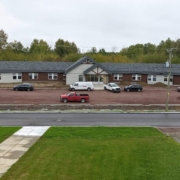
Head Start began back in 2001.  It was initially held in what is currently the Haven House building. It eventually moved to the Education Complex until a new building became available specifically for the program in 2017.

Head Start features an early childhood learning curriculum and is a program for children ages three to four in the community. The staff at Head Start consists of General Manager, Tina Martin, and early childhood educators Valery Jacques-Larocque and Mallory Larocque. Here children will learn and participate in several programs with various workstations, such as story time, yoga, fine motor skills activities, outdoor play and even learning Mi’gmaq.  The children learn how to maintain structure and routine, how to become independent and interact with other children in the community.  Head Start consists of two groups – mornings and afternoons, and each group runs on weekdays for two hours. This type of program will also help prepare them for going to school in the future.

The program is a key point in helping to determine any learning disabilities and ensure children receive the type of assistance they need. Tina Martin said, “If we see any kind of a developmental delay, we’ll be able to have them screened with the permission of parents, we can either get a speech pathologist or an occupational therapist, we can also go through Jordan’s Principle.”

When asked what their favourite thing about working at Head Start is, Martin said, “Watching these children learn and play, and then seeing them graduate from high school.”

Valery Jacques-Larocque simply said, “Watching them grow.”

Head Start has kicked off again this month, and the staff is eager to take part in the children’s education journeys!

By Ann Marie Jacques

Elawsimgewei Gina’muo’guom – Encourage, Empower, Educate

The Elawsimgewei Gina’muo’guom isn’t just your typical education institution when it comes to adult learning, it’s a safe haven and a place for students to learn about themselves and grow as individuals. As the name loosely translates, it’s a place where lifelong learning occurs.

Bella Moffat is the Academic and Guidance Counsellor and Co-Manager of this First Nation Regional Adult Education Centre right here in our community. Moffat is the first person potential adult learners meet with to discuss the next step in their education journey. “My goal is to identify the individual’s career goal or what the goals are, and it’s whatever is in the best interest of the adult learner,” said Moffat. Once the staff can establish the individual’s goal, then they can work together to determine the best path to take for success. The staff recognizes that many of these individuals are in different stages of their lives, and once they make that first step to further their education, the staff will guide them the rest of the way.

There are various programs offered at the Elawsimgewei Gina’muo’guom such as high school diploma, general development test (GDT), academic upgrading, and more. The staff at the centre understand that each adult learner is different, which is why they offer a different approach when it comes to teaching. The style of courses is switched up to keep things interesting for the adult learners. “We try to base our courses on the needs of the adult learners,” Moffat said. The courses are a mix of self-paced learning, land-based learning, Mi’gmaq learning, and theory, but also feature a lot of hands-on learning activities such as horticulture and cooking classes.

The atmosphere is very laid back and welcoming. The centre takes pride in its relationships gained with the adult learners. Each person is treated in a mature, respectful manner and their comfort is the number one priority. Moffat said she wants the adult learners to feel loved and respected when they come through the door. The staff are very eager to support and guide the adult learners throughout this stage of their life.

In addition to the relaxed, self-paced teaching structure, the centre offers various incentives and fundraising for activities, events and holidays. The centre offers transportation to the adult learners, breakfast and lunch programs, and even weekly self-care activities in the building.

The Elawsimgewei Gina’muo’guom consists of a staff of eight, and the programs are run from September to June. To find out more information on the centre, contact Bella Moffat, or Administrative Technician and Co-Manager, Myrna Sook. More information can also be found on their Facebook page.

-By Ann Marie Jacques

Winter Powwow

As the “Summer Powwow” nears, Lita Isaac often wakes up at 5 a.m.

“Your mind wakes you up,” she said. “‘What has to be done?’”

Isaac has been helping organize the Listuguj Powwows for 26 years now, since the beginning.

“Sometimes it’s overwhelming, it’s frightening,” she said. “It’s a great feeling when the Powwow happens, but at the same time – we’re stressed out, because there are so many things we have to keep an eye out for.”

The “Winter Powwow” happened in March.

Isaac would like to see a Powwow for every change of the seasons, but as of now, there are three in the year. Each has a slightly different focus.

In the winter, the kids are encouraged to participate more, and even be the head dancers. It’s not as hot and demanding as the full Powwow weekend in August.

“It gives them the spotlight,” Isaac said.

And like every Powwow, the “Winter Powwow” is an opportunity for local artists and craftspeople as well.

“This is their chance, their spot light, to expose their art, their talent, and make some money,” she said. “That’s why we have First Nation vendors – because this is their time.”

With the Winter Powwow finished, it’s now onto the next. Fundraising goes on all year, especially now.

“I never did so much fundraising in my life,” Isaac said, speaking about last year’s Summer Powwow. “Last summer we spent $92,000 – the most we ever spent.”

The Summer Powwow continues to grow, unfortunately, funding has become increase difficult to secure. Processes are also complicated, requiring research and several revisions for every application. The Heritage Canada grant required a lot of back and forth last year.

“That was four or five times this year,” said Isaac. “And the amount we’re getting is a lot lower than last year after all that.”

Filling out and submitting these applications requires a lot of time, all from volunteers.

“It could be up to 200 to 400 hours of volunteer [work] that we do a year,” said Isaac.

“I call myself the artifact. I’ve been here for 25, 26 years. And I didn’t have this much responsibility at the beginning. I don’t know when it all just landed on my shoulders, but it did.”

She sometimes wonders if the Powwows would happen without her, and her “mental schedule,” that keeps her busy all year around.

“It would happen. I know it would happen,” she said. “It’s got a life of its own now.”

Forest Kindergarten: natural learning

The importance of Language and Culture is urged wherever it can be seen or heard. Whether it’s the Mi’gmaq Word of the Day, language classes at the Education Directorate or the Listuguj Mi’gmaq Development Center.

Several years ago, the Mi’gmaq Immersion Program was initiated at the Alaqsite’w Gitpu School. It has grown to include the Forest Kindergarten program, which has also grown exponentially since its inception three years ago.

Forest Kindergartens have been described as “kindergartens without ceilings or walls.” This concept originated in Germany in 1958, and has since been used all over the world – from Europe to South Korea, and now Listuguj

Joyce Germain has been teaching the Mi’gmaq Immersion Forest Kindergarten program since the beginning. It is one of few Forest Kindergarten programs in Canada, and has seen a lot of changes.

“It was just a trial,” she said.  “We noticed that it was running smoothly – and that the kids were benefitting from the program.”

During the first year, the outings with students could happen 2 days in a week. The next year it increased to 3 days. This year, students can now go out and learn every day of the week.

“I decided to continue to work with the kids daily, rather than just a few days a week,” Germain said.

She quickly noticed the benefits the program has on the youth. The children`s enthusiasm for learning,  and the behavioral differences, simply from changing the setting from indoor to outdoor.

“There’s a lot of other benefits,” she said.  “The Scandinavian countries, when they started the outdoor program, one of the investigations and findings that they found is that the children got sick less often.”

Richard Louv – author of The Last Child in the Woods (2005) – coined the term “nature deficit disorder.”  He describes the disorder as the human costs of alienation from nature. Louv concludes that direct exposure to nature is essential for a child’s physical and emotional health, and that it’s vital for healthy childhood development.

Germain noticed that the kids developed better stamina, and that they learned to investigate. She described the program as a “inquiry based learning system.”

“Whatever they do outside, they learn from it – they’re the ones that look for what they want to learn,” she said. “They feel a sense of ownership to what they’re learning and once a child feels that way, they’re proud.”

Germain is always looking for ways to incorporate the core education subjects. 

“They learn through natural play – if I were to notice that there are rocks, or that they’re counting sticks, I would try to encourage them” she said. “That is how I incorporate math into the outdoor program. I incorporate all four subject areas – math, language arts, science and social studies.”

The program has been so successful that others are taking notice. The First Nations Education Council were filming a documentary in Listuguj about it early this year. Germain and her colleagues have also been asked to build a curriculum to help train other First Nations communities on how to begin and grow their own outdoor programs.

There are no closets in tipis

The HIV/AIDS workshops at AGS opened the door for a broader conversation about acceptance and inclusion. Gina Metallic spoke to the students about two spirit issues.

“It is recognized in our tradition, and the fact that two spirit people were always part of the community and always part of the circle,” she said later in an interview with the Nujignua’tegeg. “It was really colonization that changed … the talk about that.”

Gina spoke of the traditional understanding of LGBT two-spirit people, and the respected position they held in the communities.

Some First Nations, like the Navajo people, had eight different types of genders, she said.

“When we were colonized, we were instilled with this homosexual, heterosexual, male and female – this binary system,” she said. “In our community, we didn’t have this.”

For Gina, receiving Listuguj’s 2013 Role Model of the Year was the starting steps to bringing this this discussion forward in the community. She’s been speaking about these issues elsewhere, but this was the first time talking about it on a reserve, or for children. She was nervous.

“We have LGBT two-spirit kids in the school for sure,” she said. “We need to create a safe space to make sure that they’re not turning to self-harm behaviour because they’re told that it’s not right and that’s it’s wrong. So, you know, in order to do that, you have to put somebody at the forefront of it.”

To her surprise, Gina noticed for some of the students that were present were engaged in this discussion. “We could learn so much from our kids – if adults were to just hear them speak – they would learn so much from them” she said. “Growing up – it’s so normal and if becomes normalized it’s not a conversation we need to be having, and that’s my goal.”

While Gina says these conversations weren’t happening 10 years ago, there still a lot that needs to be done, She would like to see events like the pride parade organized in Eskasone last summer happen in Listuguj. She would like to see more discussions, film screenings, sweats, feasts, anything to make LGBT two-spirit people just simply another normal part of a community.

“It’s a very simple, easy thing. Like we’re just asking people to accept people for who they are,” she said. “The fact that we even have to explain that is a little bit crazy but we have to and it’s a process right?”

It’s a process that goes hand-in-hand with decolonization, and rethinking ideas that have been instilled over generations.

“Our culture is so rooted on the Seven Grandfather Teachings of Respect, Humility, Bravery, and it’s like we just need to uphold the Seven Grandfather Teachings. It’s very simple.”

2016 In Review

NEWS

AFN National Chief  Visits Listuguj

Issue 26, Aug. 2016National Cheif

The Assembly of First Nations National Chief, Perry Bellegarde, visited Listuguj during the Powwow weekend last year. It was his first time in the community.

Bellegarde met with people from the community, and heard the concerns of various organizations. He spoke at the Powwow, and sat down with  Nujignua’tegeg for a video interview that can be found online.

Read More

In-Community University Graduates

Issue 24, July 2016

First Ever Graudation

 The first-ever university course offered in Listuguj graduated 19 students on June 30th. The Bachelor of Arts in Community Studies (BACS) was offered through the Cape Breton University. It began in 2013.

“This program was truly a collective achievement,” said Dr. Fred Metallic, at the convocation at Alaqsite’w Gitpu School.

Many classes were taught by Listuguj teachers, and was for the community in a variety of ways.

The high percentage of graduates is proof that the model works.

Read More

Mesgi’g Ugju’s’n Wind Farm at full capacity

(Issue 30, Dec. 2016)

photos_carrousel_energies_wind2

celebration on December 1, 2016 marked the opening of the wind warm, and Troy Jerome’s resignation from the MMS.

Read More


FEATURES

‘Nnui’sultinej Let’s speak Mi’gmaq

(Issue 27, Sept. 2016)

class

Excerpt:

There is a red line at the Listuguj Education Complex that can’t be missed.  The line divides three classrooms from the rest of the building, creating the only English-free zone in Listuguj. Anyone crossing that line has to speak only in Mi’gmaq.

The line is more than red tape on the floor.  It is a compelling symbol of the protection of the Mi’gmaq language that evolved on this territory for thousands of years, but is now vulnerable.

There was never such a “language line” in Listuguj.  Maybe that’s the reason why in the last 50 years the English language had entered the homes, stayed there and with time, displaced  Mi’gmaq as the main language.  Those were the times when Canada’s assimilation policies forced Aboriginal peoples across Canada into Residential Schools and they were pushed to believe ….

Read More

Passing on Traditions

(Issue 25, Aug. 2016)

aurele-tanne-pole

Excerpt:

Tanner Sage Barnaby, the son of Tara Barnaby and Robby Ouellette, has been salmon fishing for the last six years and he’s only twelve. He leaves the quarry in the middle of a rainy afternoon and when he arrives to the fishing area he slows down the motor to set the net.  A very attentive boy, Tanner drives the boat with the seriousness that his tasks require.

As the rain continues to fall, he stops the boat and initiates a conversation with Aurele Isaac, his mentor.  They talk about the places where other fisherman set their nets. “We have to respect them,” he says. “If you see that one person has a good catch on his place you just can’t come the next time and occupy his location. We have laws and we have to respect them,” he says to Tanner…

Read More

Women’s voices of Mi’gwite’tm

(Issue 23, June 2016)

raid-sq-church-kid

Excerpt:

This year marks 35 years since the raids in 1981. But even after all this time, there are still “as many stories as there are people who fill this room,” as Victoria LaBillois said before the Salmon Feast at the Bingo Hall on June 11. This year – just like in 1981 – women of the community stood alongside the men.

Images of men standing up to Quebec Provincial Police are close in everyone’s mind, and stories of men from nearby nations coming to help are often retold with pride, but the fact that women came from other nations as well is mentioned less often…

Read More

Best Photo Page

Echoes of Powwow – Issue 26, Aug. 2016

Echoes of the Powwow

ARTS

Painting: A Healing Journey

(Issue 22, June 2016)

Tracey Metallic

Excerpt:

When your work is displayed around the continent, attracting the attention of famous artists, and selling within 30 seconds of being posted on social media, some people could probably call you an “artist.” But Tracey Metallic-Barnaby is still getting use to the title.

She’s only been painting for a year, but her work has clearly been resonating with others. She has shipped her work to Alaska, her prints caught the eye of a television set designer while on display in Thunder Bay, and her work has recently been commissioned to be installed in a new health center in Michigan.

All the recognition has definitely been exciting. But it’s all secondary. “I’ll never give painting up,” Tracey said. “It’s way too therapeutic for me.”

Tracey says she’s always been crafty, but she gave up drawing when her daughter was born. She was 18 at the time. She then raised two more children, until she was 31 and decided she needed to go back to school.

Three degrees later, after years…

Read More

Don Burnstick

(Issue 30, Dec. 2016)

don-burnstick

Don Burnstick was invited to Listuguj for National Addictions Awareness Week in November. He gave a few shows, and sat down with the Nujignua’tegeg for a video interview and a story.    

Read More

COMMUNITY

Listuguj Mourns death of Chief of Police Henry Vicaire

(Issue 21, May 2016)

Henry Vicaire

Excerpt:

Listuguj Chief of Police Henry “Hank” Vicaire was rushed to the Campbellton Regional Hospital on Friday the 13th under emergency circumstances, but was unable to recover.  He passed away several hours later.  He was 50.

On May 18, at around 10.30 a.m.. various delegations of Police, SQ, RCMP, Firemen, Ambulance technicians from around Listuguj, and a representatives of Henry’s Bike Club, gathered in front of his house. A solemn march to St. Anne’s church followed, where political banners were covered and painted with the number 21, in respect to the badge of the Chief of Police.

The Church was packed and the mass started with the Spirit Bear singers chanting the Mi’gmaq Honor song.  Native and non-natives families and friends of  Henry “Hank” Vicaire gathered to pay respect to a person that the eulogies described as a humorous, sensitive, respectful and a talented human being.

Henry Vicaire was born in Campbellton, N.B. in 1965. He attended the Justice Institute of British Columbia (JIBC) where he earned his policing certification in 1994. He served as a Listuguj K-9 officer from 2002 to 2010 with detector dogs Echo and then Bonzai.  He became Listuguj Chief of Police in 2012…

Read More

Remembrance Day: Honoring our Veterans

November 11th is a day to remember those who fought for our future and safety. 

The Listuguj Veteran’s Committee held the Remembrance day ceremonies at the Listuguj Community Development Center this year. It started at 10:30 a.m.

Half of the (Bingo) Hall was decorated, with a long table running midway through the room to accommodate our veterans.

At the front laid the Canadian, American, Prisoners of War, Listuguj American Veterans Flags,  along with the Veteran’s Cenotaph.

Shortly after the doors opened, people started filling the seats.

“I was very amazed with the turnout,” said Mary Bradstreet, one of the organizers. “This was a larger attendance – much more than what we usually get.” 

The service started with the Spirit Bear drum group, singing, while the veteran’s entered. After placing the flags alongside the cenotaph, the veterans took their seats at the table.

The ceremony opened, and Bradstreet introduced Chief Darcy Gray. He spoke of the profound impact these men had on the families, here at home.

Peter Arseneault, Chief of Police,  also spoke of the connections to family.

“There is a lot of pride – family pride – with individuals that have served in the military,” he said. 

Arsenault also noted that there’s been somewhat of a revival in honoring veterans of the past, and those of today.

The Royal Canadian Legion used to hold Remembrance Day ceremonies in Listuguj. However, many veterans served in the American Armed Forces, not the Canadian. This created some issues, and the ceremonies were ultimately discontinued.

“We didn’t have that voice or presence of the veterans for a long long time,” Arsenault said.

In 2009, the Veteran’s Committee was created to change that. The first step was creating a veteran’s monument. It was unveiled at AGS, on June 21st, 2010.

The next step was establishing a permanent home for our Veterans.

“We talked about the Veterans Lodge,” Bradstreet said. “This goes all the way back to when Michael Isaac Sr. was still alive and well. That was his dream, to have a veteran’s lodge. John Melvin Vicaire, Patrick Isaac, James Isaac – they were  key, instrumental, in getting that Veteran’s Lodge.”

Remembrance Day holds a lot of meaning for many of us.

It’s important that we continue to remember, and honor, all that these men sacrificed, for the good of their families, and the community.