Families First prepares Sweat Lodge

“We’re always getting a request to do more culture related programs,” said Christine Metallic, the Cultural Coordinator with Families First.

Six weeks of information sessions just finished on May 4th. All the sessions were leading to the upcoming fast.

“We started off with the medicine gathering … and [identified] what they’re for, and holistically how you can start taking care of yourself,” Metallic said.

All the sessions were aimed at different ways of taking care of yourself, with a holistic understanding in mind.  “As Mi’gmaq people, what ceremonies are out there,” Metallic asks.

Some of the ceremonies that are being practiced closely mimic the land, as the snow melts away.

“The fast – it’s about shedding stuff from the past, and just being able to move on,” said Metallic. “Spring is the time a lot of ceremonies take place. Spring and summer. Our highest ceremonies and our Sweats are taking place.”

This is the first time Families First is hosting this fast, but it is certainly not the first time this fast is being held.

“I have family members that have been fasting forever,” Metallic said. “We’ve been fasting in our territory – we just don’t talk about it. We just don’t come right out and say this is what we’re doing.”

But for whatever reason, right now seems to be a good time. While there are obstacles in just about anything you try to do, Metallic said these last few events have “been a breeze.”

“People are actually coming out, wanting to volunteer, wanting to learn,” she said.

The final session ended with Karen Kimbell and her knowledge of herbal medicines.

If interest continues, Metallic said she could see sessions such as these being available quarterly. It depends on demand.

“Every program that’s based in Families First is based on our client’s needs.”

The sweats are open to anyone. But it’s always asked that people refrain from alcohol and drugs – even for the days leading up to the Sweat Lodge.

“While we have people who are fasting one, two, or three days, not everybody is going to be fasting,” Metallic said.

Usually, when someone starts a fast, they go into a sweat first. And they finish their fast by going in to another sweat. Since people will be fasting for different lengths of time, organizers plan to have a sweat each morning.

Volunteers are also definitely welcomed. “We’re gonna need help in preparing the area. Building the teepees, the Sweat Lodge, keeping the area clean,” she said. “It ends up becoming a workload.”

Healing with traditional medicine

The healing power of plants are still available for those who need them and know how to use them. That was in essence the spirit of the workshop held in Listuguj on March 21 and 22. Elders Joe and Judy Googoo from Wagmatcook, Mi’gmaqi Unama’gi District, (N.S) and Doreen Bernard from Shubenacadie, Mi’gmaqi Signepgnegatig District, (N.S.) were sharing their knowledge of the plants -knowledge of thousands of years old.

The workshop’s focus is to bring back the use of traditional medicine, a practice that is endangered. Many of the herbs the Elders presented are available within the surrounding areas and could be processed into infusions (tea), decoctions and healing salves.

The two-days workshop was organized by the Listuguj Families First Services and attended by around 25 peoples interested in learning about traditional use of the minerals and herbs the land provides.

Derek Barnaby, a guest speaker on the second day of workshops, spoke of his experience with medicines and what his driving force was. The workshops finished with a Water Ceremony at lake Gospem on March 22.
The attendance of community and non-community members was exceptional and many said that they feel there needs to be more workshops like this. The Elders showed their interest to come back when the weather is permissible to let attendees to join along to gather medicines.

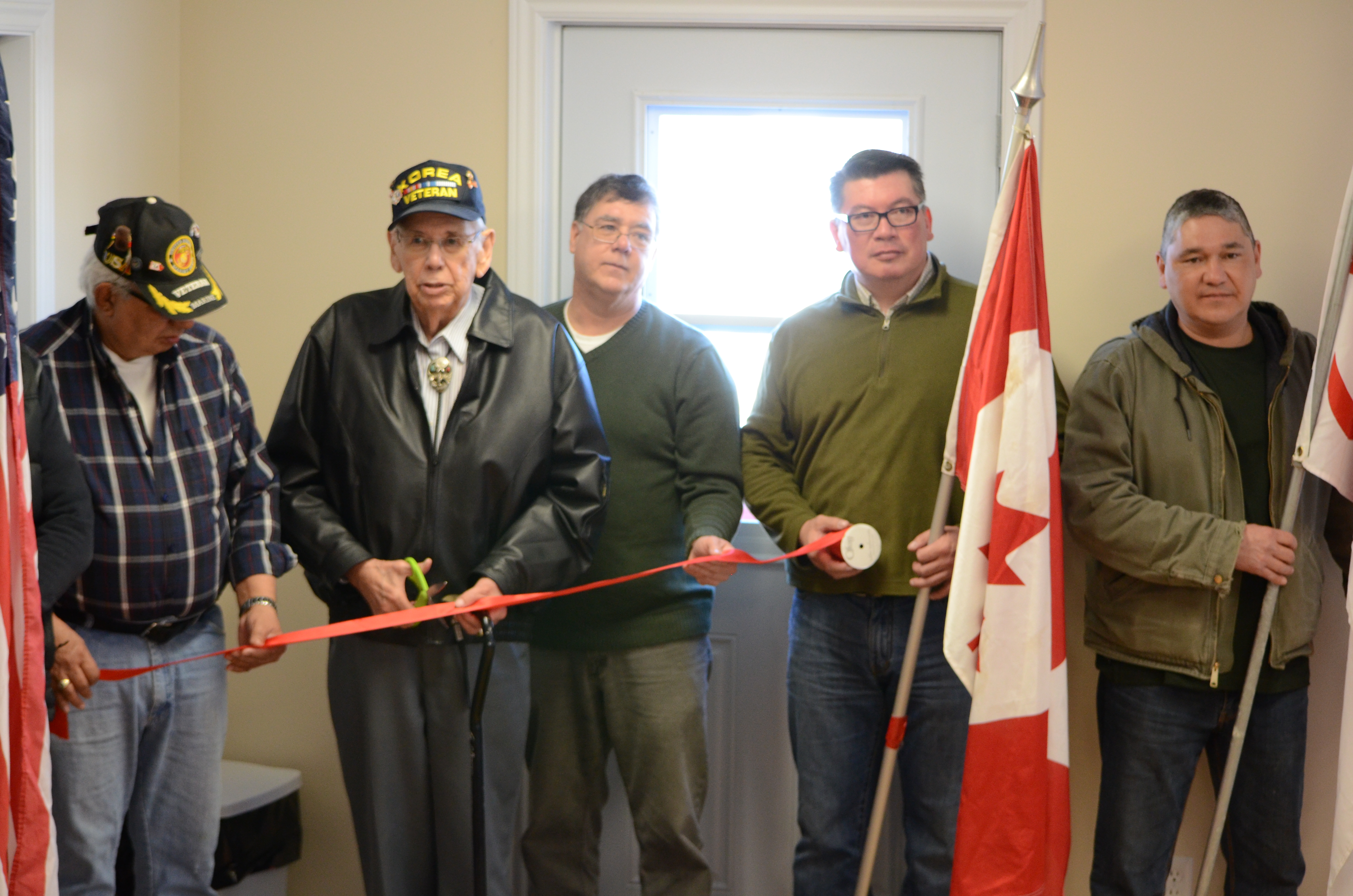
Listuguj Veterans have a place of their own

Dean Martin made a point to cut new keys before the event.

When the semi-grand opening of the Veteran’s Lodge was held on March 24, 2016, Martin went around and gave all the veterans a key of their own. “Here’s the key to the building,” he said to them. “This is our building.”

Martin is the On-site Housing Construction Coordinator for the LMG, and has also served in the American Military. “They were happy,” he said later. “Like ecstatic, relieved.”

Over the years, veterans in the community have had to find other places to meet. The locations weren’t always ideal – especially for some of the older veterans. Now, they no longer have to wait for someone to unlock the doors, so they can sit down together. They can meet whenever they want, even just to hang out and share stories.Veterans 3

The building itself is finished, so now it’s on to the next step – making the place feel like home.

People are already planning the mementos they want to bring in. Some have likely been imagining the inside for years.

In 2013, the plan was made to create a space for the community’s veterans.

Through donations, volunteer time – namely Adrian Barnaby and Dale Vicaire – and labour from the LMG during down time, the Veteran’s Lodge was built with barely any money.

It may have taken a little longer to build than planned, but now it truly belongs to the community.

“There’s no mortgage on it,” Martin said. “It’s done, it’s paid for, it’s ours.”

Veterans 2

Winter Carnvial at AGS

AGS students got to take a break, even if it was too cold for the outdoor plans.

The Winter Carnival was held on March 3rd and 4th. And while the two days included activities like watching movies and playing basketball games, the events also had other benefits for the Elementary and Middle School kids.

Jean Isaac is one of the teachers responsible for organizing the events for the Middle School students.

“We wanted to challenge them,” she said.16-03 AGS Winter Carnival21

The students all began in their homerooms, and then moved to different classrooms, for 30 minutes at a time. Some of activities required math skills, or concentration. Others had benefits that weren’t quite so obvious.

The day was deliberately planned to encourage the students. They had to interact with some of the teachers they haven’t had classes with yet. For one game, they had to get in front of the group, even if they are a little shy.

Jean has found that smaller groups helps encourage the kids to interact. A little competitive edge helps too.

Jean supervised games of “Heads Up.” The game requires one student to hold a phone to his or her forehead. The group can see a word on the screen, and they have to act it out. The person holding the phone has to guess what the word is. Guys played against the girls for “bragging rights.”

“They were laughing, they were engaged. They were sharing, they’re helping each other, which you don’t see everyday,” Jean said.

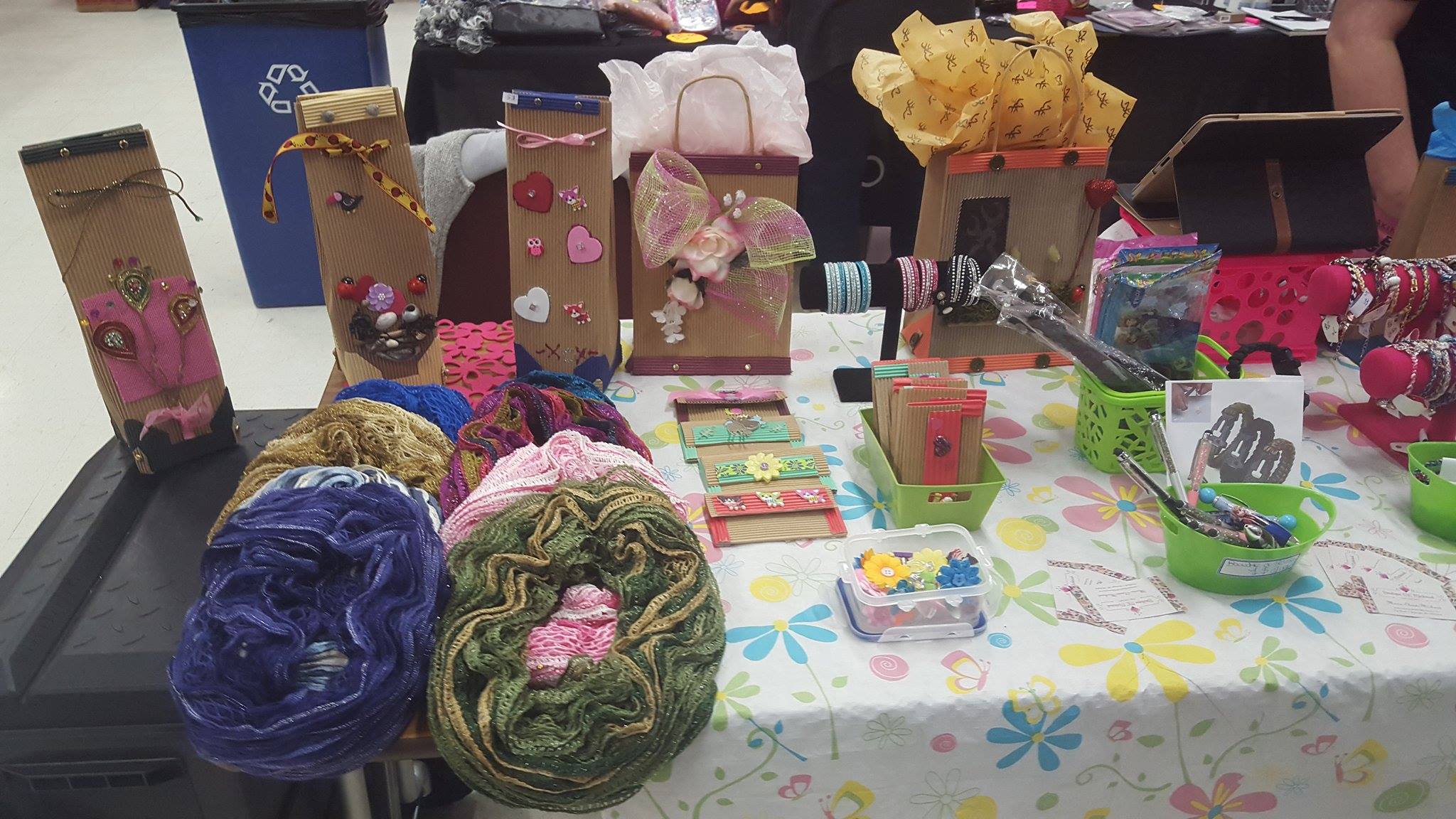
Listuguj First Nation Community Market

Listuguj Market

Abby Metallic moved home, but missed the markets she had gotten use to in Moncton. That’s why she started the Listuguj Market on Sundays.

Sometimes over two dozen vendors come out. Some even travel from as far as Saint-Quentin, or Big Cove.

Metallic tries to organize a market about once a month.

She holds them a little less often in the summers, when there are more things going on, inside and outside the community. The last one was on Feb. 21.

She does her best to plan it so the events can be as inclusive as possible, for the whole family.

“I always try to book it on days where everybody – like single parents can come with their kids,” she said. “I try to do different things. I try to get someone who does facepainting, you know, when that’s available.”

Essentially, anyone can set up. Tables are $10 each, or three for $25.

The markets originally started because Metallic knew a lot of people created things at home,. They often sold stuff online or at other markets. But for Metallic, anyone running any small business at all is welcome. Items don’t have have to be hand made.

“They’re more than welcome to come in and set up and show everybody what they do,” she said.

Metallic uses the table fees to pay for the facility, but when there’s extra, she takes the opportunity to promote the vendors.

“I’ll go back and buy from the other vendors. I’ll spend like $20-$30 and I’ll raffle it off on CHRQ, so that people can win it. But they have to come to the market to pick it up, and they need to go to the vendor to pick it up. So it kind of gets people to come and then go check everything else that’s going on. It’s really fun.”

Some of the items at the market

(Photos by Abby Metallic)

Playground Update

Numbers have just been released for all the expenses and plans for the $83,938.76 raised by the community, for the community playground.

The expenses are online at news.listuguj.ca. There is $12,920.28 remaining, which will be used to buy infant seats for the swings, additional park benches, and a picnic table.

The plan is to continue developing it in a family friendly way. But so far, everything that was planned was completed, before the snow fell.

“So in the spring, we’re just going to pick up where we left off and continue to develop it,” said Sheila Swasson.

In the short time before the snow, when the park was ready, kids were already using it regularly.

“One parent even told me that their kid is there every day, and he’s home with blisters on his hands from the monkey bars,” Swasson said. “It’s a good sign.”

Swasson hopes to build on the momentum generated by the community, that made the park possible. Ideas are already floating around for the next community project, but nothing is definitive yet. 

“It’s really good to see that this project was a community initiative,” Swasson said.  “People stepped up. They believed in the project, and they supported it 100%, and look where it got us.”

Expenses

Expenses Amount
Material and Installation 62599.38
Fred Dedam 560
Advertisment 600
Monument 1750
Ribbon Cutting Ceremony 630.93
Park Benches and Picnic Tables 2274
Site Prep 1600
Posts for Billboard 49.17
Calvin Barnaby 750
Advertisement 205
71018.48

Collecting Oral History

It all started by gathering stories about the Restigouche river.

Sailor Lloyd Jacques was interviewing community members, when everyone at the GMRC realized the importance of what was being learned.

“We all got interested in the history our elders had,” Jacques said.

Jacques and Charlene LaBillois are now conducting interviews in Listuguj, Eel River Bar, and Pabineau about the river, land, and resource use. Interviews are planned in Listuguj during the first weeks of February, but they are flexible.

They want to know what people remember, and what are some of the biggest changes people have seen. Jacques said he has some outline questions, but he prefers the interviews be conversational. All information is welcomed. It could help projects in the future.

“Based on the history given orally, we get to pinpoint where in time things started to change, and investigate it further,” Jacques said.

They’ve already learned about erosion of the river banks, the increase in eel grass, and the new arrival of snow geese.

Changes in people’s relationships to the water and land is also a focus. Jacques enjoyed learning about the reality of “living off the land” – a term often exaggerated by Hollywood and pop culture.

Large portions of the community have heavily relied on fishing, hunting, and following the cycles of nature, as recent as 20 years ago. But, Jacques says, it was in a more “modernized way.”

“It still exists [today],” he said. “But not to the extent that it did back in the 80’s and 90’s.”

Jacques managed to interview his grandfather before he passed away, and learned of how the community changed during his lifetime.

He was told that 20 years ago, driving down the road in the spring, you would see everyone out sewing their fishing nets. 50 years ago, kids would go down to the beach to fish after school. They swam in the river then, and played in the mud.

People enjoyed the interviewing process, even though they thought they had nothing to share, at first.

“For years they were taught that their knowledge isn’t good,” Jacques said. “But their knowledge is good because they’ve lived off the land most of their lives and they witnessed how it was used.”

Interviews in Listuguj will be taking place during the first part of February. If you have anything to share, please contact Sailor Lloyd Jacques or Charlene LaBillois at the GMRC at (418) 788-3017.

Restorative Justice

National Addictions Awareness Week opened the door for many, related topics to be discussed. One was “Restorative Justice,” and the study Cathy Martin recently helped complete.

“It correlates with National Addictions week because [it’s] the number one thing that came out of the survey so far,” Martin said. “The large majority of crimes in Listuguj, for the Community and Safety Wellness Plan, originates from addictions.”

Martin gave a presentation on the plan to close out the National Addictions Week events.

The Community and Safety Wellness Plan began in 2012. Martin just recently got involved to finish it. She has been involved with the Restorative Justice Healing Circle Committee since 2009. It has been active in Listuguj since 2004.

Restorative Justice provides an opportunity for those convicted of – relatively – minor crimes to stay out of the court system, and avoid criminal records.

A committee is made up of qualified people from different fields.  The accused person hears about the crime and it’s impact on the victim, families, and the community. 

“You have to have restitution for your crime, you have to address your victim,” Martin said. “And you have to really have remorse.”

Many report the process being harder than the court system, but it has been proving to be effective. It is entirely a voluntary option. But one that is not widely known, yet.

Arts and Culture Center Tour

Listuguj Summer Camp

The Listuguj summer camps are over for this year, but the kids will now start school with all the great shared memories they’ve made.

The camps began with the idea of getting kids more active. But for the coordinator, Tierra Ritchie, there are now many beneficial aspects of these camps. She sees how much the kids love it, and how excited they are to come back.

“It’s 35-40 of your friends that you’re making these memories with,” Ritchie said. “It makes it that much more special.”

Listuguj Community Services hosts these three-week summer camps for three age groups – 7-9, 10-12, and 13 and up. Each group has different activities.

An effort is made to go visit places. The kids will go to Moncton for the day, or Quebec City. There’s also lots of nearby day trips as well.

The summer camp has been running for 5 years now. And while the organizers know what to expect, kids are showing up with more enthusiastic than they did at first.

Getting kids off the computers was challenge the first year, but now kids have memories, or hear stories from older siblings, and are excited to go to camp.

The organizers are always trying to improve the experience for all the kids. There has been talk about activities with other nearby communities, to start friendships young.