
Mawiomi Cafe: a chance to listen

By creating a relaxing atmosphere, with snacks, coffee, and calming music, the Mi’gmawei Mawiomi Secretariat (MMS) hoped to get a sense of what is most important to the three communities it serves – Gesgapegiaq, Gespeg, and Listuguj.

The concept was developed by Donald Jeannotte-Englehart, the Community Engagement Officer with the MMS. 

“MMS has not been involved in the … three communities for a couple of years,” he said. “We wanted to reconnect with the people.”

The key was to have the sessions in an easy-going and informal way.

People are use to meetings where a speaker stands in front of a crowd to relay information. Unfortunately, some  people can find these scenarios intimidating, especially when it involves asking potentially embarrassing questions.  The MMS is trying to find a way around this.

Over the course of six weeks, nine Mawiomi Cafes have been held – three in each community.

People were invited to come out to sit and talk over coffee.

“There’s no agenda,” Jeannotte-Englehart said.

The Executive Director, Tanya Barnaby, found that conversations often flowed naturally.

“You start by having one discussion, and it leads to something else, and then another question pops into someone’s head,” she said. “You started talking about wind, and you ended up talking about moose. And that’s really what I like to see.”

Like everything the MMS does, there’s a citizen engagement component.

“Top [priority] is definitely citizen engagement,” Barnaby said. “For us, it’s number one, no matter what you’re doing.”

At the end of the cafes, people were asked to fill out surveys, to help the MMS organize feedback.

“The most popular [topics] are the negotiation process, the land claim and Ango’tmeq Nm’tginen which is the GMP, (Gespegewagi Management Plan),” Jeannote-Englehart said.

With the first round now finished, the MMS plans to use the findings to help inform people where it counts.

“We need to have the people know about this stuff, and it’s difficult because people have their own lives,” said Jeannotte-Englehart. “The goal – it’s to get the message to them, so they give us what they want for the future, for their kids.”

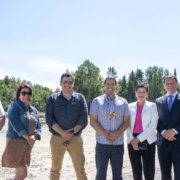
The team working a Mawiomi Cafe. From left to right: Andrew Lavigne, Juliette Barnaby-Doucet, Tanya Barnaby, Tanner Barnaby, Donald Jeannotte-Englehart, Philip Leblanc, and Oakley Barnaby.

Lobster Fishing Plan

The Department of Fisheries and Oceans (DFO) wants Listuguj to reduce its efforts in the lobster fishery this year.

The “Effort Based Management” system used by DFO has been in place for nearly ten years, but it’s the first time it’s being applied to Listuguj.

According to the plan, because of Listuguj efforts in previous years, it is being asked to reduce its effort this year. The science, and reasoning for this is unclear.

“We feel that the community wasn’t sufficiently consulted on this ‘Effort Based Management System,’ and the data that they’re using to support this … is very outdated,” said Kirt Dedam, the Aboriginal Fisheries Strategy Coordinator.  “Also, the system that they’re proposing really doesn’t meet Listuguj’s needs, or customs, or our rights.”

“So, because of this problematic process DFO has, we’ve decided that we need to get organized and develop our own Lisutugj lobster fishing plan,” said Dedam.

Two community meetings and five workshops have been organized over the last two months.

“We’re hoping to establish a fishing plan that’s representative of the community, and their wants and needs for this fishery,” said Dedam.

The attendance has been good, Dedam said. They’ve received a lot of feedback.

“The community feels that this could have a negative impact on our right to fish for food, social, ceremonial purposes. It could have a negative impact on our right to fish for livelihood, and also, it could have an impact on our right to manage the fishery,” he said.

There’s also been a lot of feedback about the food fishery in particular. The food fishery season is in the fall, as oppose to the commercial fishing season in the spring.

“What we’re hearing is, ‘We want more access to the fishery. We want more people, more community members, involved in the fishery,’” Dedam said.

Expanding zones, or looking at licenses in other zones have been raised as potential ways to achieve these goals.

Last year, nearly 8,000 lbs of lobster was donated back to the community, over the season’s 3-week period.

“That lobster was consumed every single day by community members,” Dedam said. “From what we can tell, the communities needs are only increasing, as the community grows and continues to prosper, so do our needs.”

Trapper Metallic is the new Chief of Police

Trapper Metallic is the new Chief of Police for the Listuguj Police Department (LPD). He was appointed on Feb. 6.

“This is a position I was never really considering this early in my career,” he said in an interview with the Nujignua’tegeg.

With the unexpected passing of former Chief of Police Henry Vicaire, the position opened up internally.

Metallic has been with the LPD for the majority of his career, starting when he was 17 years-old.

For a brief period, he tried post-secondary school, but realized it wasn’t for him. He started volunteering again with the LPD. When the opportunity came up to train with RCMP, he took it. Once he graduated from that, he came back to Listuguj as a full fledged police officer, and has been here ever since.

“I’ve had the opportunity to experience various positions within this organization, from the operational standpoint, to the administration organization,” he said.

He went from a Patrol Officer, to a Sergeant, to an Investigator. He was in that role for nearly two years, before submitting his name for consideration as the Chief of Police.

“I definitely was reluctant and waited until the 11th hour really to submit my name,” he said. “I felt that the Chief of Police position – it encompasses so many things for the community, for the detachment – on all different levels. It’s a position that’s a hefty one to fill.”

After process concluded, Trapper was chosen to succeed Vicaire.

“It’s just humbling to succeed such a good man,” he said. 

“It’s been an emotional journey for me due to all the personal relationships … I was very, very close to [Vicaire],” he said. “A lot of teachings I learned from him. I’m very humbled to be designated as the Chief of Police for this community … I’m looking forward to whatever this position’s challenges throws at me, we’ll take it head on.”

Listuguj takes ownership of group home

Soon, the Gignu Group Home will be run entirely by the community. On January 19th, Integrated Health and Social Services Centres (CISSS) signed over the responsibility to the LMG. The transfer has been in the works for over ten years.

Nearly 20 people gathered at the newly constructed building to witness the official signing. There is no exact opening date as of yet, but job advertisements for the new positions have been posted.

“What I really like about this agreement is the fact that we’ve been able to work out a way that we as Listuguj, will – over time – take over the running, the administration, the direction of the services that will be provided to our youth, by our people,” said Chief Darcy Gray.

Connie Jacques, the Deputy Chief Executive Officer, said the project started out simply to construct a new building, and along the way everyone decided that it was a good time to start the transfer of ownership. There had been discussions before she got involved, 10 years ago. The entire program will eventually be developed out of Listuguj.

“We’ll have a transition step where the center will be run by the Listuguj Mi’gmaq Government and with support from our services,” Jacques said. “But eventually, the goal is that we’re not here anymore.”

The event also took the opportunity to honor some of the long standing employees of the Gignu Group Home, like Dolly Barnaby.

“I initially thought that this was for recognition of Susan’s retirement,” Barnaby said.

Susan Basque retired on January 11th. But four others were recognized for working more than 25 years. Barnaby has been there for 31 years, since the beginning. She said the center was their baby, right from the start.

“We were all very young,” she said. “The whole team was very young and we had never worked in a readaptation, rehabilitation center before. And so it took quite a while to establish ourselves – for the community to recognize us and to believe in us and trust their youth with us.”

Barnaby admits that there’s been bad times along with the good, but if they’ve helped just one kid, then they’ve succeeded, she said. With the new building, and new ownership, she doesn’t see much changing.

“The way we work with the youth is not going to change,” she said. “We’re just going to have the space to be able to do the work that needs to be done.”

One change however – which excites her – is the steps to indigenize the programs more. Chief Darcy Gray echoed this vision.

“I would like to see more cultural knowledge, traditional practices, Mi’gmaq ways of healing and working together and bringing about healthier people,” he said.

For many, seeing exactly how this will all develop is exciting, and a source of pride.

“I feel we’ve just put a child forth in the world,” said Jacques. “Now we’re gonna watch it grow up.”

Helping a friend in need

Almost immediately after hearing the news about their friend, Dylan Montgomery, several students jumped into action.

Montgomery was recently diagnosed with Hodgkins Lymphoma. Montgomery and his family have been travelling back and forth from Halifax every week since Christmas.

“We wanted to make him happy,” said Embrey Isaac.

Isaac and her classmates organized a bake sale in their school to help out financially, however they can.

“He was always nice and giving to us,” said Amelia Rioux. “We just wanted to give something back to him.”

Two tables were set up along the main entrance of the school. They were filled, front to back, with cookies, cupcakes, banana bread, and more.

Anna Smith teaches Grade 7 & 8 French Immersion.

“Right away, Monday, they started planning,” she said.

Smith helped organize and supervise the bake sale.

“I just think it’s a really nice thing to see that the kids from both communities coming together and caring about each individual, and doing something special, no matter who it is and where they’re from,” she said.

The following week it was announced that the bake sale had raised a total of $900.

HIV/AIDS workshops at AGS

The annual HIV/AIDS workshop at Alaqsite’w Gitpu School focuses on more than safe sex. It uses the opportunity to discuss other important aspects of growing up – recognizing what an unhealthy relationship actually is, and self-acceptance.

“What we’re really trying to do, is create that network with our students,” said Lynn Labillois. “So growing up, you know, [the kids will think]  ‘hey, that’s the nurse. I can go and speak to her.’”

The workshop is organized by Listuguj Community Health Services (LCHS), and was separated into several stations. A station for condom and dental dam demonstrations; a station on HIV/AIDS and what it is, how it’s transmitted and how one can lessen the risk of transmission; and a station explaining situations of risky and non-risky behavior with Drugs and Alcohol.

The Haven House was also present, talking about healthy and unhealthy relationships, how to recognize it and what can be done.

“We talk about ‘no means no’ healthy relationships, so that students are aware,” said LaBillois. “It’s not always as clear as we think … I guess they need a role model in the community sometimes to say ‘this is appropriate and this is inappropriate behavior in a relationship.’”

A lot of the day was focused on preparing the students should they end up in certain situations.

“We talk about abstinence of course,” said LaBillois. “It’s the same as drugs and alcohol. We don’t want them to drink, we don’t want them to use drugs. But if they do, how are they to be safe in doing so.”

Small change to the food bank

The Listuguj Community Social Services has an active program (initiative to fight poverty) for community members in need. The initiative is funded by Quebec and Labrador Social Services Commission, and through this, the community food bank was created in April 2016. The food bank is typically held on the third Tuesday of every month, however dates still can be subject to change.

For those who come to the food bank, they would be given an assortment of fresh foods and non perishable items. Basic food items such as eggs, milk, bread, pasta, potatoes, breakfast cereals and much more.

With the amount of recipients the food bank gained over the past few months, this has brought a few changes. Starting February, they are implementing an evaluation process in order to avoid abuse of the services and to provide to those truly in need.

“They just meet with me once. They have to provide their proof of income & proof of expenses (Hydro, Telephone) and we’re going to create a file for them here,” said Jessie Gallant “Once you meet with me, then you’re good to go. Your always welcome every month.”

For more information, call Jessie Gallant at the Listuguj Community Social Services. (418-788-3039

2016 In Review

NEWS

AFN National Chief  Visits Listuguj

Issue 26, Aug. 2016National Cheif

The Assembly of First Nations National Chief, Perry Bellegarde, visited Listuguj during the Powwow weekend last year. It was his first time in the community.

Bellegarde met with people from the community, and heard the concerns of various organizations. He spoke at the Powwow, and sat down with  Nujignua’tegeg for a video interview that can be found online.

Read More

In-Community University Graduates

Issue 24, July 2016

First Ever Graudation

 The first-ever university course offered in Listuguj graduated 19 students on June 30th. The Bachelor of Arts in Community Studies (BACS) was offered through the Cape Breton University. It began in 2013.

“This program was truly a collective achievement,” said Dr. Fred Metallic, at the convocation at Alaqsite’w Gitpu School.

Many classes were taught by Listuguj teachers, and was for the community in a variety of ways.

The high percentage of graduates is proof that the model works.

Read More

Mesgi’g Ugju’s’n Wind Farm at full capacity

(Issue 30, Dec. 2016)

photos_carrousel_energies_wind2

celebration on December 1, 2016 marked the opening of the wind warm, and Troy Jerome’s resignation from the MMS.

Read More


FEATURES

‘Nnui’sultinej Let’s speak Mi’gmaq

(Issue 27, Sept. 2016)

class

Excerpt:

There is a red line at the Listuguj Education Complex that can’t be missed.  The line divides three classrooms from the rest of the building, creating the only English-free zone in Listuguj. Anyone crossing that line has to speak only in Mi’gmaq.

The line is more than red tape on the floor.  It is a compelling symbol of the protection of the Mi’gmaq language that evolved on this territory for thousands of years, but is now vulnerable.

There was never such a “language line” in Listuguj.  Maybe that’s the reason why in the last 50 years the English language had entered the homes, stayed there and with time, displaced  Mi’gmaq as the main language.  Those were the times when Canada’s assimilation policies forced Aboriginal peoples across Canada into Residential Schools and they were pushed to believe ….

Read More

Passing on Traditions

(Issue 25, Aug. 2016)

aurele-tanne-pole

Excerpt:

Tanner Sage Barnaby, the son of Tara Barnaby and Robby Ouellette, has been salmon fishing for the last six years and he’s only twelve. He leaves the quarry in the middle of a rainy afternoon and when he arrives to the fishing area he slows down the motor to set the net.  A very attentive boy, Tanner drives the boat with the seriousness that his tasks require.

As the rain continues to fall, he stops the boat and initiates a conversation with Aurele Isaac, his mentor.  They talk about the places where other fisherman set their nets. “We have to respect them,” he says. “If you see that one person has a good catch on his place you just can’t come the next time and occupy his location. We have laws and we have to respect them,” he says to Tanner…

Read More

Women’s voices of Mi’gwite’tm

(Issue 23, June 2016)

raid-sq-church-kid

Excerpt:

This year marks 35 years since the raids in 1981. But even after all this time, there are still “as many stories as there are people who fill this room,” as Victoria LaBillois said before the Salmon Feast at the Bingo Hall on June 11. This year – just like in 1981 – women of the community stood alongside the men.

Images of men standing up to Quebec Provincial Police are close in everyone’s mind, and stories of men from nearby nations coming to help are often retold with pride, but the fact that women came from other nations as well is mentioned less often…

Read More

Best Photo Page

Echoes of Powwow – Issue 26, Aug. 2016

Echoes of the Powwow

ARTS

Painting: A Healing Journey

(Issue 22, June 2016)

Tracey Metallic

Excerpt:

When your work is displayed around the continent, attracting the attention of famous artists, and selling within 30 seconds of being posted on social media, some people could probably call you an “artist.” But Tracey Metallic-Barnaby is still getting use to the title.

She’s only been painting for a year, but her work has clearly been resonating with others. She has shipped her work to Alaska, her prints caught the eye of a television set designer while on display in Thunder Bay, and her work has recently been commissioned to be installed in a new health center in Michigan.

All the recognition has definitely been exciting. But it’s all secondary. “I’ll never give painting up,” Tracey said. “It’s way too therapeutic for me.”

Tracey says she’s always been crafty, but she gave up drawing when her daughter was born. She was 18 at the time. She then raised two more children, until she was 31 and decided she needed to go back to school.

Three degrees later, after years…

Read More

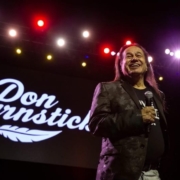
Don Burnstick

(Issue 30, Dec. 2016)

don-burnstick

Don Burnstick was invited to Listuguj for National Addictions Awareness Week in November. He gave a few shows, and sat down with the Nujignua’tegeg for a video interview and a story.    

Read More

COMMUNITY

Listuguj Mourns death of Chief of Police Henry Vicaire

(Issue 21, May 2016)

Henry Vicaire

Excerpt:

Listuguj Chief of Police Henry “Hank” Vicaire was rushed to the Campbellton Regional Hospital on Friday the 13th under emergency circumstances, but was unable to recover.  He passed away several hours later.  He was 50.

On May 18, at around 10.30 a.m.. various delegations of Police, SQ, RCMP, Firemen, Ambulance technicians from around Listuguj, and a representatives of Henry’s Bike Club, gathered in front of his house. A solemn march to St. Anne’s church followed, where political banners were covered and painted with the number 21, in respect to the badge of the Chief of Police.

The Church was packed and the mass started with the Spirit Bear singers chanting the Mi’gmaq Honor song.  Native and non-natives families and friends of  Henry “Hank” Vicaire gathered to pay respect to a person that the eulogies described as a humorous, sensitive, respectful and a talented human being.

Henry Vicaire was born in Campbellton, N.B. in 1965. He attended the Justice Institute of British Columbia (JIBC) where he earned his policing certification in 1994. He served as a Listuguj K-9 officer from 2002 to 2010 with detector dogs Echo and then Bonzai.  He became Listuguj Chief of Police in 2012…

Read More

Fire Fighters graduate from first course in 15 years

Firefighters from the first course offered in Listuguj in 15 years graduated just before the new year. The graduation was held on Dec. 16 at the Bingo Hall.

The 10-week course began in September. They could be seen running various training exercises throughout that time.

Some of the new firefighters, like 18-year-old Cody Duguay tried getting in early, but didn’t hear back. He recieved a call the day the course started. Someone had dropped out. Duguay was there five minutes later.

“What have I gotten myself into,” Duguay quickly thought.

“I would just start, take a step back, think why I’m doing this, and is this really what I want to do,” he said.  “As I read through the course books and looked at and everything, I found this would be something I would really love to do, so I kept going with it.”

The training did it’s job – it taught Duguay how to keep a level head in a stressful situation.

He remembers one time during training when he was under a firetruck, practicing how to conserve air when an air tank is low. He rolled over, and didn’t realize his air was off. Then he got stuck.

“That scared the hell outta me right there, I was ready to quit the course,” he said.

His instructor pulled him out, and he decided to go back the next day. Now he has five different certificates qualifying him as firefighter.

“We earned this and it was a hard road,” said Duguay. “While I will – and always shall – be happy that we have completed this course, I will miss this training. I will miss doing this everyday.”

Mesgi’g Ugju’s’n Wind Farm at full capacity

It may have been too dangerous to visit the windfarm, because of a snow storm, but the celebration went on anyway.

It had been set for years – December 1st, 2016 was the day to commemorate all the work that went into making the Mesgi’g Ugju’s’n Wind Farm a reality. It is now running at full capacity.

It is projected to bring in $200 million over 20 years for the Mi’gmaq.

The day also marked Troy Jerome’s resignation from the Mesgi’g Ugju’s’n Wind Farm Board. He jokes that he’s going out on a high note, like George Costanza on Seinfeld.

“I put myself into that project – my life – for eight years,” he said. “It was part of my life – too much a part of my life, I would say maybe – and it was nice to be able to go to the Chiefs and say thank you, and release me.”

He officially stepped down as of 8 p.m on December 1st. In his mind, it was the appropriate time to do so. With the farm transitioning entirely into the day-to-day operations and management, his expertise are no longer needed.

“When you look back to what we set out to do in the early days, you look at our project plan … it’s kind of bizarre that what we set out to do is practically what happened,” he said. “It doesn’t happen too often.”

Jerome also stepped down as Executive Director of the Mi’gmawie Mawiomi Secretariat (MMS) in July. Like Jerome, the MMS – with the windfarm and agreements now in place – has little to do with the farm going forward. As the new Executive Director, Tanya Barnaby, describes it, the MMS is a political and administrative entity, taking direction from the Mi’gmawie Mawiomi. It’s goal was to generate own-source revenue for the Mi’gmaq, not necessarily be in the windfarm business.

“In that sense, it could have been a windfarm, it could have been a lollipop factory, it wouldn’t have mattered,” she said. “We needed to create revenue in our communities to begin to take over the management and governance of our territory.”

It is all laid out in the Nm’tginen. Generating revenue is the first step in being able to fund things like education.

“When we say repatriating, it doesn’t mean kicking everyone off,” said Jerome, who has gone on to create Senti Aboriginal and Environmental Services. “It’s about us having jurisdiction on our lands, us accessing our resources, and us taking care of our children.”