JUSTIN CALDWELL – 20 YEARS AT CHRQ

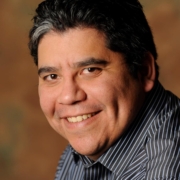
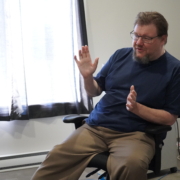
If you’ve ever turned on your radio to CHRQ 106.9 FM or checked them out on Facebook, then you’re more than likely familiar with Justin Caldwell. Caldwell has been working with CHRQ for the past 20 years in the community of Listuguj. Originally from Matapedia, QC, his radio career began when he went to school for broadcasting in Woodstock, NB. From there he did a job placement at CKNB in Campbellton where he worked for a period of time. He noticed a job ad for a DJ at CHRQ, applied for it, and the rest is history.

“Radio was a big deal as a kid. I thought it would be a cool experience to do something like that,” said Caldwell.

Even though there are no specific formats or job titles, Caldwell says his position could be called the “Program Director.” He assists with bingo, commercial breaks and productions, sales, and on-air work.

CHRQ differs from other radio stations for a few reasons. As mentioned before, there is no specific format – no specific genre of music is played in any order. The on-air staff has the freedom to be in the moment and play what they would like and can adjust accordingly on the spot. Caldwell said, “We’re able to take requests and that’s something not every radio station does because their formats are so strict.”  The station also thrives on being very local and community-driven.

The staff at CHRQ are grateful for Listuguj’s continued support over the years when it comes to bingo, advertisements, participation in request shows and events, etc. Caldwell said his favorite thing about working for CHRQ is being able to provide information to the community. He also expressed his gratitude to the community for being so welcoming and kind to him over the past 20 years. He said, “The community has just been so welcoming that I want to try to do my best for listeners and for the community to provide information and provide service the best we can.”

Tune in to Justin Caldwell on-air Monday-Thursday from 7 AM-1 PM, and on Friday nights for the very popular, All Request Country Show on CHRQ 106.9 FM.

By Ann Marie Jacques
“YOU CAN NEVER FINISH A DICTIONARY.”

In 1993, Diane Mitchell got the idea for the Mi’gmaq-Mi’kmaq Online Talking Dictionary when her daughter was only two years old. They were living in Southern Ontario at the time, and Mitchell realized that her daughter would not have access to their language. With the help of her tech-savvy husband, Sean Haberlin, website developer, Dave Ziegler, and database specialist, Watson Williams, she successfully recorded seven Mi’gmaq words.  Roughly five years later, Mitchell returned to Listuguj and got together with Eunice Metallic and Joe Wilmot to find out that the idea of a similar project had been brought up in the Education department prior, but no concrete work was done. In the beginning, the project was meant to be recorded on CDs, but as time went on, using the Internet for their platform seemed like the best route. To help kick off their project, they were given funding to purchase recording equipment. This is when the seven words that Mitchell had initially recorded, turned into something much more.

Mitchell said, “Initially I was just going to do it for domestic consumption – even though it was a large project, but I also recognized it would be really useful, simply because we have less and less speakers as the time goes on.” Mitchell, Metallic and Wilmot all grew up in a home where Mi’gmaq was their primary language. They felt as though their knowledge and other Mi’gmaq speakers’ knowledge of the language could be used to benefit the community to keep the language alive for future generations.

The team was determined to include more and more words, which meant doing work on evenings, and weekends. “This is what we wanted to do. Not because we were paid, not because somebody was telling us what to do. It was all just us doing the work,” said Metallic.

Eventually, the community recognized the project and temporarily employed the team to make the project even bigger. The team received various funding over the years as well. Even after the employment came to an end, and the funding was gone, they continued.

The dictionary received positive feedback and praise from the community. It is still being used frequently – whether it be by teachers, education staff, young generations of learners, or people wanting to become familiar with the language in general. The dictionary was also praised by the previous Chief and Council administration in the community. “Our Chiefs in the last 30 years have changed.  All the Chiefs have supported us. They support the language program because it’s for the community.” said Metallic.

As of today, the Mi’gmaq-Mi’kmaq Online Talking Dictionary has 6500 words. The words are in alphabetical order, defined, used in sentences, and are primarily voiced by Mitchell, Metallic, and Wilmot. The website also offers various traditional Mi’gmaq songs and stories that are voiced by people in the community, such as Roseann Martin, Simon Dedam, Roger Metallic, Theresa Mitchell, and even Mitchell’s eight-year-old daughter at the time. Mitchell has also created a Twitter account called “Pemaptoq” with over 1000 followers – where she tweets a Mi’gmaq Word of the Day. These words of the day can also be found on the billboard in front of the Listuguj Education Training and Employment office and can be heard on the radio station, CHRQ.

Mitchell has taken on a bit of a side project, that is still related to the dictionary. Over the years she has been collecting and studying work from Père Pacifique – a Priest from the late 1800s, who published numerous Mi’gmaq manuscripts and prayer books.  Included in his manuscripts is a handwritten Mi’gmaq dictionary that was never published. The primary entries are done in Mi’gmaq, but the explanations and definitions are mainly done in French. Mitchell has been working with various Mi’gmaq women in the community to extract words from these manuscripts. She is teaching them how to transliterate his work. The words that have been extracted from the dictionary, will be presented to some speakers in the community. Once these words have been approved and tested, eventually she would like to add some of these words to the dictionary. Wilmot said, “There are other projects that are going to be pulled into it. It will enhance the use of the dictionary, and hopefully, it results in people taking something from it, and learning from it.”

Even though the dictionary has come a long way, the team says you can never finish a dictionary. New words are often resurfacing and being discovered. Metallic said, “I hope somebody will be able to take over it when we’re gone.”

The Mi’gmaq-Mi’kmaq Online Talking Dictionary has gone on to be a staple in Listuguj.  The team could not stress enough that they are grateful for the help and support received from individuals who made the project possible and from the community in general. The time and effort that were put into this project are highly respected and recognized and will continue to be used as a major source for the language.

By Ann Marie Jacques

“If we don’t exercise our rights, then they won’t be there for us.”

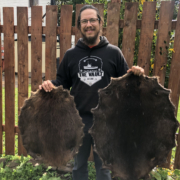
When JD Wysote isn’t fishing snow crab for the Listuguj Mi’gmaq Government, he can often be found hunting, trapping, and tanning animal hides.

He started tanning hides around three years ago when he realized that he wanted to utilize everything when it came to hunting.   After hunting or trapping an animal, he would use the meat and the skull but realized the hide could also be utilized. Wysote would eventually like to use the hides to make clothing and said, “It is the next step from hunting. You know where your food comes from, and next is knowing where your clothes come from.”  One of the main reasons for picking up this hobby is to exercise his rights as a Mi’gmaq person.  He said, “If we don’t exercise our rights, then they won’t be there for us.” While there are not many people in the community who tan hides, Wysote said he has talked to the few who do for guidance and advice.

The process of tanning hides is very time-consuming and detailed. The process differs for the type of animal and depends on if you want to keep the fur on. It also depends on the time of year and the season. Typically, in the winter, animals will have thicker fur. Winter pelt on animals will also dry lighter in color than an animal with a summer coat. Wysote talked about the process of tanning a beaver hide, “If you want to keep the fur on for beavers you don’t have to worry about shaving all the hair down, half the work is already done. You do got to skin the animal, then you got to flush it all out, get all that fat and meat off of it, until it’s just the skin itself. Then you got to dry it out, pickle it, then the final process to make it waterproof and durable is to smoke it, multiple times.” Eventually, a preservative will be added to the hide when the process is done. Some of the animal hides that Wysote has in his possession that he has worked on include, moose, beavers, and bucks.

Tanning hide is a very long process.  It’s a hobby that requires a lot of time and patience, especially if it’s just one person doing the work.  Wysote said, “Traditionally what hide work was, it was a family chore. The family got together, the men went out to hunt it and the women got together and work on the hides. It was a family activity.” His family also partake in the process, with his oldest daughter helping him set and check traps. He hopes his growing family will continue to accompany him with his hobby and fully embrace their Mi’gmaq culture.

By Ann Marie Jacques

Decolonizing Our Education

Jacob Gale is the Treaty Education Lead at the Listuguj Education Training and Employment Centre (LETE). Here he works and collaborates with a team featuring, Jeanette Henry, Paige Isaac, and Patrick Wilmot.

Often when people think of the term, “Treaty Education” they will associate it solely with learning about treaties, Gale explained it’s much more than that, “Treaties are fundamental and they’re an important part of the work that we do, but there’s also so many other pieces of work that we do under Treaty Education. It’s really about decolonizing our education here at LETE, at AGS, and at other branches of LETE. Treaty education includes our culture, our identity, our well-being, spirituality, all those pieces of who we are as being L’nu – in a way it could be called L’nu Education.”

The Treaty Education team work with teachers and educators in the community to help build a foundation that connects culture to the school curriculum through experimental learning. Gale said that it’s important to include Mi’gmaq culture in our school systems. An example that was given was the building of the sweat lodge, and how there are so many lessons embedded into that process, such as math, literacy, history, ceremony, and a connection to the community and to the elders. Another major program for our community in Treaty Education is Outdoor Education at Alaqsite’w Gitpu School.

The Treaty Education team also works with the youth in the community and helps them learn about who they are and embrace their culture.  Eventually, the youth will become leaders in our community, and it is important that they have a strong sense of belonging. Gale said, “We ask the question, ‘Whose story should we value in education?’ We’re in that business of we are a Mi’gmaq community, we are a Mi’gmaq school, and it’s important that we continue to find ways to embed our stories and our connections to our land, our elders, our ceremonies, in school – so that students understand that, “Hey I’m Mi’gmaq, I’m proud to be Mi’gmaq and I’m proud to be L’nu” They’re Learning so much about who we are in their education journey.”

There are many events and activities in the community that the Treaty Education team helps organize – a few recent events were the Cultural Night and Social Night held at Alaqsite’w Gitpu School in August. Gale mentioned that many students will be attending the Tim Hortons Children’s Camp in Tatamagouche, Nova Scotia, he also mentioned an upcoming Moose Hunt Camp in the community with the Outdoor Education program.

Gale stated that being part of the Treaty Education program is always fun and exciting and that he is proud to be part of many youths’ cultural and spiritual education journeys.

By Ann Marie Jacques

BRANDON MITCHELL – COMBINING CULTURE AND CREATIVITY  

Many of you may know Brandon Mitchell from his time working at Alaqsite’w Gitpu School as the art and technology teacher, since then he has gone on to be a very successful creative writer and illustrator.

At a young age, Mitchell always had a passion for drawing and art.

Mitchell said, “I was into comic books, cartoons, movies, and video games but instead of re-drawing my favourite characters, I would try and make my own. It was only in grade 11 when I had an opportunity to flesh out my ideas in writing.  We had an open assignment to write on any topic we wanted, and I asked if I could write about these characters I created. From there, I was hooked on seeing where my characters took me.”

Mitchell then enrolled and obtained a diploma from an Animation and Design program at NBCC in Miramichi. “I learned not just HOW to draw, but HOW to tell a story with images,” Mitchell said. Mitchell went on to earn a Bachelor of Integrated Science and a Master of Adult Education from UNB.  Mitchell began working at AGS, and with inspiration from his students, he eventually founded Birch Bark Comics, and from here, a comic book story called Sacred Circles was created. This story was based on local legends with a contemporary twist.  

“One of the things I didn’t grow up with was Native characters being the main characters in the stories I read.  That’s what inspired me the most in creating these stories,” said Mitchell.

Mitchell also had the opportunity to write six Indigenous-themed stories focusing on health-related issues with Indigenous Story Studio, with stories such as River Run – which focuses on smoking prevention, and Tomorrow’s Hope about First Nation suicide prevention. He has been a part of numerous creative writing and art projects such as, the National Best-selling graphic novel anthology series This Place: 150 Years Retold, Migwite’tmeg: We Remember It – a story of the 1981 salmon raids in Listuguj, and the traditional Mi’gmaq story, Adventures of the Pugulatmu’j: Giju’s Gift.

Mitchell and his wife Natasha Martin now live in Fredericton, but there are a lot of things to miss about Listuguj.  “I miss my family, the river, and the beautiful mountains,” said Mitchell.

As of right now, Mitchell is currently working on the second adventure of the Pugulatmu’j, and he’s also illustrating a picture book for Ksalsuti Wellness Resources Inc. You can find his books and work on Amazon, Chapters, Portage and Main Press, and at a Pow Wow near you.

By Ann Marie Jacques

INTRODUCING THE NEW MUSIC PROGRAM AT ALAQSITE’W GITPU SCHOOL

Former Youth Care worker Douglas Pictou is the Performing Arts teacher at Alaqsite’w Gitpu School. Last year he solely taught Mi’gmaq hand drumming to the students, and this year, he will be the music teacher from grade four to eight. Pictou has plans to update former music classes and teach them in a more modern and progressive way. Pictou said, “It’s going to be more percussion-based and projective-based as opposed to music class I grew up with.”

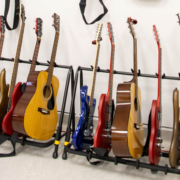
The brand-new classroom is equipped with many different instruments, like guitars, pianos, and drums, but will also have a variety of cultural instruments as well such as Mi’gmaq hand drums, and African rainmakers. The students will also get to learn digital aspects when it comes to music – such as MIDI boards and using various recording software.

Pictou explained his class will be very project based with exercises such as group rap projects, music video producing, and creating elements in sound.  One project, in particular, will be having the students mute scenes in a film and have them find a piece of music that fits the tone and mood of the film. When it comes to his goal for the class Pictou said, “I want to encourage them to play music, expose them to different types of music as opposed to just being a listener. If they still want to be just a listener, at least they’ll know what they’re listening to.”

Pictou says that he is looking forward to building relationships with students and letting them know that the classroom is a safe environment where they can come and blow off steam, feel accepted, have fun and perhaps heal themselves through music if need be.

By Ann Marie Jacques

Elawsimgewei Gina’muo’guom – Encourage, Empower, Educate

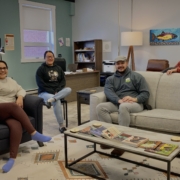
The Elawsimgewei Gina’muo’guom isn’t just your typical education institution when it comes to adult learning, it’s a safe haven and a place for students to learn about themselves and grow as individuals. As the name loosely translates, it’s a place where lifelong learning occurs.

Bella Moffat is the Academic and Guidance Counsellor and Co-Manager of this First Nation Regional Adult Education Centre right here in our community. Moffat is the first person potential adult learners meet with to discuss the next step in their education journey. “My goal is to identify the individual’s career goal or what the goals are, and it’s whatever is in the best interest of the adult learner,” said Moffat. Once the staff can establish the individual’s goal, then they can work together to determine the best path to take for success. The staff recognizes that many of these individuals are in different stages of their lives, and once they make that first step to further their education, the staff will guide them the rest of the way.

There are various programs offered at the Elawsimgewei Gina’muo’guom such as high school diploma, general development test (GDT), academic upgrading, and more. The staff at the centre understand that each adult learner is different, which is why they offer a different approach when it comes to teaching. The style of courses is switched up to keep things interesting for the adult learners. “We try to base our courses on the needs of the adult learners,” Moffat said. The courses are a mix of self-paced learning, land-based learning, Mi’gmaq learning, and theory, but also feature a lot of hands-on learning activities such as horticulture and cooking classes.

The atmosphere is very laid back and welcoming. The centre takes pride in its relationships gained with the adult learners. Each person is treated in a mature, respectful manner and their comfort is the number one priority. Moffat said she wants the adult learners to feel loved and respected when they come through the door. The staff are very eager to support and guide the adult learners throughout this stage of their life.

In addition to the relaxed, self-paced teaching structure, the centre offers various incentives and fundraising for activities, events and holidays. The centre offers transportation to the adult learners, breakfast and lunch programs, and even weekly self-care activities in the building.

The Elawsimgewei Gina’muo’guom consists of a staff of eight, and the programs are run from September to June. To find out more information on the centre, contact Bella Moffat, or Administrative Technician and Co-Manager, Myrna Sook. More information can also be found on their Facebook page.

-By Ann Marie Jacques

CHEY DESIGNS – CRAFTING MEANINGFUL INDIGENOUS FASHION

Cheyenne Isaac-Gloade is originally from Listuguj and now resides in Millbrook, Nova Scotia. She always had a passion for Mi’kmaq art and fashion and her goal was to become a fashion designer. She could often be found sketching and drawing dresses, and studying various runway looks, but she quickly realized there wasn’t a lot of Indigenous fashion out there.

“Some of my earliest inspirations were mainstream fashion, but one of the things I noticed was there was no Indigenous presence there,” said Isaac-Gloade. She set out to change that.

She always appreciated traditional, Indigenous fashions, and it was important to keep ancestral symbols alive but to also modernize and evolve it. “My inspiration is I take kind of an older concept and combine it with a modern-day twist,” said Isaac-Gloade. And that leads us to Chey Designs.

Chey Designs is a way for Isaac-Gloade to express herself and create elegant garments that tell a story. The brand features Indigenous apparel, intricately beaded jewelry, and most recently, ribbon skirts. The debut collection, Wasuwegl Nigwegl was launched in August – which consisted of beautifully crafted, modernized ribbon skirts. Wasuwegl Nigwegl loosely translates to “growing flowers.” Her concept behind this collection is that every woman is a unique flower who is beautiful in their own way. “The sun shines on all flowers. There’s enough sun for all of us.” – said Isaac-Gloade.

The Wasuwegl Nigwegl skirt collection sold out in under five minutes on launch day. “I just felt like I was living my dream,” said Isaac-Gloade

Isaac-Gloade’s plan for the future is to continue to release meaningful Indigenous collections with Chey Designs with a powerful message. She would also love to collaborate with other Indigenous artists. Her long-term goal would be to have the opportunity to design for clients and have them wear her garments at red carpet events.

You can find more information on Cheyenne Isaac-Gloade and Chey Designs at cheydesigns.ca.

By Ann Marie Jacques

“You Have to Find Humor in Painful Things”

What better way to kick off Listuguj’s first Pow-Wow in two years than kicking it off with a live performance from the hilarious, Don Burnstick?

The last time Burnstick was in Listuguj was in 2017 for National Addictions Awareness week where he talked about sobriety, violence, and well-being, this time around, he came to the community to lighten things up after the pandemic. “COVID was horrible across the board,” says Burnstick, “You’re healing when you can make fun of an experience. You have to find humor in painful things.”

Burnstick is forever grateful for the impact he has on people, and how his show affects the lives of his multi-generational fans: youth, adults, and elders.  He is touched by the laughter that erupts from the crowd at each show, and by the stories from individuals saying he played a major part in their lives. Burnstick recalls one powerful fan encounter where the fan stated he and his father often laughed and bonded together listening to Burnstick, and since the fan’s father passed away, he continues to watch and listen to Burnstick in memory of his father and feels his father laughing alongside him.

Burnstick believes it’s his mission to make people forget their problems while he is performing. He says, “Somebody in the audience could be thinking about suicide, or someone is depressed, or someone got beat up the night before, there’s stuff that’s going on, so if I can help those people, I’ll do it. I’ll pour my guts out.”

Touring North America and performing for Indigenous communities is what Burnstick craves. He acknowledges that he could travel the world and perform, but says he wants to specifically share his humor and visit with the Indigenous communities who have supported him since day one.  Burnstick says it is truly humbling to see fans lined up outside venues to listen to him speak. “I used to get in trouble for my words, now I get paid for them.”

Burnstick has developed a major following on various social media platforms.  Be sure to follow him for news, upcoming show dates, and of course the humor we all love him for.

By Ann Marie Jacques

A reluctant author in Cuba

While attending school at St. Francis Xavier University, Mike Isaac Sr. was up against the wall. He had to write a children’s story with a moral or lesson for a class. He hadn’t written much, and wasn’t sure how to approach it.

“Then, I reflected upon my experience,” he said. “Then I came up – very quickly – with this story.”

The resulting project would become a children’s book – How the Cougar Came to be Called the Ghost Cat. It is now used in the Grade 3 curriculum in Nova Scotia.

Isaac went on to write another book, The Lost Teachings. His work as an author is what brought him to Cuba.

One day, Isaac got a call from his publisher to go promote Canadian literature in Cuba.

“I certainly wasn’t going to question why or how,” he said.

He was one of 30 Canadian authors, along with Margaret Atwood and Margaret Pokiak-Fenton – author of Fatty Legs.

“I think [Cuba] was an ideal place for the book fair to be held,” Isaac said.

Aside from being an extremely literate country, Cuba’s indigenous peoples have had similar experiences to First Nations people in Canada.

“Plus, my books speaks to identity and I think that was one of their themes down in Cuba,” he said.

When Isaac handed in the first copy of How the Cougar Came to be Called the Ghost Cat, his professor told him that it was a simple, yet powerful story, which warranted publishing.

Isaac just said, “well sir, I wouldn’t mind just having a good mark.”

Years later, Isaac would run into the same professor again. Isaac hadn’t done anything with the book, so the professor threatened to publish the copy he handed in, unless he did something himself.

Now, Quebec, New Brunswick, and Nova Scotia want to include the book in the curriculum of various grades, and subjects. The book carries a message that applies to a lot of people.

“[It’s about] trying to live in two worlds,” Isaac said. “Trying to better understand their world, from whatever indigenous nation they’re from, and at the same time, trying to fit into the eurocentric world.”

He followed the book up with The Lost Teachings.

He believed that while The Seven Teachings are often be seen, it’s often in a “decorative” way. He believes  that by actually following The Seven Teachings it will build good character, as oppose to good citizens who simply follow the rules.

“Good character will automatically direct you to become the good citizen. You will be doing the right thing, because it’s the right thing to do.”

That book is now carried in a Grade 5 curriculum.

Isaac said he doesn’t want his books to just be a “flash in the pan.” He’s got some ideas, and hopes to work on them after he retires.

”I’ve got the bug in me now,” he said. “I won’t have to be bullied into it this time.”