Message from the Chief

We began Mi’gmaq history month with two wonderful celebrations, one at the Alaqsite’w Gitpu School and the other at Sugarloaf Senior High School.
Both schools, in the spirit of reconciliation, took the time to recognize the importance of Treaty Day, with many in attendance wearing orange shirts to honour residential school survivors. Both events were capped off with delicious meals made with moose meat; donated by two of our local students.

This month the Listuguj Mi’gmaq government hosted an Open House. It was held on October 18th, at the Listuguj Community Development Center.

We were happy to have many of our community members come check out and learn about the programs and services of the LMG; as well as some new initiatives that are in the works.

We will have more opportunities for people to come out and be a part of the discussion.

Culture Day at AGS

The Alaqsite’w Gitpu School held a seasonal Culture Day on Sept. 14.

‘Nnui’sultinej Let’s speak Mi’gmaq

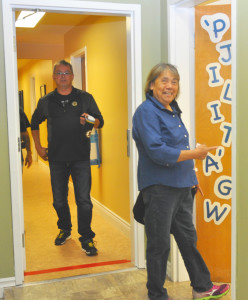
There is a red line at the Listuguj Education Complex that can’t be missed.  The line divides three classrooms from the rest of the building, creating the only English-free zone in Listuguj. Anyone crossing that line has to speak only in Mi’gmaq.

The line is more than red tape on the floor.  It is a compelling symbol of the protection of the Mi’gmaq language that evolved on this territory for thousands of years, but is now vulnerable.

There was never such a “language line” in Listuguj.  Maybe that’s the reason why in the last 50 years the English language had entered the homes, stayed there and with time, displaced  Mi’gmaq as the main language.  Those were the times when Canada’s assimilation policies forced Aboriginal peoples across Canada into Residential Schools and they were pushed to believe that their culture and their language were unimportant and an obstacle to progress.

Today, that red line in Listuguj represents the last stronghold of resistance and decolonization.  On the other side of the line there is a group of teachers and students – men, women and children – learning the language that was used to name the lakes, valleys, mountains, rivers, communities, cities, and plants on this territory.

In the adult section 12 students are committed to learn the Mi’gmaq language five days a week, until March 2017.  Around 800 hours of Mi’gmaq lessons in the classroom as well in the territory. This pilot project was initiated by a grant from Heritage Canada. red-line
After almost 500 years of the arrival and imposition of English and French languages, our Mi’gmaq language is at risk.  According the 2010 UNESCO’s report Mi’gmaq language is considered “vulnerable,” a close step to the endangered category.  However, in Listuguj there is a consensus that our language is in severe decline and it’s necessary to act now.

“Mi’gmaq was declared the official language of Gespe’gewa’gi, but a declaration is not enough.  We need policy, language law and other initiatives to save our language”, said Lorna Sook, Director of the Listuguj Education, Training and Employment.  “We did a survey and we got a lot of suggestions, ideas and we decide to strengthen the immersion programs”.

One of the strategies implemented was to move the AGS Mi’gmaq immersion classes to the Education Complex, the other side of the red line and next to the adult immersion program.

Nathalie Metallic requested a leave from her work at Day Care to learn Mi’gmaq.  As a mother of three children she feels it’s important to pass the language on to them and eventually be able to converse with elders.  She understands Mi’gmaq but like many in the community, she lacks the confidence to speak, something that an immersion program will provide. “I really want to speak it and practice at home with my kids,” she said.

For Scott Isaac, his decision is about identity. “It is part of my decolonization process”, he said. “For 50 years I have been speaking the language of the colonizer and now it is time to speak the language of my ancestors.”  He also sees the possibility of new job opportunities associated with knowledge of the language.

Mary Ann Metallic, Janice Vicaire and Dianne Mitchell are the instructors of the Minuignewa’tu’g ‘Gtli’sutiminu Program.  Their combined work experience for the language is associated with Mi’gmaq Online, research, summers courses, adult classes, teaching sessions at AGS, SSHS, nursery, translation, etc.  They are part of a devoted group of people working in the education system.

Mary Ann Metallic wishes to replicate Quebec’s measures to protect French. “They passed a law to promote the predominance of their language on public signs, at work places, at schools, at public services, etc. It worked for them.”  She sees the importance of taking diverse initiatives and not only leaving the transmission of the language up to the education system.

Janice Vicaire has worked on language programs since 1998. “When I started working we knew the decline of our language and we confirmed it now. Little was done and it was left to teachers or the school,”  she said. “I wish it to be a grassroots movement, from the people, from young parents to learn the language, to pass it to the kids. We need to start a movement to protect our language.”

What will it take to bring back our language, who will do it?  “The preservation of the language has to be the will of the community,” responded Janice Vicaire.

The loss of the language in some Aboriginal communities, including Mi’gmaq has different factors recorded in numerous reports and studies. If the responsibility of its preservation is taken on by speakers and non-speakers living in the community, the participants of the immersion programs at the Education Complex will feel supported.  That is the kind of environment that Diane Mitchell remembers as a young girl.  “In Listuguj the language was just spoken naturally, we were spoken to exclusively in Mi’gmaq. That kind of environment allowed the passing on of the language naturally. I grew up in a generation where everyone was a speaker and the exception was English.”

That’s what the immersion program will recreate – a Mi’gmaq-only space in Listuguj. For Mary Ann Metallic “the red line is a symbol of resistance,” she said. “We have to get stronger for our language, we have to regroup forces, we have to isolate, and by concentrating our language in one space it will help to pass it on to the little ones.  They will hear the language more often”.

In fact, visiting Miss Mabel Metallic’s class next door, we can see the children surrounded by Mi’gmaq textbooks, native chants and designs.  Their little voices speaking Mi’gmaq represents the hope for the survival of our Mi’gmaq language.


red-line-sign

Chaleur Terminals: the battle isn’t over

The New Brunswick Court of Queen’s Bench may have ruled in favour of Chaleur Terminals Inc. project on Aug. 5, but the Mi’gmawei Mawiomi Secretariat (MMS) doesn’t entirely consider it a loss.

“We were not able to halt any construction during the court case,” said Tanya Barnaby, the new Executive Director, who acted as the interim Executive Director since April.

Now, it’s on to the Federal Courts. An application to quash federally approved permits – similar to the provincially issued permits – has been filed.

“We’re also able to attack the project as a whole through the federal courts, whereas through the provincial courts, it had to be specific to certain permits,” said Barnaby.
“Our legal team has assured us that this is a good way forward.”

An appeal hasn’t been filed yet, but the MMS clearly disagrees with the New Brunswick court’s decision. As for other action, discussions with the leadership of the three communities will be held in the middle of September.

While the most cost effective way to challenge the transportation of 150,000 barrels of oil through the Restigouche region, has not been identified yet, the commit to stop it is loud and clear.

“We will stop the Chaleur Terminals trains,” said Barnaby.  “[The leadership’s] goal is to make sure that these trains do not come through our territory carrying this bitumen oil, and they’ll do what it takes to make sure that that doesn’t happen.”

Listuguj Investing in Emerging Industry

The Listuguj Mi’gmaq Government’s $3 million investment in International Herbs Medical Marijuana Ltd. – which owns Zenabis in Atholville NB – was officially announced on Aug. 30 at a press conference at the LMG.

“This opportunity will not only provide a financial return, but more importantly – a partnership built from meaningful conversations, a vision for the future within the sector, and a lasting, mutual, beneficial, business relationship,” said Chief Darcy Gray at the event.

“We know we make a significant contribution in the local economy, and are key contributors. Together, working in respectful business relationships, we can strengthen this region.”

Kevin Coft, CEO of International Herbs Medical Marijuana Ltd, said the plan is to have the facility producing by early 2017. In the meantime construction needs to be complete, and staff needs to be trained.

“The most critical thing for zenabis is to have trained people, who understand the legislation, and once they understand that legislation, there’s going to be many job opportunities,” said Coft.

“We are having training programs with the Listuguj education department, and training programs with – we’re in talks with – the New Brunswick government.”

Chief Gray said community members will be notified of all training opportunities.
“It comes down to the training and qualifications,” he said. “We’re going to be focusing on making sure that we get community members trained, up to speed, and get the qualifications that they’re going to need to go and work and take advantage of those opportunities.”

Coft has previously stated that the facility will be the largest indoor producer of medical marijuana in the country, and the investment by the LMG follows a week after the New Brunswick Provincial government’s announcement of a $4 million investment.

The investment from the LMG will be made in the form of a convertible debenture.

“A convertible debenture is issued at a later time, in stocks. And that will be something that we will be considering in the future,” said Coft. “So it’s an interest, and a stock position.”

The LMG stated in a press release that this investment is part of its long-term economic view – to work with neighbors and strengthen the region with economic development.

“One of the things that we have noticed is that the Listuguj Government is very proactive in this area – to try and see how they can benefit the economy,” said Coft. “This loan from the Listuguj Government is really a strategy. A long-term strategic strategy that the government has, in order to provide more jobs, more opportunity.”

VIDEO: Stephanie Levesque and Denny Isaac

Food and Water Study being done in Listuguj

It is our lifestyle to consume what comes from the land. We fish, we hunt and we harvest. With the rise of industry, came the reality of exposure to harmful contaminants.

What could be in the local resources? This is what the First Nations Food, Nutrition and Environmental Contaminant Study (FNFNES) is here to examine.

The FNFNES will be conducting a four mon th study here in Listuguj. This is just a small portion of the study, which spans coast to coast over the course of 10 years. The FNFNES has collected data from many First Nation Communities all across Canada.

The study is collecting traditional food and water to be prepared and sent for testing.  During the four months Stephanie Levesque, the Nutrition Research Coordinator from FNFNES, will be here alongside two Community Research Assistants, Stacy Martin and Claudette Methot. The data of the study is separated into these 5 components:

• Drinking Water Component
• Traditional Food Sampling and Collection
• Surface Water Collection
• Hair Sampling for Mercury
• Traditional Food Frequency
Questionnaire

100 Households will be selected at random for the Food Frequency Questionnaire. The first part asks how much of the traditional food the participant has consumed, and how often. The second part asks about the water sources used in the household for cooking.

Nujignua’tegeg’s Tyler Morrison sat down with Stephanie Levesque and Denny Isaac, the Director of Research at the GMRC, in Listuguj to talk about the FNFNES study, as well as information from the studies conducted by the GMRC.  “I find it very pleasant to know as a Dietician that some people are hesitant to eat traditional food, but once it’s been tested it’s proven to be healthier than typically what we can buy in the grocery store” said Levesque.

AFN National Chief Perry Bellegarde

Powwow

Echoes of the Powwow

Every year the Powwow seems to get a little bigger. But that’s not really a priority for the coordinators.

“Our main goal is not to be the biggest, or the best Powwow,” said Lita Isaac, who has been involved since the very first Powwow in 1993. “It’s just for people to get here safely, enjoy their weekend. Dance. Drum.”

That’s a big enough job. Keeping people hydrated alone required over 170 cases of water, which had to be requested — and donated — from local businesses.

“It’s a lot of hard work. We have a small committee,” said Isaac. “But people will approach us and ask, ‘can we help?’”

The whole weekend runs on volunteers. Whether it’s in the weeks and months leading up to it, or those filling all the small, but demanding jobs. Everything from making coffee to directing traffic needs someone giving up their time.

“The Powwow belongs to the community,” said Isaac. “When people step up and offer to help … it might be something small, but it all counts.”

Laura Arsenault has been involved with the Powwow for seven years. She’s now one of the coordinators. “It’s just something for me that I would donate all my time to — even if it was yearlong, I’d still do it,” she said.  “I’m passionate about. It’s the only thing I really volunteer for.”

While she spent this year mostly occupied with the vendors, Arsenault’s favorite job is working the canteen. She gets to meet new people and catch old friends visiting home.

A lot of people plan their vacations around the Powwow, and new people people discover it every year.

This year, over 500 people were fed moose, salmon and fiddleheads on Saturday alone. Isaac says being able to feed everyone is their way of thanking those who come and support Listuguj, and the Powwow.

“It’s building up the pride,” said Isaac.“If somebody leaves the Powwow with a feeling of experiencing a ceremony at the sacred fire, or just praying at the sacred fire, or enjoying the drumming and dancing. Or going to the native crafts and buying something made by somebody from a New Brunswick First, or Quebec, or Listuguj — it’s wonderful … Or just enjoying an indian taco. Leaving with something in their bellies or their heart or soul, it’s the best feeling for us. That’s our aim.”


Vilma Almendra, Nasa Nation, Colombia

DSC_4294

It’s nice to feel that with the dances and the presence of the Grand-Father-the-Fire, you are still honoring the spirituality of Indigenous people here. AFN Chief Perry Bellegarde said: “despite colonization they couldn’t kill us and we are still here, alive”.  These strong words, speaks about the ongoing death and life struggle that Indigenous peoples of Turtle Island are facing for many centuries.


Garland Joe Augustine, Elsipogtog,Mi’gmaqi

At the first Powwow there were few regalia, few eagle feathers and now we see more drums, more dancers, more children at the Powwow. This mean that people are coming back to their culture and it makes me proud. I come here every year since the first Powwow and they treat us good. I always want to come back.


Rene Arsenault, Member of Parliament, Restigouche East—Madawaska Riding

This is my first powwow and it’s nice to sees Natives, Acadians, French and English to meet at the beat of the drums. This is a family gathering. I feel like the Earth vibrates when I see a community that chants, dances and respect Mother Earth.

Jamie Metallic, Listuguj, Mi’gmaqi

This was my first time dancing with my regalia and in my home community. The support of friends and family was overwhelming and makes me feel proud. Looking at them was like looking at a rainbow with all their colors and they were around the circle.  This is a new road for me, physical and spiritual.