


Oakley Barnaby shot his first moose this year. It was given to the Pow Wow. He just turned 12 years old.
He’s been hunting with his mom, Jill Metallic, and Ricky Condo his whole life. Condo likes to bringing kids hunting and fishing.
Among many things, Condo reminds people of the recent past, when First Nation hunting rights weren’t being acknowledged. When he was growing up, some people were even scared to hunt. He makes sure the kids never feel that way.
“Nowadays it’s not the same,” he said. “We go everywhere and anywhere there’s moose. Whenever we want – to practice our rights.”
But Condo certainly doesn’t take every moose he sees.
“My god, there’d be no moose left out there,” he said.
He tries to teach the kids the many aspects of hunting, like when, how, and why to hunt.
“You don’t just shoot it for fun,” Barnaby says now, pulling a stool up after school. “You have to have a reason to have it.”
“Anybody can shoot a moose,” Condo said. “It’s what you do with the moose after.”
Condo and Barnaby were driving on “Pow Wow Road,” when they spotted a big dark moose about 350 yards away. Barnaby had been practicing, so he got out, and steadied the gun in between the door and truck. His mom had her gun ready too, in case he missed.
Barnaby could only see the face. He shot. And everyone thought it fell just off the road.
When they got up, they saw the moose running down the hill – now nearly 1,000 feet from the road. It was heading straight for the trees.
Condo took aim and shot. The moose fell
With the help of a friend and lots of rope and pulleys, they managed to pull the moose all the way back to the road, and onto the truck.
“It was good that it was hard,” Barnaby says now. “So I know how difficult it could be.”


Mi’gmaq history is a complicated term for Glenda Wysote-Labillois.
“This is our history,” she said. “This is our way of life. This is how we live.”
Wysote-Labillois is an elder, owner of the Sacred Fire Healing Lodge, and a fluent Mi’gmaq speaker.
When discussing “Mi’gmaq History Month,” she says her perspective is completely different. She lives everyday as a “traditional person that’s living with culture, and practicing culture, and doing that on a daily basis for the past 24 years.”
Wysote-Labillois grew up speaking Mi’gmaq as her first language. It wasn’t until Grade 1 that she was forced to speak English, and even then, she wasn’t aware that English was her “second language.”
“I never knew that, until I went to university,” she said. “I just always thought that I had a hard time to read, or a hard time to write.”
She now travels home to Listuguj as often as she can, even if only to speak the language.
She has friends, family, and neighbors that are fluent. Speaking with them can be deeply familiar.
“I can actually hear my parents speak,” she said. “Because they spoke in the same dialect.”
She says she’s very fortunate to practice a way of life that has been practiced for thousands of years.
“We’ve been so assimilated, with the church, with the language, with all these material things – that’s not what’s important. The children need to learn about mother earth. Where the food comes from … We need to learn hunting, fishing, you know. We need to learn how to respect one another. Respect the youth, respect the elders. Again – like the four directions that I talk about, with the children, women, and men and the elders. We need to go back to that again, and respect again.”

Good Morning,
I would like to thank Darcy for inviting me to speak today at the 20th Anniversary of SSHS celebrating Treaty Day.
Last year I was doing some cleaning at home and found some old photo albums of pictures that I had taken when I was working at Sugarloaf. Included in the pictures were photos from the first Treaty Day celebration that I had organized in 1995. Later in the year, I had a conversation with Darcy, and I mentioned to him that 2015 will mark the 20th anniversary that SSHS has celebrated Treaty Day and that I had pictures of the event that he could borrow and include in the 2015 celebration. My original plan was to provide Darcy with the photos, not to be a speaker, but here I am.
I began my teaching career as a Teacher Assistant and attended university part-time. I received my teaching degree in 1989. I worked at CMS, then here at SSHS and am presently at the AGS. My assignments at SSHS were to teach one class, to organize an Aboriginal cultural center in the school, and to be the guidance counselor for the Native students.
I decided to show a visual presentation on how I included First Nation content into my classes and the activities that the students and I organized that recognized and promoted the contributions that First Nation people have made.
1. Native Awareness Week 1993 – One of the first events that we facilitated was Native Awareness week in 1993. This event was celebrated during heritage week and featured First Nation people and organizations from Listuguj. The objective was to bring awareness to the resources that the community had to offer and to welcome others to our visit our community.

2. Maritime Studies Class 1994 – In addition to including First Nation history in the lesson plans in my Maritime Studies class, I had learned how to make a dream catcher and decided to teach the students how to make one also.

3. Trip to Maria 1994 – This activity was organized to teach the students how baskets were made. The wood mainly used in basket making is ash, which isn’t readily available in our area; so our class went to Maria and spent the entire day learning how our ancestors took a piece of wood and transformed it into a work of art.

4. Native Studies Class – Drum 1994. SSHS was one of the first schools in the province of NB to pilot the Native Studies 120 course. A drum group was in the process of being formed; however we did not have a drum, so we decided to make one. Don Caplin was our instructor and his teachings were very hands-on, as you can see from the photos. That was the one and only time that I de-haired a moose. After the moose was cleaned it was brought to the school to be dried. We placed it in the industrial lab area – not realizing that the ventilation system would carry the smell throughout the entire school. Administration was not pleased with me on that day.


5. Drum Cover 1994-95 – After the drum was completed, it needed something to be covered and carried in. The students each created their own work of art on a piece of material and we then sewed it together to create the drum cover. I want to mention that all of the classes, cultural center activities and all events were open to all students – not just the First Nation students.

6. Variety Show – 1995. This was an annual event that was put on by the school and in 1995, for the first time, the show included the school Aboriginal drum group and the shawl dancers.

7. Treaty Day 1995 – The first Treaty Day event was held on Oct. 1st, 1986 in Nova Scotia. It recognized the connection between the government and the Mi’gmaq Aboriginal people and it commemorated the Peace and Friendship Treaties that were signed in the 1700’s. As 20% of the school population was Mi’gmaq at the time, we decided that SSHS was going to have a celebration on October 1st also to recognize Treaty Day. The school drum group performed and were accompanied by the shawl dancers. A traditional feast was held in the cultural center. My mom – Gerry Basque – made corn soup and listugingin and other traditional foods were also served. My mom could not be here today, but she did make her corn soup again, which you will be able to sample later during the feast. That event started the tradition of celebrating Treaty Day at SSHS and I am very proud and happy that the tradition was carried on by individuals and still is celebrated today.


8. Native Studies class 1995 – There were a number of events and activities that happened and continue to happen at SSHS that include First Nation Peoples contributions in history. The Native Studies course became an accepted elective course for graduation and is offered in many high schools in NB, including here at SSHS. I cannot show you all of the many positive things that have taken place over the years, due to time; however I do want to show you a few more pictures from activities that the students participated in.

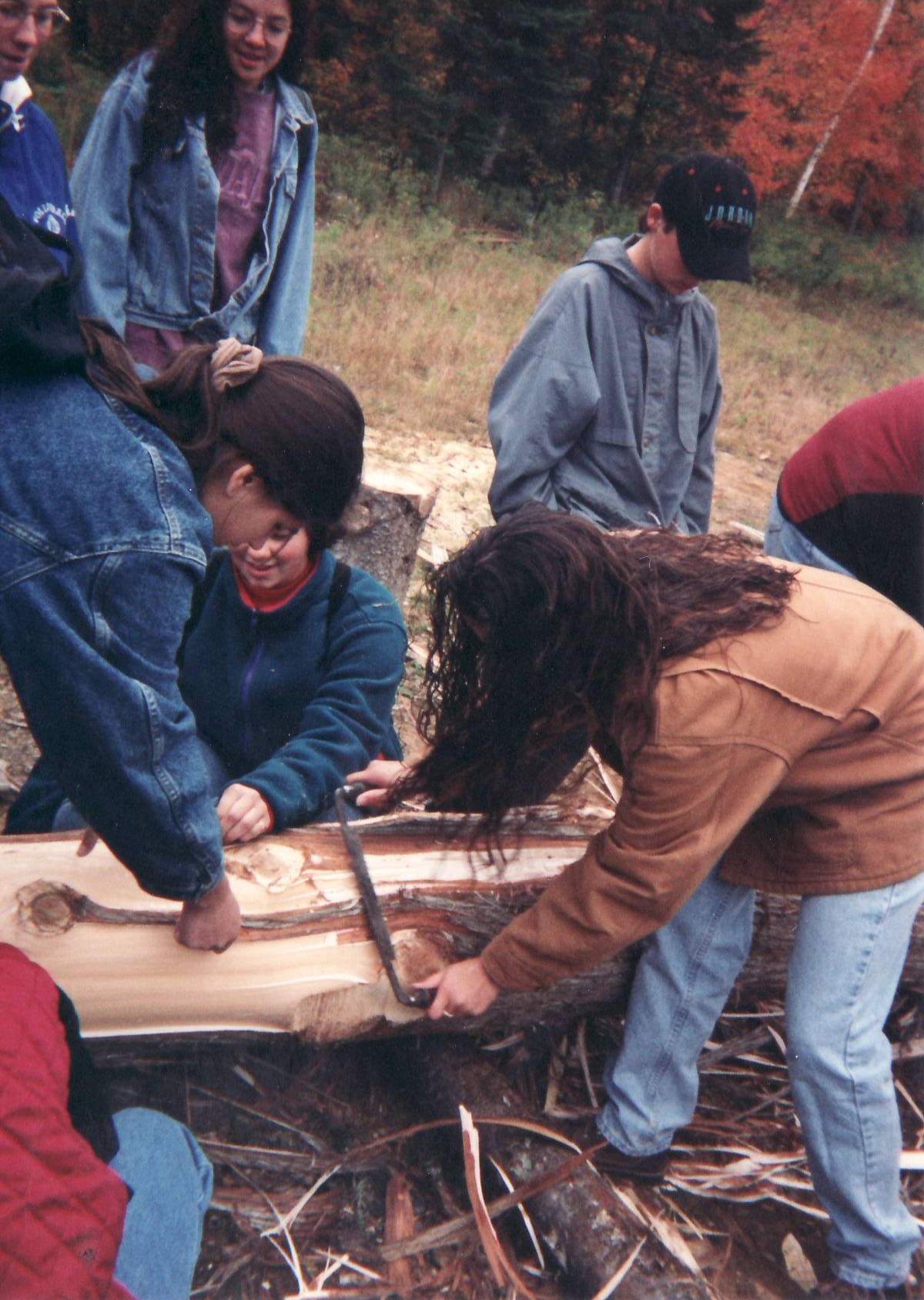
9. Native Studies Class Totem Pole 1995-96. The Totem pole that sits on the landing as you enter the school was made by the students from the Native Studies class under the guidance and instruction of Don Caplin. My dad- Peter Basque – cut the log for the Totem pole and I brought the students to his gravel pit, where they learned how to shave a log using a traditional shaving device. An eagle flew overhead as the students were working on the log, which was a positive sign. The log was brought to the school and each student designed their own creation, carved it into the log and then painted it. My logo with my initials – BKS – is located on the back side of the totem pole. Mr. Lepage and my nephew –Timo – along with other students, mixed cement and erected the Totem pole in its present location. The plaque listing the individuals who participated in that activity, was made by students and hangs next to the totem pole.




10. Totem Pole Assembly 1996 – This assembly was held to celebrate the completion of the Totem pole.


11. Trip to Cultural Center & Fort 1996 – As some of the students in my Native Studies class had never been to Listuguj, I decided to arrange a field trip to the Cultural Center and to visit Fort Listuguj. It was hard to believe that some students had never visited our community before that activity and they were impressed with what they saw.


12. Jimmy Herman 1996 – The Cultural center at SSHS was one of the first ones established in the province of NB and people were becoming more aware of the work that was being done. We received many visitors from other schools and we were featured in the “Aboriginal Education in New Brunswick” newsletter. Jimmy Herman- an actor known as ‘Joe on North of 60’ was visiting in the area and heard of the Cultural Center and decided to pay us a visit. He was impressed with what he saw happening at the school and autographed a hand drum that is still located in the Cultural Center.

In closing I would like to read an excerpt from “The Demand” by Chief Dan George; who among many other things, was an actor and a poet from British Columbia.
The Demand
“Let no one forget it…… we are a people with Special rights guaranteed to us by promises and treaties. We do not beg for these rights, nor do we thank you….we do not thank you for them because we paid for them….and God help us the price we paid was exorbitant! We paid for them with our culture, our dignity and self-respect. We paid and paid and paid until we became a beaten race, poverty-stricken and conquered.”
As Aboriginal people, we still have ‘limited’ special rights due to the treaties that were signed. And our ancestors did pay for those rights with our culture, language, and at times our dignity and self –respect. We cannot change the past, but we can change the Future.
I believe, and I teach my students that ‘Knowledge Is Power”. Academic knowledge is important and equally important is knowledge about who you are – your culture, language, and traditions.
At the community school in Listuguj – Alaqsite’w Gitpu School – , we try to include all aspects of knowledge in the teachings to the students. I feel that Sugarloaf does the same. Today is a good example of this.
It was an honour to be asked to speak here today – enjoy the feast and the rest of the day.
Welalioq


Twenty-three years ago, decisions were made to revive Mi’gmaq traditions. A program began, titled – “Relearning a Way of Life.”
Twenty-two people came together to learn and share what they knew of traditional practices. Some even came from out west.
Claudia Gray remembers one elder from Gesgapegiag, who was going blind and deaf. She was teaching how to make baskets.
“If you did it wrong, she’d go up to you and just tear it apart and throw it down,” Gray said. “That’s how we learned. It was fantastic.”

Claudia Gray in her classroom at AGS
The group wanted as close to a real understanding as possible of aspects of pre-contact culture.
“The only way to really do that,” Gray said. “Was creating the village, from the ground up.”
An entire village was built, with as much traditional knowledge as possible.
“Some of the students still practice the skills,” Gray said.
A lot was learned from a book Gray’s aunt – Vivian – had written, but never published.
“She studied this her entire life,” Gray said.
Her aunt had been teaching her things her as long as she could remember. So for Gray, a lot of practices were just a part of her life. Now they were being shared.
The program ran for three years, and then Gray was asked to teach “Pre-Contact Mi’gmaq Culture,” when AGS opened up. It has been open for 19 years now.
Vivian Gray’s work is now taught to every single kid in Listuguj. It is now just a part of growing up, and going through school.
This is a long way from when Claudia Gray was a kid. She remembers making crafts secretly. She would have history lessons and often wonder why textbooks never mentioned Mi’gmaq people.
Now – even when her students don’t seem interested in the material – Gray is certain the class is having a beneficial impact.
“We notice that our students, when they leave AGS,” she said. “[They] cross over and don’t feel inferior, don’t feel different. They feel equal, and happy with who they are. And if there’s something said that’s not correct, they correct it. They have the ability to do that. That makes us proud.”
“Who would ever think that this is what I would do,” Gray said.
She had never planned to move back to Listuguj. She thought she might of retired here. But things changed.
She found herself unexpectedly moving home as a single mother.
It happened to be at a time that interest in reviving traditions was growing.
Members of the LMG knew Gray’s family — particularly her aunt — had interests in traditional practices. Not that Gray had ever thought much of it herself. In fact, she didn’t always understand it as a kid.
“I thought it was torture,” she said.
Regardless, it was always remained a part of her life.
“Crafty Claudia is what they called me.”
Still, she never imagined these interests could be a job.
“Relearning a Way of Life” was so successful that it ran for three years, and changed Gray’s life.
“That was my ‘aha moment.’ That was my Oprah moment. Of — ‘this is it, I’m home for a reason,'” she said. “It saved my life.”
The original program grew into “Pre-Contact Mi’gmaq Culture” at AGS. It’s been taught since the school opened. Gray now teaches some of the grandchildren of participants of “Relearning a Way of Life.”
They teach the kids a lot of what they learned 23 years ago, but they also try to pass on some of the experiences of rediscovering the knowledge for the first time. One exercise for fourth graders helps them begin imagining what life could have been like hundreds, and thousands, of years ago
“The scenario is — you’re in the woods. It’s October, so it’s kind of cool. And you’re bare naked. What are you going to do to survive?” Gray said. “It really sparks their thinking.”
The class does quill work with actual porcupines quills. They go out to the woods, and gather everything they need.
“They have to learn to wait. Patience is a big thing,” Gray said.
Some kids don’t necessarily appreciate everything that is taught, but then again, neither did Gray when she was young.
“I said the same thing at 13, and I’m sitting here in a Mi’gmaq school, doing something that I thought was totally irrelevant, totally unnecessary, but yet it was my whole life,” she said. “For them to have the opportunity to know where you come from, and why you are still here today, makes who you are – I think anyway – makes you a better person.”
For Gray, it’s important that the kids share what they learn. She encourages them to go home and talk with their parents and grandparents.
“They were part of the group that we were a part of. It wasn’t a part of our teachings everyday in school. Or even practiced with families.”
The class is proof that the decision to revitalize these aspects of culture 23-years ago was successful. Gray says the interest — and understanding of its importance — has grown tremendously over the last two decades.
“The spark was there. Now it’s fire.”
It is now at the point where students exposed to these traditions throughout their lives have grown up, graduated from university, and are doing great things. Gray certainly doesn’t take all the credit, but a healthy approach to history has undoubtedly contributed to pride, and confidence.
“Knowing who you are and where you come from – that’s all you need. And you know right from wrong. And you know that things that happen in the past can either break you, or shape you,” she said. “Most of them are standing their grounds, and changing the future. And that’s what makes us proud… they will make a difference. Because they’re not going to let history repeat itself.”

Derek Barnaby didn’t feel connected with his culture and traditions as a child.
“It wasn’t until I was 19 years-old that I realized – this is a part of who I am,” he said.
Growing up in Listuguj in the 70’s was a very different time than today.
“If you wore a t-shirt in school that says Mi’gmaq and pride, well back in those days – you were told to go home and change your shirt,” Barnaby said. “People weren’t ready to accept the ideas of what happened here in Canada.”
With some Polish ancestry, Barnaby said he often felt caught between two worlds at times in growing up.
As a young man, he travelled to Ottawa, where he saw a Pow Wow.
“When I seen the dancing, and everything that was happening – I was really drawn to it.”
Barnaby says that he had always been drawn to dancing, even if it was just Michael Jackson, or Paula Abdul.
For awhile he struggled to get started, but met teachers who encouraged him. Now, him a his wife teach kids to dance and sew.
He says his connection with Mi’gmaq traditions have made him a stronger person, in many aspects.
“It’s not just about feathers and drums,” he said. “It’s about an understanding of a way of life.”
Barnaby is glad to consider himself part of the “rebirth of Mi’gmaq identity.”
“There has to be a sense of pride in being Mi’gmaq, and within that, there has to be a sense of history. And in knowing that, it creates a stronger, healthier nation.”


After nearly three and half months, the Anti-Racism Strategy has chosen a logo. The slogan is “Strengthening Relationships.”
“It was a real challenge to come up with a design to reflect the strategy,” said coordinator , Debbie Dedam-Montour. “We did not want it to be Mi’gmaq specific, since we are reaching out to neighbouring communities in Quebec and New Brunswick, and they need to identify with the logo too.”
The goal is to reduce acts of racism by 2020.
With only about half a year on the job, Dedam-Montour has been researching, and developing resources and strategies. She’s creating workshops and presentations, and ways of appropriately scaling them to different demographics.
“The objective of this strategy is to build better relationships,” Montour-Dedam said. “So anything that’s going to create conflict – we want to move away from that.”
She recently held a session on being assertive when encountering racism. She said there are three ways a person can react.
They can say nothing. But Research suggests internalizing and carrying negativity can have detrimental effects, even on physical health, Montour-Dedam said.
Those encountering racism can also engage aggressively. This can often lead to conflict, which is counterproductive to changing someone’s negative opinion.
People can also address racism in positive ways. Many people have no idea some things they say are racist.
“You don’t say – ‘you’re a racist.’ You can say – ‘your comment was racist.’”

“Passing Moments” is a relatable and poetic approach to loss.
“I guess it’s kind of a little about dealing with it,” said Melissa Girvan, the filmmaker. “Some people get so stuck in the past and things that happen. I think it’s really important to let it go sometimes. You can mourn it, but you can’t define your life [by] it.”
Girvan’s film immediately creates a powerful tone.
Deliberate cuts and other choices lend the hazy, emotional quality of memories to the film. The voice-over provides just enough context.
The stories are only hinted at. The monologue feels personal, but it’s vague. You can’t help but fill in the blanks with your own life.
The film makes you recall the feeling of loss, and it seems to hint at the dangers of holding on to that feeling for too long.
It is very unique, and affective.
Passing Moments from Wapikoni mobile on Vimeo.
 Formerly titled the Nujignua'tegeg - The Wi'gatign is a multi media community newsletter for Listuguj First Nation.
Find our printed issues within the community. We print once a month.